
Editorial: Interior delivers a blow to habitat protection
Daily Inter Lake | Daily Inter-Lake | UPDATED 1 week, 6 days AGO
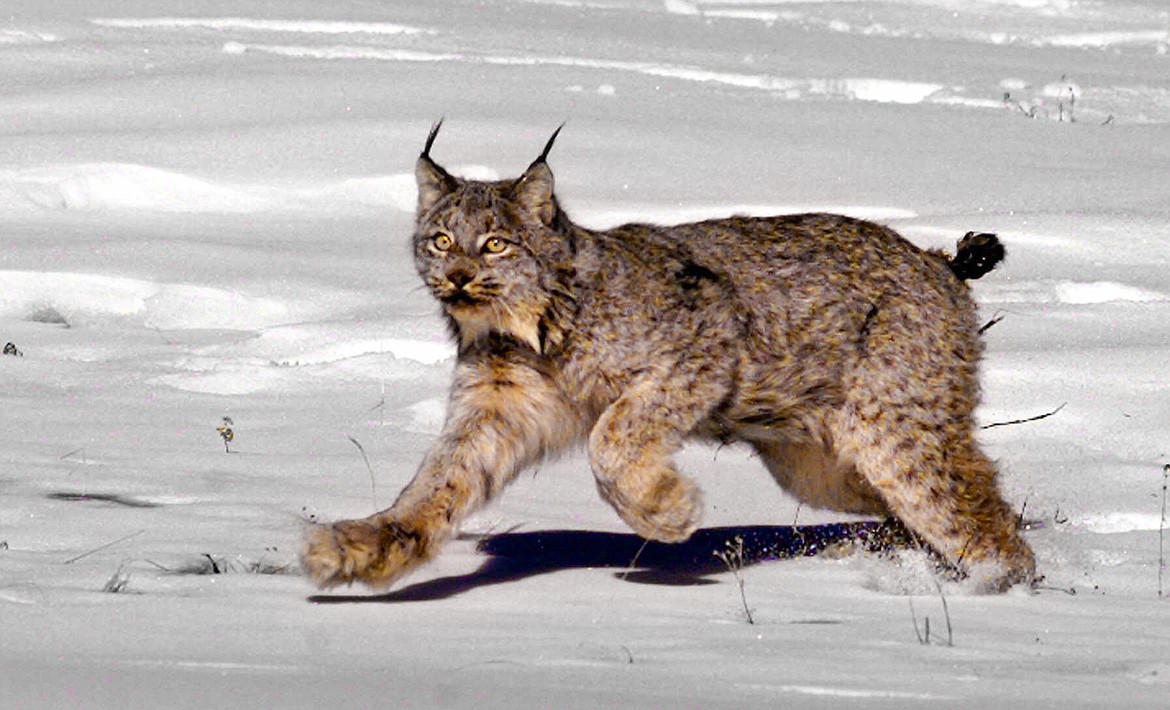
A female Canadian lynx heading for the woods near South Fork, Colo. (AP Photo/Jack Smith, File)
President Trump’s Interior Department is being disingenuous when it describes its overhaul of the Endangered Species Act as a mere statutory clarification and insists the law’s “core protections remain firmly in place.” By rolling back the act’s definition of harm, the department has opened a Montana-sized loophole that could allow developers and extraction companies to destroy critical habitat without consequence.
The agency this month removed the regulatory definition of “harm” from the act and adopted Supreme Court Justice Antonin Scalia’s 1995 interpretation of “take,” which concludes that the killing of an endangered species must be purposefully directed at a particular animal to be illegal. Ruining or removing a species’ habitat does not necessarily equate to a “take” of the animal.
“Felling a tree is not a take of the bats roosting in it unless the tree is felled for the purpose of killing or capturing them,” U.S. Fish and Wildlife Service Director Brian Nesvik wrote in a Sept. 14 memo about the changes.
That interpretation renders the landmark conservation law as useful as a butter knife in a sawmill. The tool still exists, but what purpose will it serve in protecting animals on the brink with such a narrow definition?
In making its case, Interior said interpretations of harm had been abused as a wrench to jam up natural resource extraction and development and that the harm definition had been extrapolated beyond its intent when applied to habitat protection.
“For too long, the Endangered Species Act has been weaponized to stop almost any new project in America, driving up costs for families, weakening our competitiveness and undermining our national security,” Interior Secretary Doug Burgum said in a July press release announcing the reform.
Burgum is right that the act has become an overbearing weapon in the courtroom. In Northwest Montana, important forest management and harvest operations are often halted or delayed because of drawn-out lawsuits that rely on Endangered Species Act protections for grizzly bears, lynx and native fish.
But instead of using the precision of a scalpel to correct the act’s deficiencies, Interior opted for a sledgehammer. The result could be devastating for animals affected by development and habitat loss, while extraction industries get a hall pass.
Western Montana’s threatened bull trout are highly sensitive to sediment in spawning streams. The region’s elusive Canada lynx needs large, undisrupted tracts of habitat and mature forests. And Montana’s wolverines depend on habitat suitable for high-elevation den sites.
Under the new Endangered Species Act directive, building roads that increase stream sediment and development activities that lead to patchwork habitat would not necessarily be considered actions “intentionally and purposefully” directed to harm, despite the obvious connection between a degraded ecosystem and a species’ decline.
While Interior officials shout platitudes about how the rule change is a return to “common sense,” common sense suggests that development and extraction companies should be held responsible for their actions. Multiple groups have rightly challenged the Endangered Species Act rollback with lawsuits.
“It’s a radical reinterpretation that would put polluters and other industry before the natural world,” said Noah Greenwald of the Center for Biological Diversity.
The Endangered Species Act should be subject to review and refinement, not a teardown that benefits development and industry at the expense of the multibillion-dollar ecotourism economy and the threatened species that may pay the ultimate price. A conservation law that fails to consider the full scope of an ecosystem is missing the forest for the trees.