
Researchers examining Glacier National Park's newest lakes
By Vivianne Ostheimer, FLBS Ted Smith Environmental Storytelling Intern | Hungry Horse News | UPDATED 1 week, 1 day AGO
| September 30, 2026 6:30 AM
GLACIER NATIONAL PARK — Sperry Basin is a place of beautiful juxtapositions: wet, lush streams interrupt vast stretches of red and purple rock. Fields of snow lead to meadows of wildflowers. Turquoise lakes sit tucked behind rocky red shores.
Three researchers and three interns make their way through the landscape, sliding down snow and scrambling over boulders. They jump a stream and climb uphill until they’re looking down at a glacial lake — the first of three they’ll sample this summer day.
The lake below didn’t exist a century ago; at 75 years old, it’s still an infant in geological time. Formed by the retreat of Sperry Glacier, the lake is one of several new glacial lakes researchers from the Flathead Lake Biological Station have monitored each summer since 2016.
Reaching these lakes isn’t easy. Over three days, the group hiked more than 25 miles.
“That’s the challenge about working in these places,” Tyler Tappenbeck, a Flathead Lake Biological Station researcher, said. “It takes a lot of people power to get things in there and then get them back out.”
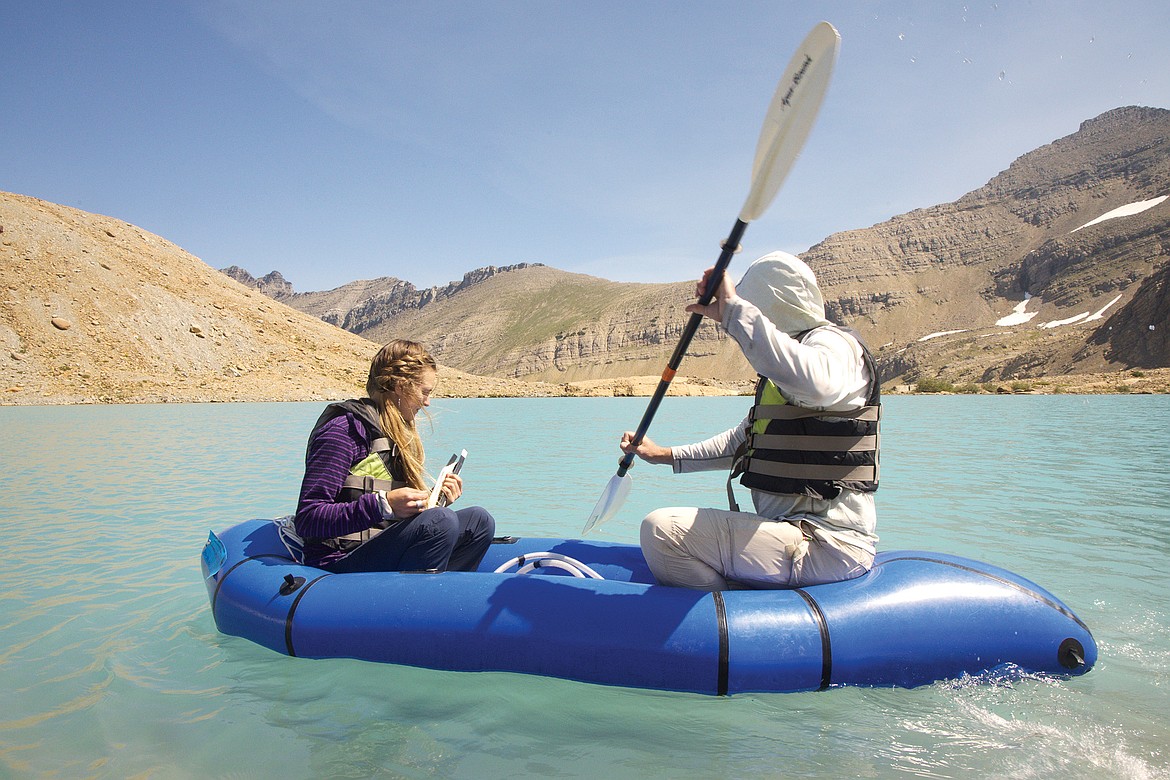
Tappenbeck pulls a small raft from his giant backpack. He and Kyra Baranick — an intern — inflate it and climb aboard.
“Don’t fall in,” he tells her. The water is just over 5 degrees Celsius, or 41 degrees Fahrenheit.
They paddle to the lake’s deepest point, which Tappenbeck finds using a Hydrolab MS5 — a multi-sensor instrument that measures depth, water temperature, pH and other characteristics throughout the water column.
The researchers call this lake Ghost Lake because, on every previous sampling trip, its water has looked ghostly gray. This year, it shimmers a bright, icy blue.
Tappenbeck and Baranick fill bottles with water collected at different depths and bring them back to shore, where bio station director Jim Elser and intern Fern Stewart wait with filters and pumps. Some of the water goes back to the lab for further analysis, but the researchers process most of it by hand in the field. They pump water through tiny filters to remove larger particles and collect algae, allowing them to analyze nutrients and seston — tiny living and nonliving bits of matter at the bottom of the food chain.
“It’s a bummer that these glaciers are retreating, and at the rates that they are,” Tappenbeck said, “but there are also new ecosystems being formed.”
Joe Giersch, a member of the sampling team, said this work is important because these lakes are untouched by humans and understudied.
“There’s nothing known about them, so each trip you do, you learn something,” Giersch said.
Giersch also said the hike never gets easier.
“If a grad student had funding and liked to be outside, they could do some neat stuff in Glacier,” he joked, “because I am too old for that!”
The idea for the new-lakes project began with a camera.
Inside Elser’s office at the bio station sits a camera that once belonged to Morton Elrod, founder of the Flathead Lake Biological Station. Elrod took some of the first photographs of Western Montana’s landscapes, according to Elser, including Glacier National Park. Since Elrod’s photos — taken nearly a century ago — the glaciers have retreated substantially, leaving new lakes behind.
When Elser became director in 2016, Elrod’s camera inspired him.
“ I was doing a lot of thinking about being director of the bio station and its history,” Elser said, “and it struck me that this was a pretty cool opportunity to find out what lakes are like when they’re newborn. So we endeavored to go and try to visit them.”
Elser, who’s retiring this year at 67, said this was his last backcountry sampling trip as director. In his 45 years as a limnologist, or lake ecologist, Elser estimates that he’s been on nearly 500 sampling trips.
“This trip, in particular, is quite grueling,” he said, laughing. “There’s a fair amount of suffering involved… but there’s also a lot of fun and amazement.”
Glaciers shaped Northwest Montana, according to Elser — every peak, valley, lake and rock. He said this trip always feels bittersweet. While the landscape and lakes are awe-inspiring, they exist because glaciers are retreating.
“I think understanding what’s going on around you makes it a richer experience to be alive,” he said. “But these glaciers are retreating at an unnatural rate, and it’s worrisome.”
When Elser retires, the future of the new-lakes project will depend on funding and the research priorities of the station’s next director, who has not yet been named.
Researchers have already documented changes in the three lakes below Sperry Glacier, though Tappenbeck cautions that a single annual sampling trip isn’t enough to draw conclusions.
Ghost Lake — measured at 5 degrees (Celsius) this year — was 2 and 3 degrees during previous sampling. In fact, water temperature increased in all three sampled lakes below Sperry Glacier this year.
“Would it have been like that if we got there a month earlier? We don’t know that for sure,” Tappenbeck said. “But there’s a possibility that things are warming.”
Ghost Lake also changed from muted gray to icy blue, a shift that could mean glacial remnants are settling and allowing more light — and life — deeper in the lake.
“If we could get funding to continue to do this for a long time-series, then we’d have a really neat picture of what’s happening,” Tappenbeck said.
But for now, with their work complete, Tappenbeck, Giersch and Elser begin the steep descent back to the trailhead. For Elser, it’s the last time he’ll make the trek as bio station director.