
Awakening in Japan
Yvette Johnson Benham | Hagadone News Network | UPDATED 15 years AGO
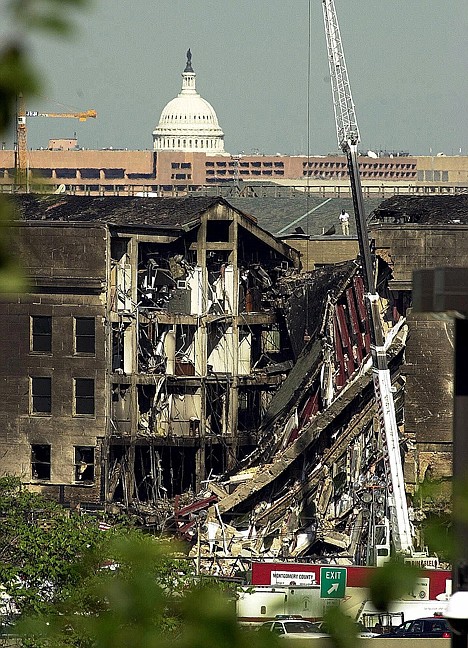
<p>Firefighters and inspectors look over the damage to the Pentagon in Washington after a hijacked airliner crashed into the Department of Defense building on Sept. 11, 2001.</p>
Sometime after 11 p.m. Japan time on Sept. 11, a telephone call from my husband's boss woke us from a deep sleep. He told us to turn on the TV but gave no further information. We stumbled out of bed and down the stairs, and groggily flipped on the TV. We plopped onto the couch and started flipping though channels, stopping at each for a moment and wondering why the boss called. In 2001, on military bases on mainland Japan, we had only one station that didn't show tape-delayed Stateside programming or local Japanese shows. After a short time, my husband excused himself for a minute. I continued to switch channels, when I saw a chaotic scene with smoke coming from a large building. I took a moment before I realized this was not a movie but a live feed from New York. I called to my husband and together we sat on the couch completely stunned. What on Earth was happening? We just sat there, trying to process what was playing before our eyes. Another telephone call interrupted our stupor; the boss called again to inform my husband not to go to work tomorrow. After a while, we went back to bed, but I know I didn't go to sleep. The images from the television kept sleep far from me for a long time.
By morning, the base was in lock-down mode. Base personnel were not to leave home, school was canceled, and only emergency personnel were to report to work. The gates and all businesses were closed. Walking outside to let our Pekingese out, the beautifully sunny September weekday was unusually quiet. We tried to keep our four young children entertained indoors, while covertly snatching bits of news from the TV. It was extremely difficult not to become obsessed with watching the live news feed and evaluating every detail from New York, DC, and Virginia. We wanted to keep our children, the eldest being 11 years old and very curious, away from the disturbing images shown.
The base stayed in lock-down mode for several days. When we were finally allowed to leave our homes, I went shopping at the commissary, as I routinely did every two weeks. Though not many people were there when I arrived, by the time I entered the check-out line, it snaked from the front cashier area, down an aisle, and across the back of the store. I remember I waited over an hour to check out, and overheard many people catching up with friends and swapping stories of how the Stateside attacks affected them.
By the time the schools reopened, many changes around base had occurred. First of all, everyone had to show military ID in order to gain entrance to every building: post office, PX, theater, gym, chapel, everywhere. Snipers were stationed on cherry pickers and on top of buildings near the base perimeter and overlooking the four-lane highway and railroad tracks that bordered the base. (As the weeks went on and the snipers continued their 24/7 vigils, I participated with youth from many church groups who took sack lunches and treats to these snipers while on duty. This activity, of course, had to be approved by base security, which was another understandably long process.) When children arrived at the elementary school, they lined up with their teachers. One by one, each class walked to the entrance of the school and approached a table with several military personnel with loaded weapons (I think M16s) strapped on their backs while snipers on apartment buildings and businesses watched. Each teacher vouched for the children under her/his care before the class could enter the school.
Only certain Japanese nationals were allowed on base immediately after 9/11; most Japanese workers (cooks, hairdressers, janitors, etc.) and Japanese guests were not allowed for several weeks. Because of this, many on-base businesses remained closed for a while. The schools' custodial staffs were Japanese, so parents were asked to come to school to clean bathrooms and cafeterias after lunch. At the time, I taught conversational English and American cooking to several small groups of Japanese women in my home. These classes were canceled for several months. In fact, one student did not return to base for the remaining seven years I lived in Japan. She, too, had seen the attacks on the World Trade Center and the Pentagon, and decided that this military base was now unsafe, too. Even Halloween, when the base usually opened its gates and our arms to countless tour bus-loads of costumed Japanese children and their guardians to celebrate this uniquely American festival, was subdued. I don't recall if the base allowed off-base trick-or-treaters in 2001, but I do remember for several years afterward the number of Japanese children who came on Halloween had significantly decreased.
We moved Stateside in 2008 after living in metro Tokyo for 12 years. We knew what life overseas was like before and after 9/11. Changes made due to the attacks still stay with me. I never, ever leave my home without official ID; it's not in a purse or a briefcase, but on my person at all times. Our family has sufficient supplies to last for a while in case of an emergency. I am constantly scanning for someone that looks out of place. These actions, and many others, are just integral parts of my life now in northern Idaho.
Life dramatically changed for all military and civilian personnel and their families after the attacks on New York and the Pentagon. My appreciation and love for the military and all those who defend our country only increased after seeing these incredibly well-trained and professional people perform their duties against this unseen enemy.
Yvette Johnson Benham is a Plummer resident who owns and manages the RiverFront Suites and RiverFront Apartments in St. Maries.
ARTICLES BY YVETTE JOHNSON BENHAM

Awakening in Japan
Sometime after 11 p.m. Japan time on Sept. 11, a telephone call from my husband's boss woke us from a deep sleep. He told us to turn on the TV but gave no further information. We stumbled out of bed and down the stairs, and groggily flipped on the TV. We plopped onto the couch and started flipping though channels, stopping at each for a moment and wondering why the boss called. In 2001, on military bases on mainland Japan, we had only one station that didn't show tape-delayed Stateside programming or local Japanese shows. After a short time, my husband excused himself for a minute. I continued to switch channels, when I saw a chaotic scene with smoke coming from a large building. I took a moment before I realized this was not a movie but a live feed from New York. I called to my husband and together we sat on the couch completely stunned. What on Earth was happening? We just sat there, trying to process what was playing before our eyes. Another telephone call interrupted our stupor; the boss called again to inform my husband not to go to work tomorrow. After a while, we went back to bed, but I know I didn't go to sleep. The images from the television kept sleep far from me for a long time.