
C. Falls brothers win honors for ambitious science project
HILARY MATHESON | Hagadone News Network | UPDATED 12 years AGO
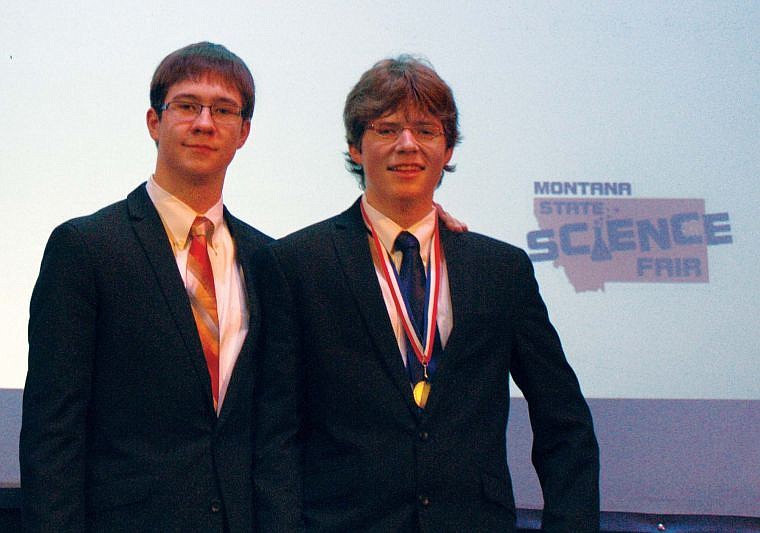
<p>Colter and Colin Norick will showcase their research at the Intel International Science and Engineering Fair in May where more than $4 million will be awarded. The international fair features high school students from more than 70 countries. (Photo provided by Tara Norick)</p>
EDUCATION REPORTER Hilary Matheson covers education for the Daily Inter Lake. Her reporting focuses on schools, students, and the policies that shape public education across Northwest Montana. Matheson regularly reports on school boards, district decisions and issues affecting teachers and families. Her work examines how funding, enrollment and state policy influence local school systems. She helps readers understand how education decisions affect students and communities throughout the region. IMPACT: Hilary’s work provides transparency and insight into the schools that serve thousands of local families. | March 24, 2014 6:00 PM
One Norick brother can be tough competition at a science fair, but pair the two together and they are a force to be reckoned with.
Maybe it’s because they have years of experience competing, or it could be that their projects are a step beyond the usual science fair projects such as pressurized bottle rockets or baking soda volcanoes.
The Norick brothers — Colter a junior and Colin a freshman at Columbia Falls High School — teamed up to produce an ambitious project, “The Correlation between Docosahexaenoic Acid (DHA) Levels and Cognitive Function in Healthy Teens.”
Docosahexaenoic acid is a type of omega-3 fatty acid found in fish meat.
“We teamed up this year because we planned to do a more involved project,” Colter said.
They had the highest-scoring project at the Regional Science Fair at Montana Tech, qualifying them to compete at the International Science and Engineering Fair against roughly 1,600 projects from more than 70 countries.
The international competition will be in Los Angeles May 11 through 16.
Their most recent showing at the Montana State Science Fair at the University of Montana resulted in five top awards and a gold ribbon; Columbia Falls High School received the first place Outstanding School Award in the large high school category.
Their awards at the state fair ranged from the Larry Fauque Grand Award to an award for the “most challenging, thorough and creative investigation of a problem involving mathematics.”
Their participation in a yearlong 4-H program at Montana State University called BioScience Montana was a springboard to their project and connected them with a mentor.
One topic BioScience participants learned about was metabolomics. In one experiment, students took blood samples and observed how much omega-6 and omega-3 fatty acids were present. Samples changed depending on a participant’s dietary intake.
“We connected with our mentor, Montana State University Professor Ed Dratz,” Colter said.
The Noricks gained access to the university laboratory from Dratz.
“He provided us the lab to do all our data analysis,” Colter said. “They have all the tools, materials and equipment that we simply don’t have access to [at school].”
With an open door to the university laboratory, Colter and Colin took their science fair project to a new level, but they had to go through some red tape to use human test subjects (their high school classmates) and handle biological material.
“We had to get the project approved by the Institutional Review Board through MSU,” Colter said.
For their research, the Noricks split up 29 students into three groups and gave them different dosages of fish oil supplements or placebos. They also tested DHA levels in their test subjects’ blood.
“Once we gave them their supplements we did cognitive tests and the cognitive tests gave us a way to evaluate if they got smarter,” Colter said. “We tested reaction time and working memory. We were really looking for a correlation between how much of the supplement they took and how much of a cognitive improvement we saw.”
Researching how the dosage affects cognitive function is new territory, according to Colin.
“This is actually new research,” Colin said. “Studies out there focus primarily on the cognitive function, not how much you’re taking.”
Colin said they are finding that docosahexaenoic acid does affect cognitive function. They have also found that dosage matters.
“This is the level a high school experiment needs to be at,” Colin said.
Colter and Colin were about three months into their research when they competed in the science fairs, but they haven’t quit yet.
The brothers have a loftier goal in mind and plan to continue their research for a total of six months.
“We plan to publish the study in a scientific journal under our names,” Colter said. “When we started this project we had that as the goal.”
Reporter Hilary Matheson may be reached at 758-4431 or by email at [email protected].
ARTICLES BY HILARY MATHESON

Flathead grad waits for new heart after life-changing diagnosis
Going into finals week, Flathead High School student Katelyn Baughman was ready to graduate early and excited to plan for college. In one night, her life and her family’s lives were upended.

Fair-Mont-Egan and Cayuse Prairie put levy elections before voters
School elections are May 5. Here is a roundup of what’s on the ballot in Fair-Mont-Egan and Cayuse Prairie.
Rural Flathead County school districts put levy elections before voters
School elections are May 5. Here is a roundup of what’s on the ballot in area districts, including Helena Flat, Fair-Mont-Egan, Deer Park and Cayuse Prairie.