
I-90 Watercraft inspection station last line of defense in Montana
MONTE TURNER | Hagadone News Network | UPDATED 4 years, 6 months AGO
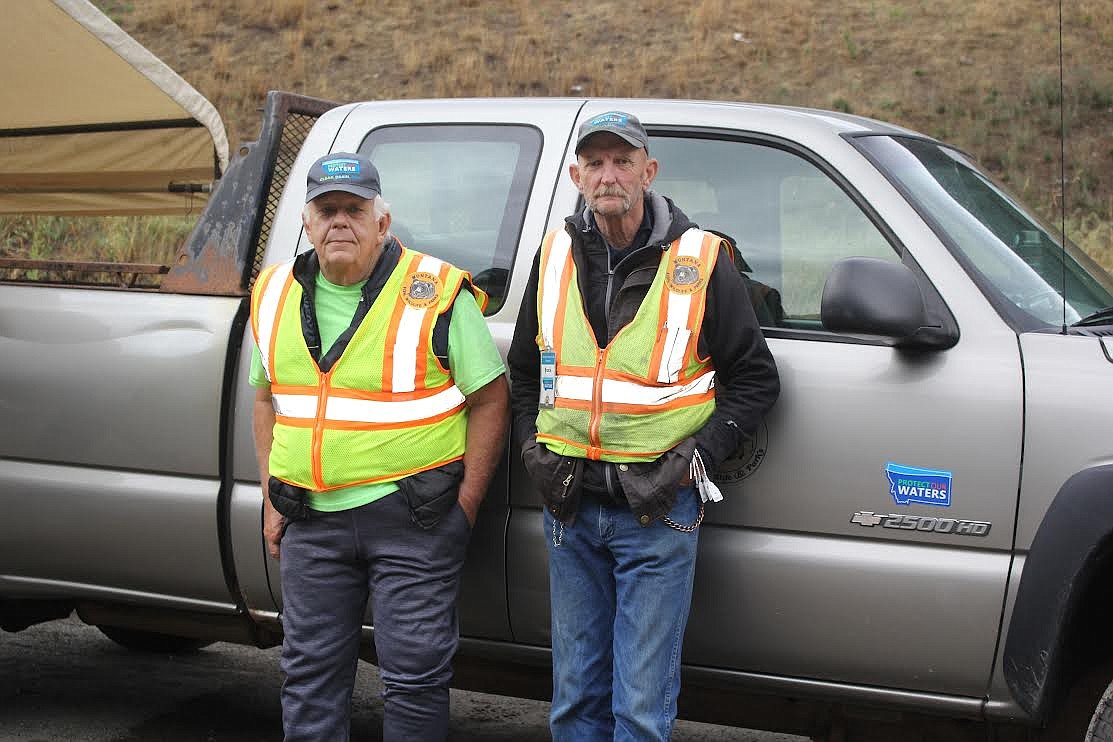
Mineral County boat inspectors Terry Pond, left, and Bruce Nixon are the last line of defense for detecting aquatic invasive species on boats before travelers enter Idaho on Interstate 90. (Monte Turner/Mineral Independent)
For those who own any type of water vessel, the message of Clean, Drain & Dry is very familiar.
It’s the slogan, and instructions, for the Montana Fish, Wildlife and Parks Watercraft Inspection Stations across the Big Sky Country.
It’s a mandatory stop with stiff consequences if you drive by with your kayaks, boat, paddle boards, jet skis or any water-toy going in any direction.
The first station in Montana for east bound traffic and/or the last one for westbound travelers is at the Drexel Exit 25 on I-90.
Bruce Nixon is from Alberton and Terry Pond comes from Plains. Both have been working 12-hour shifts for $14.79 an hour all summer looking for trespassers.
Invasive aquatic plants and animals are what they want, and for good reasons.
“There are native fresh water mussels in Montana, but these invasive species are double shelled and devour all of the nutrients for other aquatic plants, fish, reptiles and amphibians,” Nixon said. “They will clean the water so that any algae on the bottom will now receive sunlight and blossom and take over and grow up to the surface where boat motor props become fouled.”
The water can become crystal clear, which sounds wonderful, but that takes away the micronutrients that the native species feed on. Other states are doing the same thing as this is becoming more problematic in areas where water recreation is a prized commodity.
“We get boats coming from the ocean that have sat there and have barnacles and blue mussels. They won’t live in fresh water, but we still wash them off and make sure the boat is cleaned, drained and dry,” said Nixon. “When washing off a boat, there are no chemicals needed or used. 120-to-140-degree water cooks and kills everything,” he said.
Nixon also shared an interesting story of what happened at the Drexel station.
“We don’t do much with freshwater invasive mussels. We’re looking more for Eurasian milfoil, New Zealand mud snails, Asian clams and aquatic plant material from the Columbia River or Pacific Ocean,” Nixon stated. “But about a month ago we did catch our only vessel with zebra mussels which was a small sailboat that came out of Minnesota. It made it through two Montana check stations. An Idaho check station, a Washington check station. Did a 100-mile regatta in Puget Sound.
"Turned around and came back though the Washington and Idaho check stations. The guy stops here and in conversation said that his last freshwater lake had been Minnetonka Lake (Minnesota) which is a hot lake for zebra mussels. When we hear that, we do a high-risk inspection and we got to looking at a clamp on a rudder with a flashlight. Dan (the other inspector) saw the bissel threads deep in a crevice that a mussel will use to attach itself to hard surfaces with. That led us to follow along to the transducer and they were, after all of the check stations coming and going!”
The five states that do not have zebra and quagga mussels in them today are Wyoming, Montana, Idaho, Washington and Oregon. British Columbia and Alberta are free of them, too.
Mussels are in the Missouri River and headed this way as they’ve made it to South Dakota. There is a three-layered check system in Montana with a special zone for watercraft going into the Flathead Basin. This is because the area is considered the main headwaters of the Columbia River, not to discount other tributaries, but the volume of water from the Flathead Basin is gigantic.
“We try really hard to keep the Flathead area clean because if they get loose there, then they can contaminate everything to the Pacific Ocean.”
Because of the bissel threads, they will attach to any hard surface. They attach to themselves over and over into layers and layers that will clog pipes.
“One of the other inspectors that works here came from Cleveland and told of a water in-take pipe that was 6 feet in diameter. The mussels were so infested there that you couldn’t shove your fist into the opening. They actually had to dynamite them out of the pipe.”
They clog sewer pipes, boat motors, water pumps and anything below the surface. One mussel will produce 1 million offspring. There is no poison that will kill them.
“I love it”! grins Nixon when asked what he thought about his job. The WIS statewide will be closing soon as summer is over, and recreational boating is pretty much wrapped up for the season.
Nixon explains that most of these invasive species do well in water from about 40 degrees to about 90 degrees. Below that and above that, they start dying out.
ARTICLES BY MONTE TURNER

St. Regis mill expanding operations, adding employees
Driving along Montana 135 just outside St. Regis, it’s hard to miss the towering stacks of bundled posts and poles, and the large building at Big Sky Forest Products.
Superior students send postcards from the British Isles
Every two years, Superior teacher Jeff Schultz organizes an unforgettable European tour for students and locals touring different countries.
Legion begins refurbishing highway fatality markers
Ray Welch American Legion Post 13 in St. Regis is responsible for maintaining fatality markers along Interstate 90 from Lookout Pass to mile marker 77, just east of Alberton, as well as along Montana 135 from St. Regis to the Sanders County line.