
Medical facilities find ways to address staffing shortages
CHERYL SCHWEIZER | Hagadone News Network | UPDATED 3 years AGO
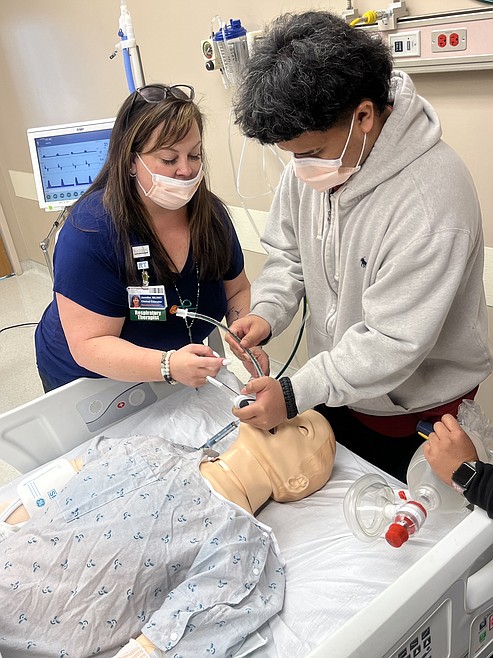
Bringing high school students to the Providence Sacred Heart Medical Center campus is one of the strategies the hospital is using to interest the next generation in medical careers. Students from Rogers High School in Spokane are pictured.
COURTESY PHOTO/PROVIDENCE SACRED HEART MEDICAL CENTER

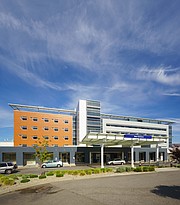
Confluence Health officials are using flexible scheduling and staff trained in multiple specialties to help meet some of the staffing demands. The main entrance of Confluence Health-Central Campus (Central Washington Hospital) is pictured.
Senior Reporter Cheryl Schweizer is a journalist with more than 30 years of experience serving small communities in the Pacific Northwest. She began her post-high-school education at Treasure Valley Community College and enerned her journalism degree at Oregon State University. After working for multiple publications, she has settled down at the Columbia Basin Herald and has been a staple of the newsroom for more than a decade. Schweizer’s dedication to her communities and profession has earned her the nickname “The Baroness of Bylines.” She covers a variety of beats including health, business and various municipalities. | August 8, 2023 1:00 AM
MOSES LAKE — Whether the hospital is big or small, public or private, the challenge is the same.
“The workforce shortage exists everywhere, and it’s in every discipline, and they’re all critically important to the hospital,” said John White, chief executive officer at Mid-Valley Hospital in Omak.
“For Sacred Heart, I think a lot of people have the idea that because we’re larger, because a lot of people view us as the desired place to work, especially for nurses straight out of school, that our workforce challenges might be less than other hospitals,” said Neil Christopher Apeles, chief nursing officer for Providence Sacred Heart Medical Center, Spokane. ”And unfortunately that’s not true.”
During 2022 Samaritan Healthcare in Moses Lake spent about $10.8 million for temporary employees to plug the staffing gaps, but Samaritan officials hoped that expense would decrease in 2023.
“It’s not,” said Samaritan Chief Administrative Officer Alex Town. “It probably won’t drop until late this fall or early next year.”
White said temporary employees, also called travelers, are having a major impact on expenses at Mid-Valley.
“Our projection this year was to spend about $4 million in 2023, on traveling labor alone,” he said.
Confluence Health operates two hospitals in Wenatchee and clinics throughout North Central Washington, from Tonasket to Royal City. Confluence officials closed, at least temporarily, a unit at Confluence Health-Central Campus (Central Washington Hospital) to reduce some of its expenses for traveling staff.
“We’re not immune to the staffing shortages that all of healthcare is seeing, and in different areas of healthcare,” said Confluence Chief Nursing Officer Kelly Allen. “I think nursing gets a lot of attention because there are a lot of nurses - and we still need more. But there are other areas that we struggle with staffing, like respiratory therapy.”
“Respiratory therapy is really hard right now,” said Stephen Brooks, Samaritan’s chief human resources officer. “Leave it to a pandemic to show us how valuable they are.”
Apeles said a generation of medical professionals is reaching retirement age, and Allen said that trend was accelerated by the COVID-19 pandemic.
“(The pandemic) was hard. It was hard on everybody,” Allen said. “And it burned people out, and I think that people who could retire chose to retire from nursing earlier. They have not come back; they just simply retired.”
Those retirees aren’t being replaced, at least not fast enough.
“There are not enough students and new hires to make up for all the retirements,” Brooks said.
Apeles said there are people who want jobs in medicine, but that there aren’t enough training opportunities.
“Some of the programs, they’re maxing out the number of students, and they’re filling up their programs every year. But the capacity of the program may not be meeting the needs of the community,” he said.
Before he became Mid-Valley CEO last year, White worked with medical professional instruction programs in Hawaii. The goal was to help them build curricula that meet the needs of both students and healthcare organizations - and right now they don’t match, he said. He cited the case of a major nursing program in Hawaii whose admission class was 40 students out of about 400 qualified applicants.
“It’s a mindset of exclusivity instead of inclusion, that has to change,” he said.
Allen said from her perspective, part of the problem is that requirements for nursing instructors are such that people who qualify as teachers can make more money working as nurses.
With the shortages, hospitals big and small are looking for solutions. Apeles said that Sacred Heart is one of the organizations working with Eastern Washington University to start a nursing program. Samaritan has partnerships with WVC and Big Bend Community College to help train nurses, and Mid-Valley and Confluence also work with WVC.
Brooks said many applicants are looking for different things from a job than they used to, at least in a tight labor market.
“A lot of it is focused on flexibility. (Applicants) don’t want full-time jobs, they want a couple of part-time jobs and (to) determine when they work. We’ve been creative in our nursing positions, (and) where we’ve created part time jobs, we’ve seen an influx of applications,” Brooks said.
Confluence Health also is working to increase flexibility for its employees, Allen said. Employees in Confluence’s far-flung clinic network can choose multiple locations where they want to work, what she called “float pools.” Nurses can train for different departments and move from department to department as they’re needed. Confluence also has a program for “flex nurses,” where people trained in multiple departments can work part-time in each.
“When you talk about the workforce of the future, it needs to be flexible. And we need to be flexible to give people what they want in a job,” Allen said.
Sacred Heart provides internship programs for employees who want more training in specific specialties.
“With (surgery) techs, we’ve created a surgery tech program. It’s an internship program, so they earn a salary while they’re doing their internship here. We have the same thing for respiratory therapists. Nursing assistants is another big one too,” Apeles said.
Mid-Valley offers prospective nurses, and even physicians, help with their education expenses, White said. If graduates come back to the hospital, a portion of the loan is forgiven each month, he said; if they go to work elsewhere, they pay the loan back.
Apeles said that health care organizations are going to job fairs as well as middle and high schools, talking to young people about careers in medicine.
“There are opportunities,” Allen said. “We just need to be creative in how we staff.”
Cheryl Schweizer may be reached via email at [email protected].
ARTICLES BY CHERYL SCHWEIZER

Road projects on hold for Labor Day weekend
MOSES LAKE — With Labor Day weekend dead ahead, drivers will be able to move freely about the state. Most road projects are on hold for the holiday weekend. Nobody will be working on the Hansen Road overpass on Interstate 90, but the lane restrictions that are in effect will continue through the end of the project.
Cost estimates for water source alternatives given to Moses Lake City Council
Protected under the U.S. Endangered Species Act, efforts are ongoing to keep it self-sufficient
MOSES LAKE — It’s going to cost a lot of money to provide alternative water sources for the city of Moses Lake, but some of the possible alternatives will cost more than others. City officials provided the Moses Lake City Council with costs for various alternatives Tuesday.

Dryer vent cleaning is important -- but often overlooked
MOSES LAKE — Not all the maintenance a house needs is visible. Sometimes a potential problem just goes unnoticed until it causes trouble, sometimes serious trouble. But a lot of potential problems give off warning signs. Clothes dryers often do when they need a good cleaning.