
Peeling the apple market
CHERYL SCHWEIZER | Hagadone News Network | UPDATED 3 years, 7 months AGO
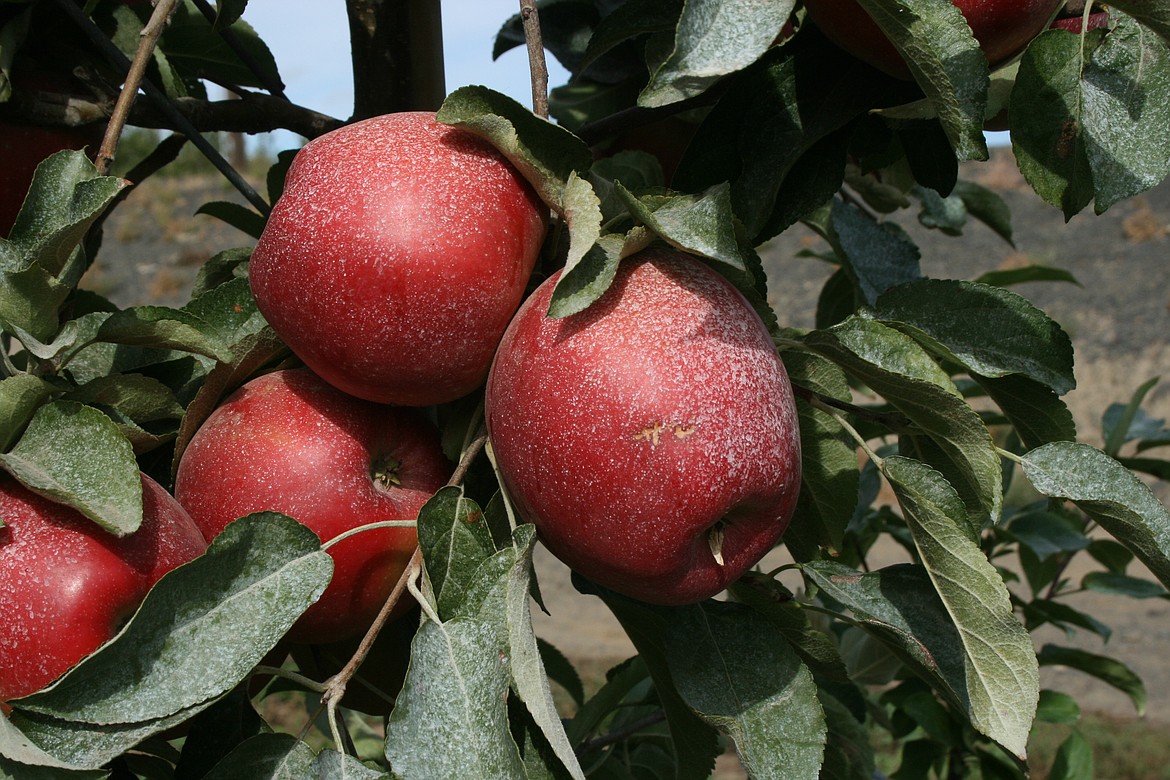
Apples fill a branch in an orchard near Royal City. At the start of 2023, domestic apple sales remain strong, but the export market does have challenges ahead.
CHERYL SCHWEIZER/COLUMBIA BASIN HERALD
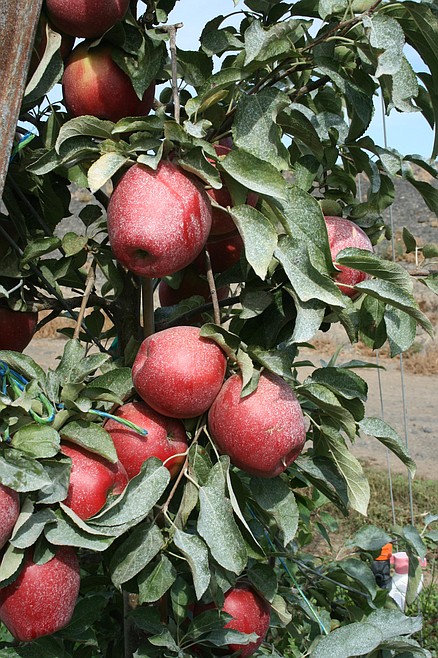
Retaliatory tariffs and congestion at U.S. ports have scrambled the export market for Washington fruit growers, including apple growers. Pictured, apples ready for harvest in a Royal City-area orchard.
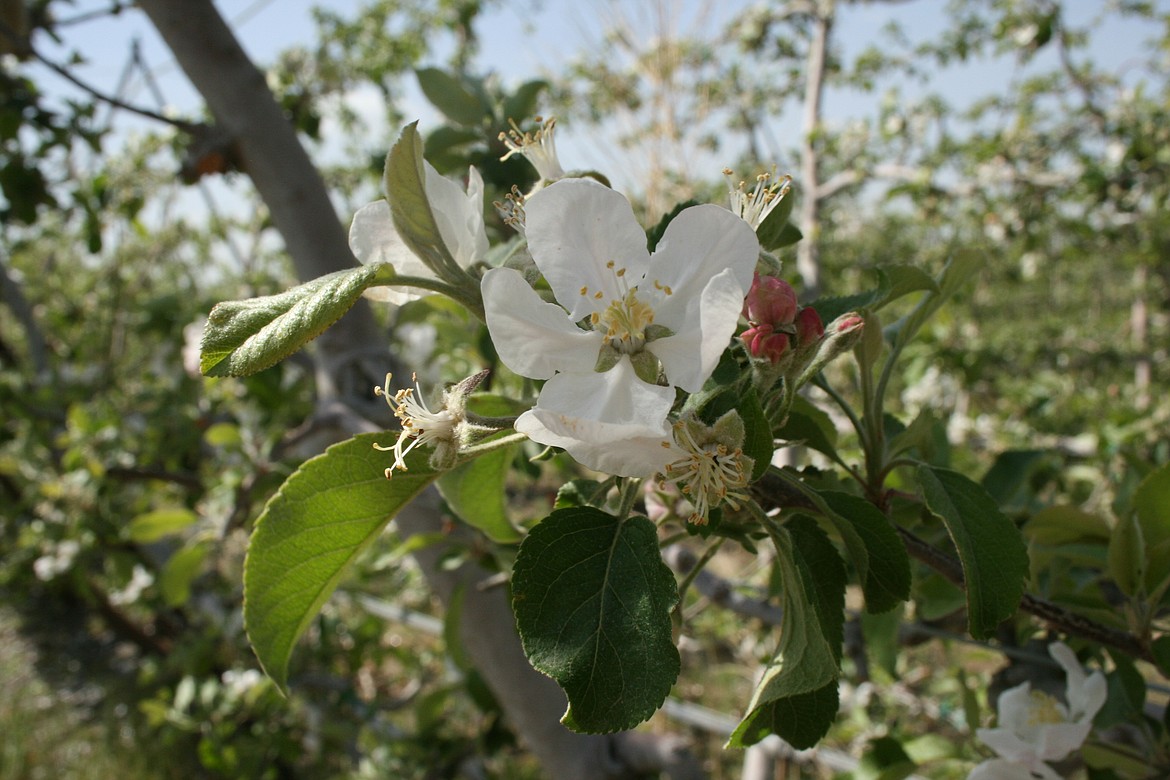
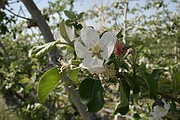
Apple blossoms in various stages of maturity, from bud to petal fall, fill an orchard near Mattawa. The domestic market for the 2022 apple crop has been relatively strong.
Senior Reporter Cheryl Schweizer is a journalist with more than 30 years of experience serving small communities in the Pacific Northwest. She began her post-high-school education at Treasure Valley Community College and enerned her journalism degree at Oregon State University. After working for multiple publications, she has settled down at the Columbia Basin Herald and has been a staple of the newsroom for more than a decade. Schweizer’s dedication to her communities and profession has earned her the nickname “The Baroness of Bylines.” She covers a variety of beats including health, business and various municipalities. | January 16, 2023 4:08 PM
QUINCY — Washington apple growers, having survived a wild and crazy 2022, are making the turn into a new year with a market that’s looking pretty good domestically, but facing some export challenges.
Riley Bushue, director of Congressional relations and export programs for the Northwest Horticultural Council, cited Washington apple sales to India as an example of the export issues.
“In India, we face retaliatory tariffs on apples,” he said. “Those were put in place by India in 2018 in response to the U.S. putting in place steel and aluminum Section 232 tariffs.”
Section 232 of the Trade Expansion act provides the President of the U.S. with the power to adjust imports, including with the use of tariffs, if foreign imports are found to be a threat to national security. Then-President Donald Trump utilized that power in March of 2018 to establish a 25% tariff on steel and aluminum from most nations with the exceptions of Canada and Mexico, according to the U.S. Bureau of Industry and Security.
Bushue estimated Washington growers sold about $120 million worth of apples to India in 2017-18 before the tariffs were imposed. He estimated 2022 sales at about $3 million.
“That’s in large part due to those tariffs,” he said.
“We have a similar situation happening in China, where we have retaliatory tariffs as well,” he said. “Combined, between India and China, those have cost our industry over the last four years - a few more than four years now - over $800 million. So that’s a huge challenge that we’re working through.
“At the end of the day, we need to bring an end to this retaliation. Those are two important markets - just on a pure population basis, the two largest countries in the world. And we’re obviously conveniently located on the Pacific to serve those countries,” Bushue said.
The entire Washington delegation to the U.S. Congress sent a letter to Secretary of Commerce Gina Raimondo and U.S. trade officials, requesting that apple tariffs be on the agenda when U.S. trade representatives met with their Indian counterparts at a scheduled Trade Policy Forum in mid-January.
“The tree fruit industry has suffered significant losses due to India’s retaliation for U.S. Section 232 tariffs,” the letter said. “On average, 30% of the apples, pears and cherries produced in the Pacific Northwest are exported and India was once a strong market. With retaliatory tariffs in place, Washington state apple growers have continuously lost market share in India.”
The export troubles, however, don’t stop there.
“The last few years there have also been a lot of challenges with ocean shipping - congestion in the ports, and while that’s improved, it can still be a challenge,” Bushue said.
Tim Kovis, director of communications and events for the Washington State Tree Fruit Association, said the news is better on the domestic market.
“We’re still seeing strong domestic consumption of apples,” Kovis said.
As of Jan. 13, Washington extra-fancy size 80 Galas were selling for an average of about $44 to $46 per 40-pound box, according to the U.S. Department of Agriculture marketing report. Size 80 Fujis were selling for an average of about $37 to $39 per box, and Washington extra fancy size 80 Honeycrisp were bringing an average of $50 to $52 per box.
Apples for the fresh market typically are sold in 40-pound boxes, and the size designation is based on the number of apples it takes to fill a box. So it takes 80 size 80 apples to fill the box. Generally, bigger apples are more desirable and bring higher prices. Size 72 Galas were bringing an average of $46 to $48 per 40-pound box. Size 72 Fujis were selling for an average of $37 to $39 per box, and size 72 Honeycrisp were selling for an average of $60 to $67 per box.
How the fruit looks also matters, and “fine appearance” fruit sells for higher prices.
Canada and Mexico remain the top markets for Washington apples, Bushue said.
“Obviously, the advantage that Mexico and Canada have is that they’re land transport,” he said. “They’ve always been important markets, but that’s certainly been an advantage the last few years.”
Cheryl Schweizer may be reached at [email protected]. See more of her work at www.columbiabasinherald.com and www.basinbusinessjournal.com.
ARTICLES BY CHERYL SCHWEIZER
Road projects on hold for Labor Day weekend
MOSES LAKE — With Labor Day weekend dead ahead, drivers will be able to move freely about the state. Most road projects are on hold for the holiday weekend. Nobody will be working on the Hansen Road overpass on Interstate 90, but the lane restrictions that are in effect will continue through the end of the project.

Cost estimates for water source alternatives given to Moses Lake City Council
Protected under the U.S. Endangered Species Act, efforts are ongoing to keep it self-sufficient
MOSES LAKE — It’s going to cost a lot of money to provide alternative water sources for the city of Moses Lake, but some of the possible alternatives will cost more than others. City officials provided the Moses Lake City Council with costs for various alternatives Tuesday.

Dryer vent cleaning is important -- but often overlooked
MOSES LAKE — Not all the maintenance a house needs is visible. Sometimes a potential problem just goes unnoticed until it causes trouble, sometimes serious trouble. But a lot of potential problems give off warning signs. Clothes dryers often do when they need a good cleaning.