
Regulation, economics and change focus at WA Horticultural Convention
CHERYL SCHWEIZER | Hagadone News Network | UPDATED 2 years, 9 months AGO
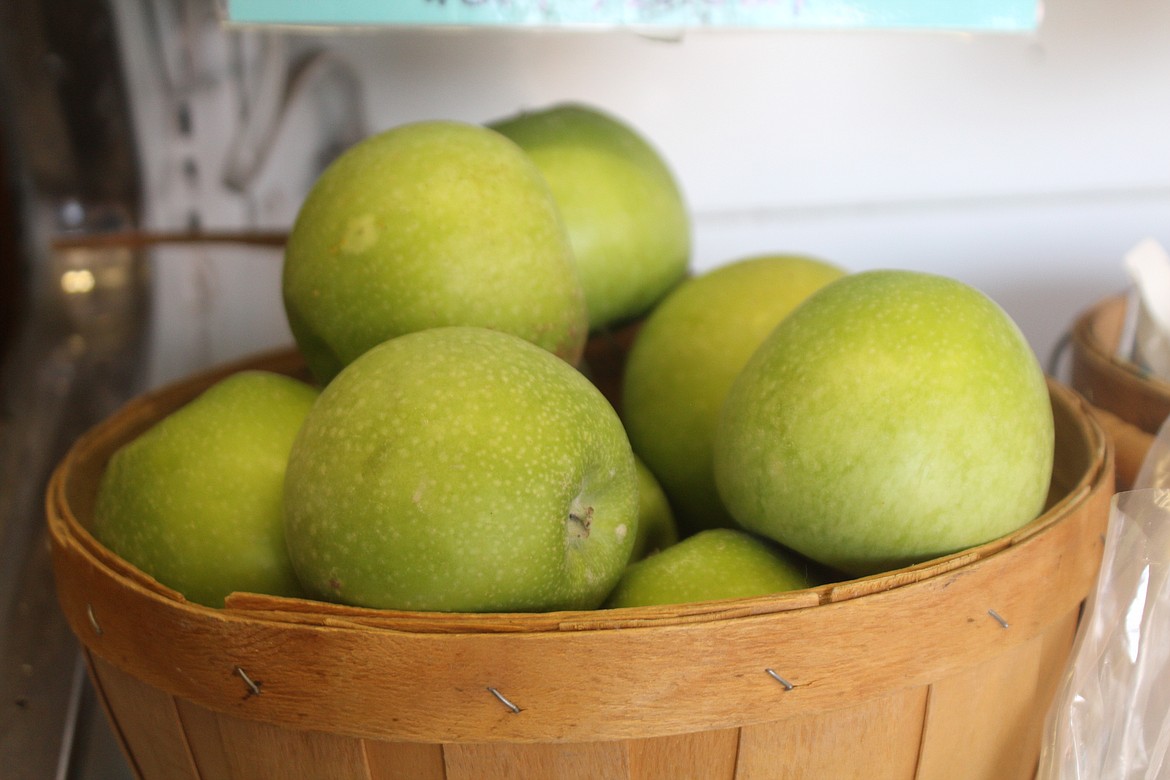
Granny Smith apples on sale at a Columbia Basin fruit stand. The apple market and where it might be going will be topics at the 109th annual Washington Horticultural Convention in December.
File photo
Senior Reporter Cheryl Schweizer is a journalist with more than 30 years of experience serving small communities in the Pacific Northwest. She began her post-high-school education at Treasure Valley Community College and enerned her journalism degree at Oregon State University. After working for multiple publications, she has settled down at the Columbia Basin Herald and has been a staple of the newsroom for more than a decade. Schweizer’s dedication to her communities and profession has earned her the nickname “The Baroness of Bylines.” She covers a variety of beats including health, business and various municipalities. | November 28, 2023 5:36 PM
KENNEWICK — The global market for American apples, pears and cherries, technology in the tree fruit industry, controlling pests, adding new varieties, profitability and economic sustainability will be among the many topics at the 109th annual Washington Horticultural Convention, Dec. 4-6 at the Three Rivers Convention Center 7016 Grandridge Blvd., Kennewick.
Tim Kovis, communications director for the Washington State Tree Fruit Association, said the convention includes a trade show along with two and half days of classes, workshops and meetings.
“A lot of it is to identify, ‘What are the issues we’re facing?’ And then what are some of the strategies people can use to address and mitigate what we see?” Kovis said.
“We’re hoping (growers and orchard workers) will get the tools and strategies to help them make decisions in their business, both financial and HR, but also into the horticultural topics,” he said.
Many classes are in English and Spanish, and there are Spanish-only sessions Dec. 5. Some classes come with continuing education credits needed for pesticide application licenses. But Kovis said many sessions will focus on important changes in an ever-changing industry.
Private equity firms are showing increasing interest in buying fruit orchards, Kovis said, and have for a few years.
“There are a number of different (options) growers can look at, based on their particular dynamic. We’re seeing groups do full buys, we’re seeing folks coming in as silent investors. So there are a number of different things that are going on, and folks should be aware of what those options look like and how to evaluate what makes the best sense for their operation,” Kovis said.
The horticulture show used to focus a lot on operations in the orchard – pest management, irrigation systems, management tools – and Kovis said those topics are still on the agenda. But growers are looking at new challenges too.
“One thing we’ve kind of pivoted (to) in the last few years is a lot more content around the evolving regulatory environment,” he said.
The federal and state governments are adding new labor rules for hot days, and possibly for wildfire smoke, Kovis said. There are also new rules governing H2A workers.
“A lot of this is regulatory compliance and as that has evolved, we’ve tried to be mindful of weaving those topics into the annual meeting,” he said.
Technology has had an impact on growing and harvesting apples, pears and cherries, just like all other industries. Growers have access to advanced techniques in soil management, crop protection, engineering the modern orchard, and advances in harvesting such as picking platforms.
Some of the proposed technological innovations have worked out, some haven’t. The long-awaited mechanical harvest system, for instance, is still awaited.
“We’ll have sessions on technology that’s really going to focus on what is here today that you can use,” he said.
Looking at the future will be a part of that theme, he said.
“There’s going to be some content on what’s out there in development because that’s important to keep in mind. But it’s going to a lot of (classes) on what can I utilize today? Because issues are pressing,” Kovis said.
Growers will get a look at a new apple variety, WA 64, under development at Washington State University, Kovis said.
“It’ll be a session on what does that apple look like? It’s another tool for when growers are looking at replanting. There’s another variety they can utilize,” he said.
The COVID-19 pandemic affected the hort convention just like most other events, Kovis said, but attendance has started bouncing back. The 2022 hort show in Wenatchee drew about 1,700 registrants. A lot more fieldmen and industry professionals are attending, he said. The number of small independent growers is going down, but the land is still in production.
Registration information is available on the WSTFA website, www.wstfa.org.
Cheryl Schweizer can be reached via email at [email protected].
ARTICLES BY CHERYL SCHWEIZER
Road projects on hold for Labor Day weekend
MOSES LAKE — With Labor Day weekend dead ahead, drivers will be able to move freely about the state. Most road projects are on hold for the holiday weekend. Nobody will be working on the Hansen Road overpass on Interstate 90, but the lane restrictions that are in effect will continue through the end of the project.
Cost estimates for water source alternatives given to Moses Lake City Council
Protected under the U.S. Endangered Species Act, efforts are ongoing to keep it self-sufficient
MOSES LAKE — It’s going to cost a lot of money to provide alternative water sources for the city of Moses Lake, but some of the possible alternatives will cost more than others. City officials provided the Moses Lake City Council with costs for various alternatives Tuesday.

Dryer vent cleaning is important -- but often overlooked
MOSES LAKE — Not all the maintenance a house needs is visible. Sometimes a potential problem just goes unnoticed until it causes trouble, sometimes serious trouble. But a lot of potential problems give off warning signs. Clothes dryers often do when they need a good cleaning.