
Export market causing reduced hay prices, despite high quality
CHERYL SCHWEIZER | Hagadone News Network | UPDATED 2 years, 1 month AGO
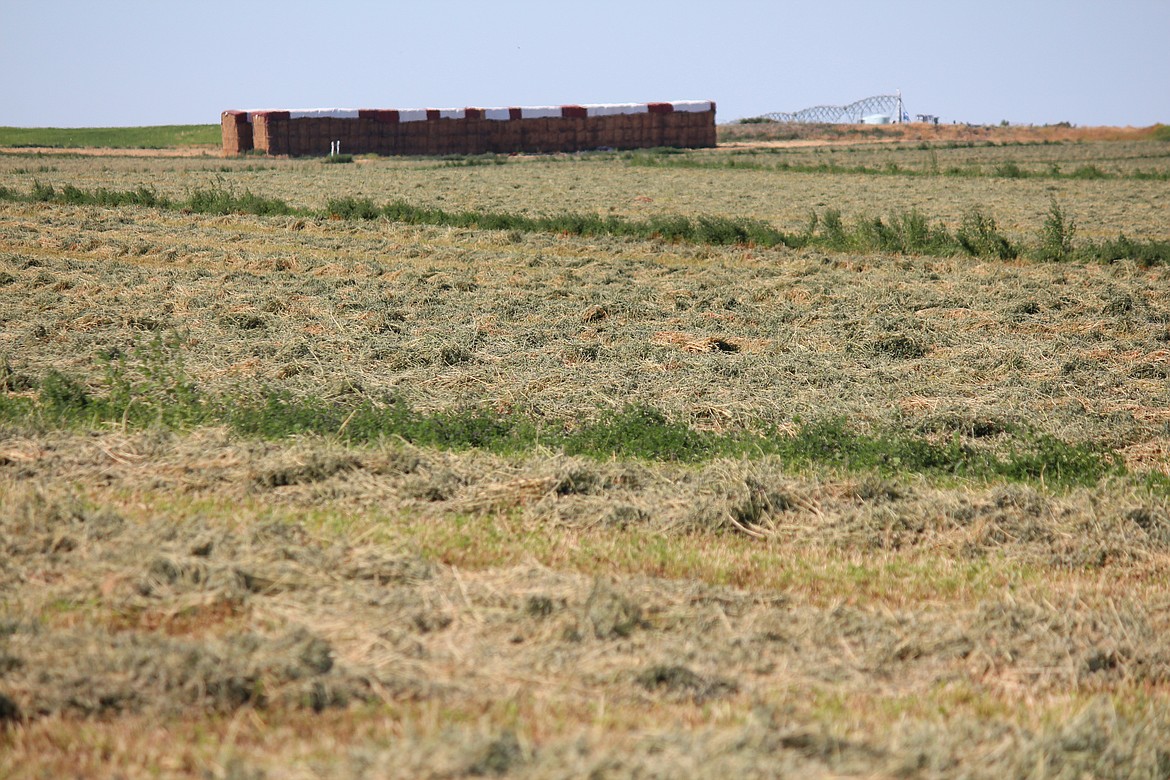
Hay dries prior to baling in a field near Warden. According to hay growers, quality is good but prices are being affected by a weak export market.
CHERYL SCHWEIZER/Basin Business JOurnal
Senior Reporter Cheryl Schweizer is a journalist with more than 30 years of experience serving small communities in the Pacific Northwest. She began her post-high-school education at Treasure Valley Community College and enerned her journalism degree at Oregon State University. After working for multiple publications, she has settled down at the Columbia Basin Herald and has been a staple of the newsroom for more than a decade. Schweizer’s dedication to her communities and profession has earned her the nickname “The Baroness of Bylines.” She covers a variety of beats including health, business and various municipalities. | August 3, 2024 1:00 PM
MOSES LAKE — The quality of Washington hay is pretty good in 2024, but the price – well, not so much.
Mark Anderson, president and CEO of Anderson Hay and Grain, Ellensburg, said the issue is the strength of the U.S. dollar relative to other currencies. It’s making Washington hay more expensive on the export market.
“I think we’ve got nice hay,” Anderson said. “(But) the strong dollar is definitely a huge headwind to the hay business for exports.”
For people who don’t know much about hay, there are two types grown in Washington for feed, timothy hay and alfalfa. The growing season in the state is long enough to harvest multiple crops, two in the case of timothy hay and three or four of alfalfa.
Each cutting produces slightly less yield, Anderson said. Dairy farmers will use hay from all cutting to feed their herds, but first cutting usually is in high demand, he said.
Harvest 2024 was looking pretty good early on, Anderson said.
“We got off to a great start with alfalfa first cutting,” he said. But it started raining before the first cutting was completed, and hay is one of those crops that doesn’t like rain.
Wet alfalfa will turn brown as it dries, and has to be rotated to dry it all, which causes damage and reduces the nutrient value. It also turns brown during the drying process, which (for whatever reason) makes it less appealing to buyers. And hay that takes too long to dry will interfere with the next cutting.
Andrew Eddie of RNH Farms, Moses Lake, said there are good options for buyers nevertheless.
“There’s a lot of nice quality hay out there,” Eddie said.
Weather challenges didn’t end with the rains. Temperatures topping 100 degrees and little to no wind arrived in the middle of harvest, and both can affect perfectly good hay.
Hay has to dry before it’s baled, but it also needs at least some moisture to retain its nutritional value.
“We need air movement and we need dew at night,” Anderson said.
The hot weather affected both. In addition, hot weather means crews have to start really, really early to take advantage of good cutting conditions.
“Three a.m. wakeup calls and done about noon,” Eddie said.
The crop was neither particularly big or particularly small, Anderson said.
“From a supply point of view, I think we’re about average,” he said.
There was some good quality in the first cutting of timothy hay.
“There was a lot of good green hay going up early,” Anderson said.
But quality diminished a little over the harvest, he said, and the overall first cutting was of more average quality. The irrigated timothy crop was of average size, Anderson said, while the dryland timothy crop might be below average in size.
Even with good hay, demand – and prices – have been dropping, Eddie said.
“(Prices) are just kind of all over the board on alfalfa,” Anderson said.
As of early July, early test hay was about $170 to $190 per ton domestically and about $150 to $200 per ton on the export market, Anderson said, but export demand was low. Eddie said he didn’t anticipate hay demand or prices recovering any time soon.
“It hasn’t come all the way back yet,” he said.
ARTICLES BY CHERYL SCHWEIZER
Road projects on hold for Labor Day weekend
MOSES LAKE — With Labor Day weekend dead ahead, drivers will be able to move freely about the state. Most road projects are on hold for the holiday weekend. Nobody will be working on the Hansen Road overpass on Interstate 90, but the lane restrictions that are in effect will continue through the end of the project.

Cost estimates for water source alternatives given to Moses Lake City Council
Protected under the U.S. Endangered Species Act, efforts are ongoing to keep it self-sufficient
MOSES LAKE — It’s going to cost a lot of money to provide alternative water sources for the city of Moses Lake, but some of the possible alternatives will cost more than others. City officials provided the Moses Lake City Council with costs for various alternatives Tuesday.

Dryer vent cleaning is important -- but often overlooked
MOSES LAKE — Not all the maintenance a house needs is visible. Sometimes a potential problem just goes unnoticed until it causes trouble, sometimes serious trouble. But a lot of potential problems give off warning signs. Clothes dryers often do when they need a good cleaning.