
Evolution drives further advancement in tree fruit industry
CHERYL SCHWEIZER | Hagadone News Network | UPDATED 2 years, 8 months AGO
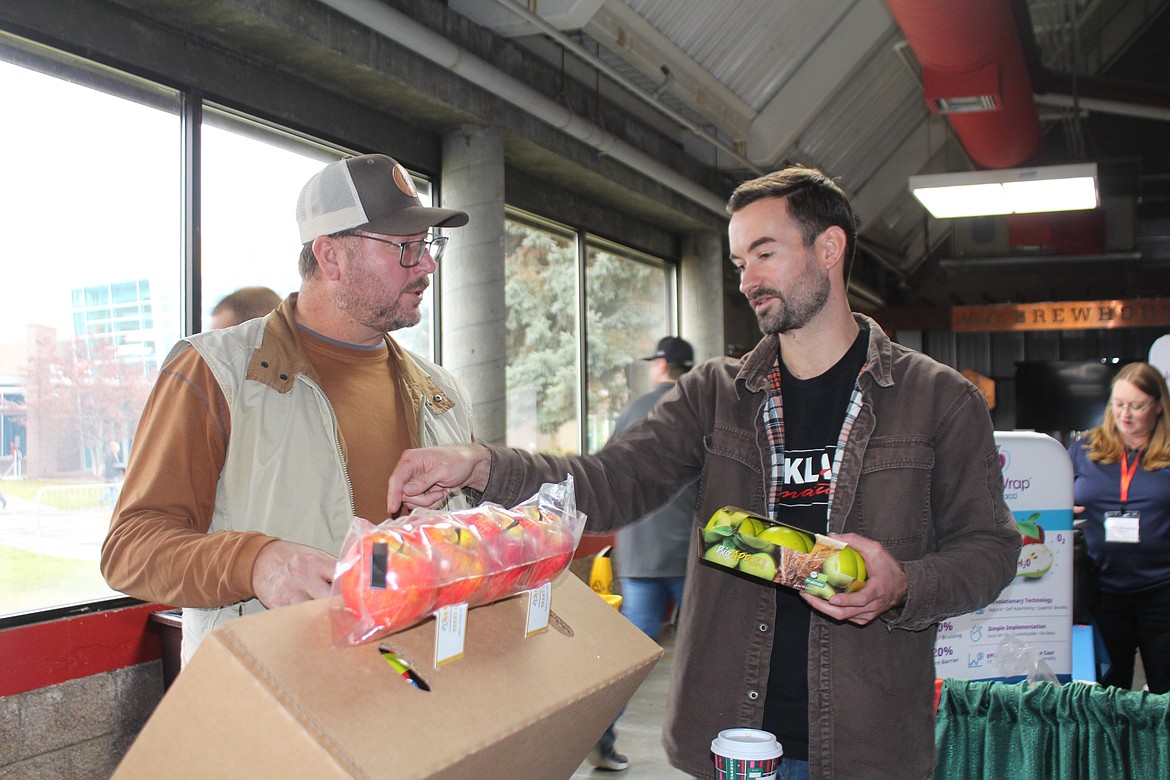
Brant Carman, right, of 4HM Solutions talks packaging with an attendee at the WSTFA annual meeting.
Cheryl Schweizer/Basin Business Journal
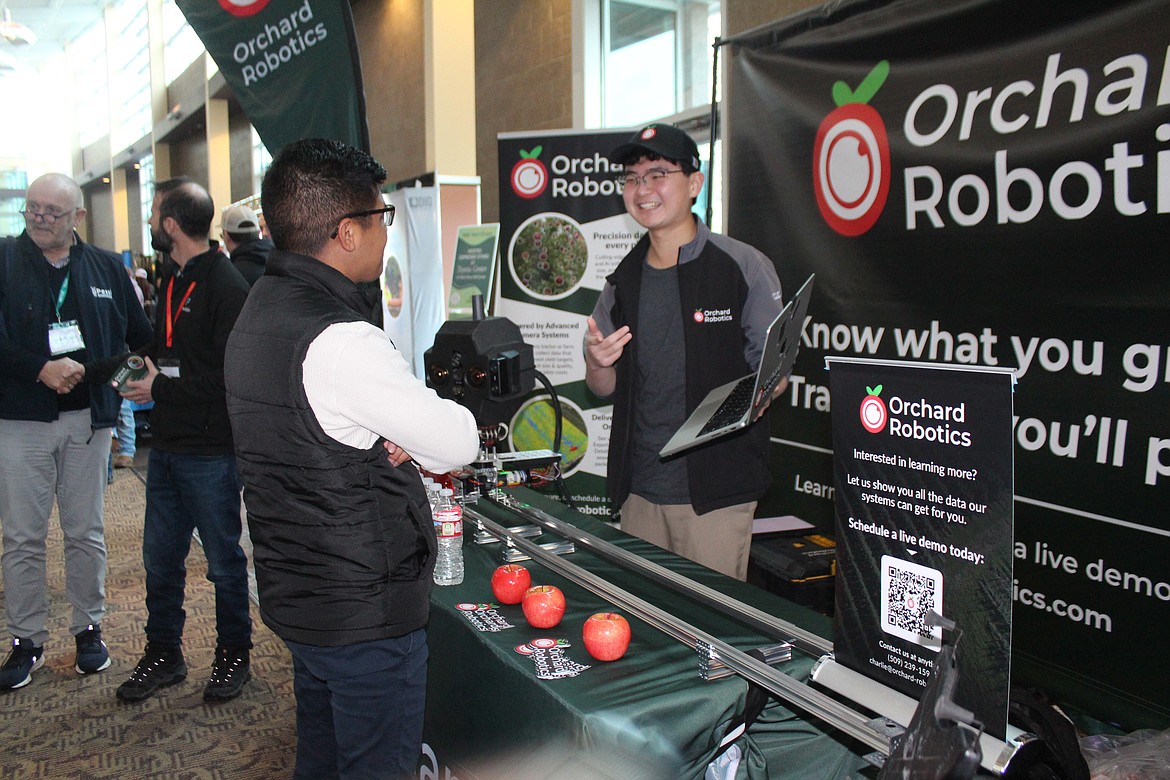
Charlie Wu, right, owner of Orchard Robotics, shows some of the options available from his company during the trade show that was part of the Washington State Tree Fruit Association annual meeting.
Cheryl Schweizer/Basin Business Journal
Senior Reporter Cheryl Schweizer is a journalist with more than 30 years of experience serving small communities in the Pacific Northwest. She began her post-high-school education at Treasure Valley Community College and enerned her journalism degree at Oregon State University. After working for multiple publications, she has settled down at the Columbia Basin Herald and has been a staple of the newsroom for more than a decade. Schweizer’s dedication to her communities and profession has earned her the nickname “The Baroness of Bylines.” She covers a variety of beats including health, business and various municipalities. | January 3, 2024 1:00 AM
KENNEWICK — As they say, things change.
Industries evolve, pushed by changes in technology, changes in the workforce, changes in regulation. One of the tractors on display at the Washington State Tree Fruit Association annual meeting in early December was an illustration of how that plays out in agriculture, at least in tree fruits.
Dan Gage of SS Equipment, Quincy, said raising apples is expensive these days, and that has changed everything, even the way trees are planted.
“It’s called high density - they get the highest density they can out of every acre they can,” Gage said. “Whereas before (trees were planted) in 20-foot rows, now they’re nine.”
And the tractor has to be narrower to fit in that more densely planted orchard, he said.
Some challenges have evolved too. If the ghost of a grower from the first annual meeting in 1904 or thereabouts materialized on the 2023 trade show floor, pretty much everything about raising apples would look different, from the trees to the containers. But that grower could still commiserate with his modern counterparts about a lot of things - expenses, prices, pests, weather. And labor.
Cort Deitrich, a crop consultant for GS Long, Yakima, said new work rules that went into effect in Washington in 2023 are making it more difficult to manage labor. Overtime wages for farm workers now kick in at 40 hours per week.
“So it’s either you’ve got to get more equipment or more workers,” Dietrich said. “But then again, you can’t keep those guys fully employed. There are ups and downs in the season as far as how many hours you need every week, depending on what you’ve got going on. It’s going to be tough to find guys that are willing to stay.”
The answer - at least the one that’s been under discussion for decades - could be automation. As of now, automating the harvest is still a while off, Dietrich said.
“Right now, workers are still the fastest option we have because it’s a short time window. You’ve got to get those apples off the tree,” he said.
JJ Daggoret of Automated Ag, Moses Lake, said machines haven't caught up with humans yet, at least in an economical manner.
“The problem with automation right now is, it’s not fast enough,” Dagorett said. “Unless we’re at four bins per hour, minimum, there’s no way to do it.”
And automated harvesters would need to be able to do more than simply remove the apple from the tree.
“We need to get the leaves out of the way, we need to be able to see the fruit, read the fruit, we need to scan it, we need to check the color on it before we pick it,” he said.
In the meantime, growers still need to harvest their fruit, and the platforms made by Automated Ag are designed to make it easier to manage and pick a high-density orchard. Instead of the workers moving a ladder from tree to tree, the platform moves. Daggoret said the switch to high-density orchards made the platforms a viable technology.
Even if automated harvesting isn’t here yet, technology has changed orchard management. Mike Thurow of Spectrum Technologies, Chicago, said cell phones and wireless technology connect a grower with the orchard - or a farmer with the field - wherever they are.
Thurow manufactures weather monitoring equipment, and growers can find out what’s going on in their orchards even when they’re miles away.
“They can give him an alert when there’s going to be a frost event, for them to (take) action to minimize the damage from frost, as an example,” Thurow said.
Monitoring equipment can and should be customized to the crop, and the region, he said.
“Each crop, there’s one, two or three things that you need to measure to stay out of trouble, have a good healthy crop, good quality and good yield. So it varies from crop to crop,and it varies (depending) on where you’re growing,” he said.
Technology has given growers access to more data, driving a need to make that data more usable. Charlie Wu, founder of Orchard Robotics, Yakima, said his company started while he was an undergraduate at Cornell University in New York, and was trying to find out what farmers needed.
“This whole thing started when we talked to a bunch of farmers in upstate New York, and they were telling us, ‘You know, if you could tell us how many apples we have on that tree, it would be golden data.’ And we really just took that idea and ran with it,” he said
Wu devised a camera system that’s driven through the orchard.
“These things are taking, like, 100 images a second, going past every single tree,” he said. “We can get counts for trees, we can get blossom counts for trees. And our bread and butter is counting and sizing.”
The data collection helps growers pinpoint areas where they might need to prune or thin, among other things, he said. The data also has value for the fruit processing facility where the grower ultimately takes the fruit.
“We can do things like harvest yield estimates, so (the warehouse) can know in advance of harvest what to expect coming out of the fields,” Wu said.
The next phase will be adding cameras that can help growers detect what’s going on outside the visible light spectrum, he said.
Dagget said the past shows that change may not be what people expect.
“They’ve been (harvesting) with a ladder for 2,000 years. So in a 10-year time frame, what I saw was this kind of paradigm shift from ladders to the adoption of platforms. And now we have potential robots coming in, in a matter of 10 years. But the industry had to change - we couldn’t just do this 40 years ago. The coming of the hedgerow, the trellis system, meant opportunity for something like this to be used,” Dagget said.
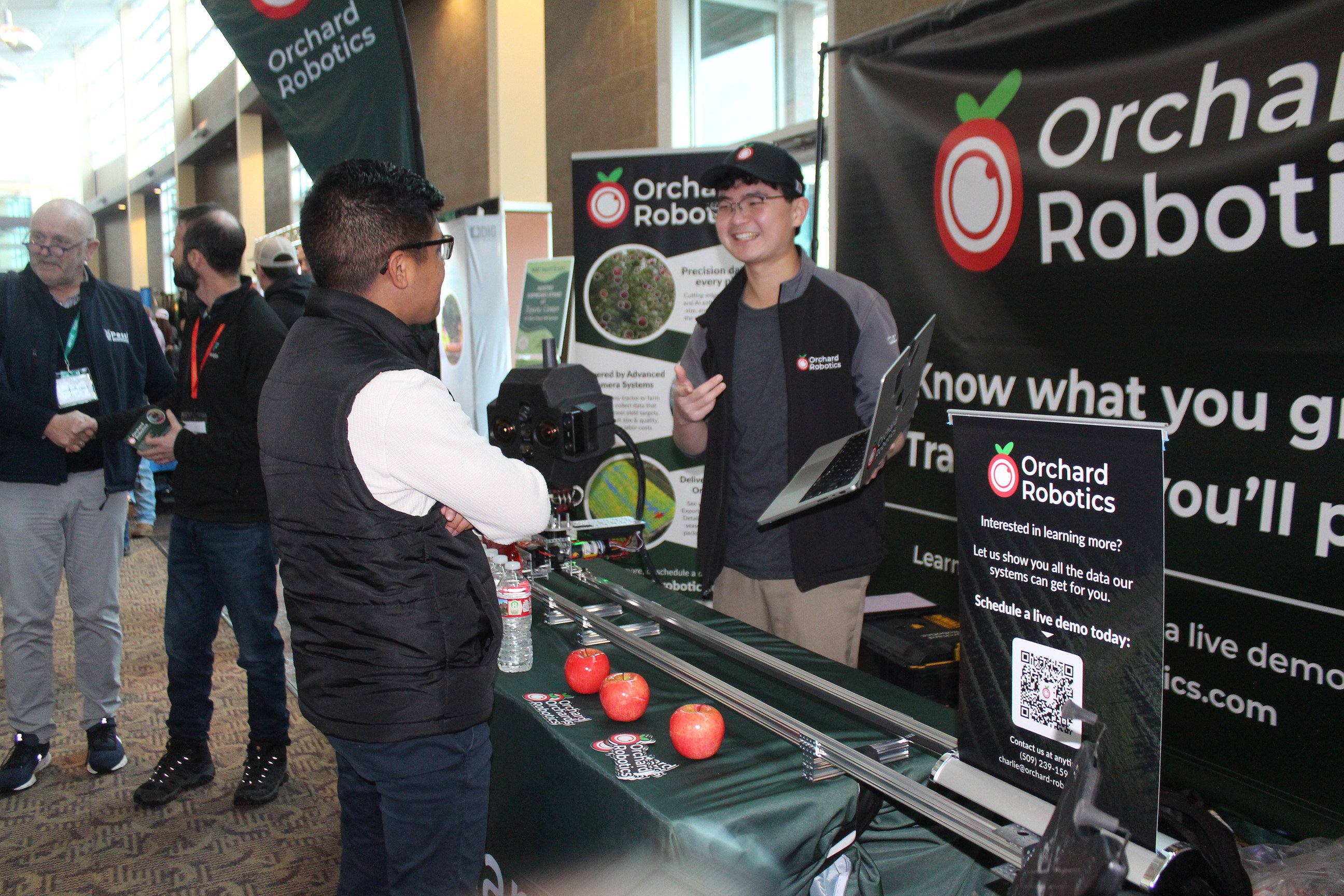 Charlie Wu, right, owner of Orchard Robotics, shows some of the options available from his company during the trade show that was part of the Washington State Tree Fruit Association annual meeting.
Cheryl Schweizer/Basin Business Journal
ARTICLES BY CHERYL SCHWEIZER
Road projects on hold for Labor Day weekend
MOSES LAKE — With Labor Day weekend dead ahead, drivers will be able to move freely about the state. Most road projects are on hold for the holiday weekend. Nobody will be working on the Hansen Road overpass on Interstate 90, but the lane restrictions that are in effect will continue through the end of the project.
Cost estimates for water source alternatives given to Moses Lake City Council
Protected under the U.S. Endangered Species Act, efforts are ongoing to keep it self-sufficient
MOSES LAKE — It’s going to cost a lot of money to provide alternative water sources for the city of Moses Lake, but some of the possible alternatives will cost more than others. City officials provided the Moses Lake City Council with costs for various alternatives Tuesday.
Dryer vent cleaning is important -- but often overlooked
MOSES LAKE — Not all the maintenance a house needs is visible. Sometimes a potential problem just goes unnoticed until it causes trouble, sometimes serious trouble. But a lot of potential problems give off warning signs. Clothes dryers often do when they need a good cleaning.