
Grant PUD considering new rate class for agriculture
CHERYL SCHWEIZER | Hagadone News Network | UPDATED 1 year, 10 months AGO
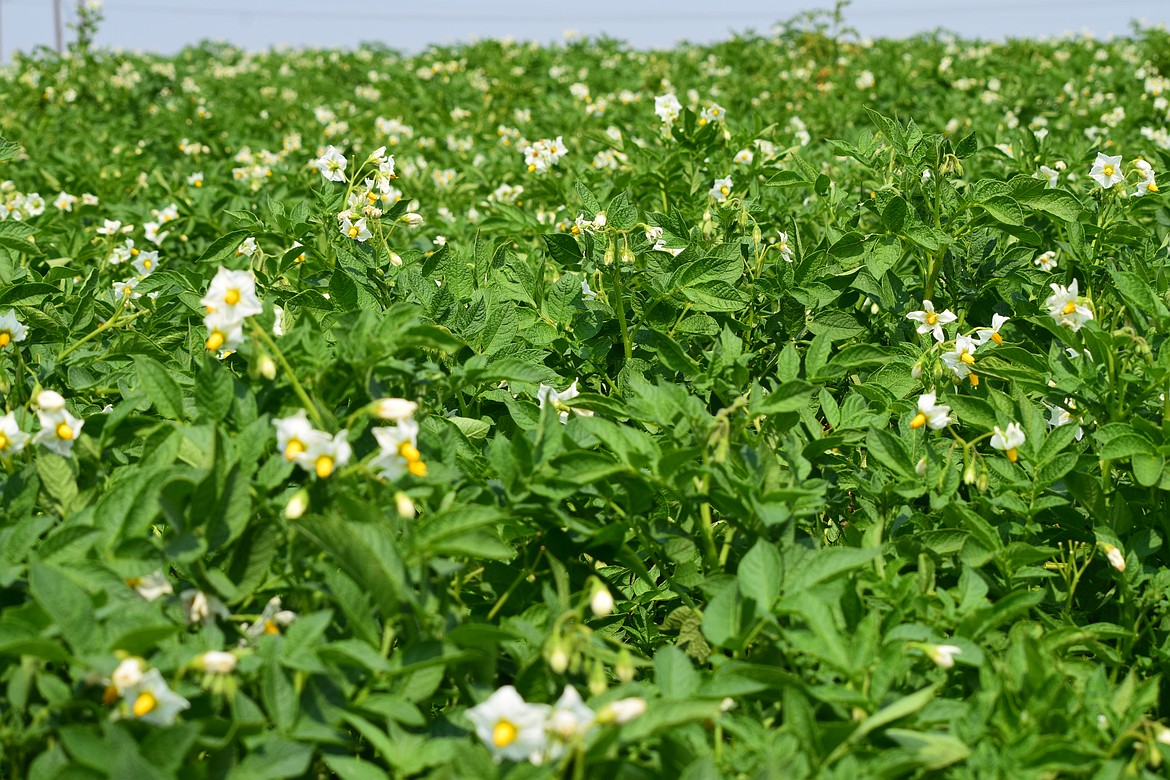
The Grant County PUD is accepting applications for a new “agriculture services” rate class that would group ag-related activities that are now included in other rate classes. A potato field in bloom is pictured.
FILE PHOTO
Senior Reporter Cheryl Schweizer is a journalist with more than 30 years of experience serving small communities in the Pacific Northwest. She began her post-high-school education at Treasure Valley Community College and enerned her journalism degree at Oregon State University. After working for multiple publications, she has settled down at the Columbia Basin Herald and has been a staple of the newsroom for more than a decade. Schweizer’s dedication to her communities and profession has earned her the nickname “The Baroness of Bylines.” She covers a variety of beats including health, business and various municipalities. | October 29, 2024 1:00 AM
EPHRATA — The Grant County Public Utility District is researching a new rate class for agriculture uses other than irrigation. If it’s approved by PUD commissioners, the “agriculture service” rate would go into effect in April 2025.
Julio Aguirre, PUD program manager of rates and pricing, said it would give ag customers another option that might lower their costs.
“Our intent is to have a specific rate that is dedicated to this activity,” Aguirre said. “It’s really to be able to isolate the (rate) class, understand their usage, their behavior, and be able to offer a rate that is more favorable for that activity.”
Utility district commissioners have said they are committed to ensuring the biggest economic benefits from the power produced by the Wanapum and Priest Rapids dams are reserved for what are called core customers, which include residential, general service (small and medium-sized businesses) and irrigation.
There’s a lot of activity in agriculture, however, much of it year-round such as potato and onion storage. The new rate class would consolidate all of those uses in one rate class, instead of partitioning them among different rate schedules. Aguirre used Class 2, general service – currently the PUD’s second largest class – as an example.
“It’s a mixed bag, because we have different businesses, small businesses, like restaurants (and) offices. So it’s really very diverse (and) includes agricultural activity. So by separating (agriculture) from this group, we’re able to identify more accurately the cost we incur to serve and offer them, if It’s warranted, a rate that is more advantageous,” he said.
“The goal is to have a benefit for the wholesale producers because they don’t have the retail component of passing on price increases,” said commission chair Tom Flint at the April 23 commission meeting.
The actual rates are still being determined, Aguirre said.
“Structurally the (rate) itself is not going to be significantly different than others we currently have,” Aguirre said. “We have not finalized what we call the rate design, where we determine the different elements and the rates we’re going to be charging.”
Utility district customers currently pay a basic charge, then are charged for the electricity they use. Aguirre said the new rate probably will follow that structure.
Applicants must submit a stipulation that at least 70% of the electricity used in their activities is for agriculture purposes to qualify, he said.
“We do check (customer) usage and make sure they do qualify,” he said.
Agriculture customers are charged for irrigation under a separate rate class, and Aguirre said that rate class would stay. So would the ag processing rate schedule, which is designed for businesses that do things like prepare and process frozen vegetables.
“This is intended to be for smaller agricultural processing (and) storage,” he said. “As a matter of fact, we don’t really expect any large customer initially participating in this schedule. We expect customers will be less than 500 kW (per month), and probably in the low 200s (kW), maybe 150 (kW) or so. We’re looking into the data right now, but that is where I see the majority of the customers participating.”
Utility district staff asked customers to apply for the new rate class earlier this year in an effort to determine how many businesses might use it. That led to some confusion, Aguirre said.
“We received a few applications from customers that are currently receiving service on irrigation, Rate (class) 3. But they don’t qualify for this rate because this is for, basically, agriculture service, not for irrigation purposes,” he said.
To date the PUD has received applications from about 130-140 customers, he said.
“There may be others that may not have heard about the (new class) that qualify for the rate,” Aguirre said.
Utility district customers can apply for the new rate class at any time, he said. People who think they may qualify for the new rate can contact the PUD at 509-766-2502. A copy of the application can be downloaded from the PUD website, https://bit.ly/4hnaqFI.
Completed applications can be emailed to [email protected].
ARTICLES BY CHERYL SCHWEIZER
Road projects on hold for Labor Day weekend
MOSES LAKE — With Labor Day weekend dead ahead, drivers will be able to move freely about the state. Most road projects are on hold for the holiday weekend. Nobody will be working on the Hansen Road overpass on Interstate 90, but the lane restrictions that are in effect will continue through the end of the project.

Cost estimates for water source alternatives given to Moses Lake City Council
Protected under the U.S. Endangered Species Act, efforts are ongoing to keep it self-sufficient
MOSES LAKE — It’s going to cost a lot of money to provide alternative water sources for the city of Moses Lake, but some of the possible alternatives will cost more than others. City officials provided the Moses Lake City Council with costs for various alternatives Tuesday.

Dryer vent cleaning is important -- but often overlooked
MOSES LAKE — Not all the maintenance a house needs is visible. Sometimes a potential problem just goes unnoticed until it causes trouble, sometimes serious trouble. But a lot of potential problems give off warning signs. Clothes dryers often do when they need a good cleaning.