
New FWP supervisor’s career rooted in connecting community with science
HAILEY SMALLEY | Hagadone News Network | UPDATED 1 year, 5 months AGO
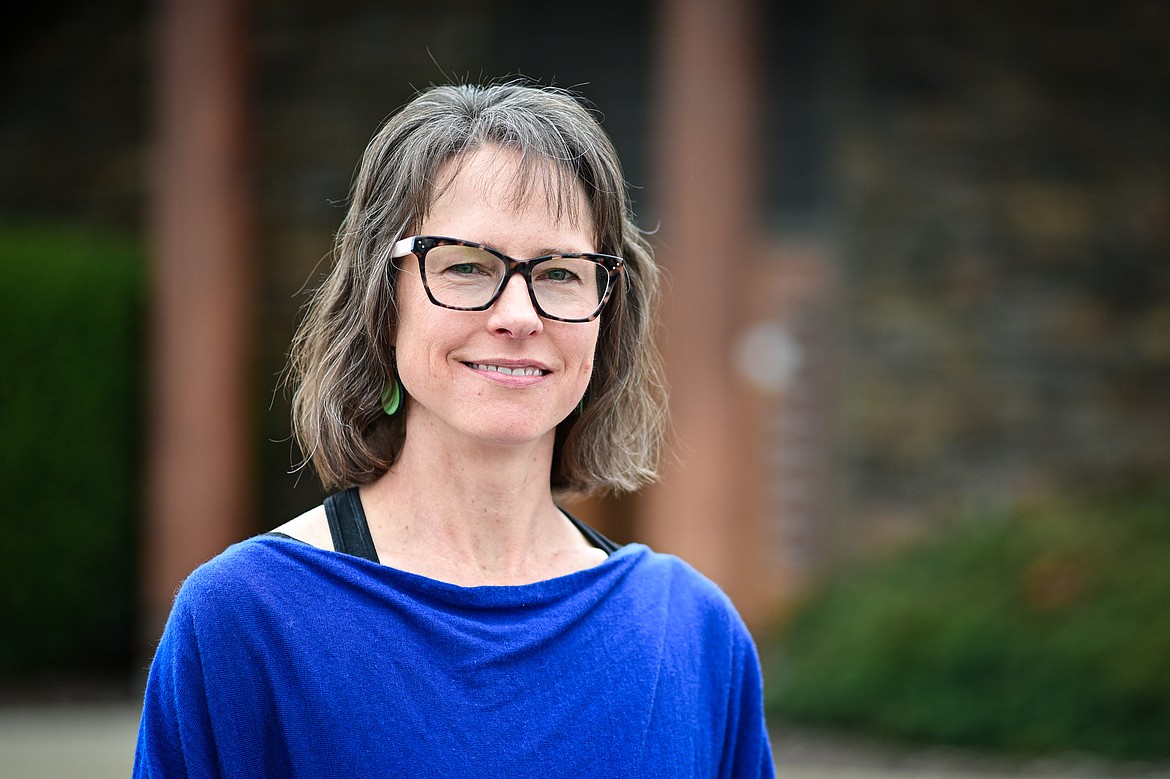
Amber Steed, the new regional supervisor at Montana Fish, Wildlife & Parks Region 1 on Monday, April 7. (Casey Kreider/Daily Inter Lake)
Casey Kreider
The headwaters of Amber Steed’s career can be found in the backwoods of Minnesota, where she grew up alongside her older brother.
Spending time between family camping trips scouring streambanks for frogs and scaling trees to retrieve intricately woven bird nests, her father stoked her love for the outdoors with extended fishing trips on some of the state’s proverbial 10,000 lakes.
Steed was recently appointed Montana Fish, Wildlife and Park’s Region 1 supervisor.
After two decades researching and managing Montana’s fisheries, Steed’s proficiency as a scientist is certain, but she said it was her connection with people that prompted her to take on one of the agency's top leadership positions.
“It’s kind of beholden on us as wildlife managers to connect people with what we’re doing and why it matters,” she said. “Unless there’s a connection with a majority of the public, it loses its significance and impact.”
By the time she turned 18, Steed knew she wanted to forge a career in biology. A research project on a local river soon sharpened her interest in the aquatic side of wildlife management. Steed’s class was tasked with trapping fish at different locations on the Chippewa River, which runs through the University of Wisconsin campus where Steed attended. The class compared how many different species were captured at each location during different times of the year to determine how seasonal changes impacted fish movements.
“It was an introduction to how to do science,” said Steed. “It helped me learn how to be a scientist and to think critically.”
THE EXPERIENCE was enough to hook Steed. She signed on for extra summer classes at a university on the Gulf Coast in Mississippi and channeled what she called “a marine biology obsession” into a research career on the Pacific Coast, studying first salmon, then native plants, then intertidal zones.
But by the time she started looking at graduate schools, Steed said the appeal of the ocean was beginning to wear thin. She turned her sights back inland, accepting a graduate research position at Montana State University in 2005.
In many ways, Steed’s graduate work harkened back to her first foray into science. She was once again surveying freshwater fish — this time, Arctic grayling — to determine how they moved along tributaries of a major river. This time, though, her laboratory was on the Gibbons and Firehole rivers running through Yellowstone National Park.
Steed spent the summer of 2006 snorkeling and electrofishing under the purview of the park’s 2 million visitors. With her work on full display, Steed said she often found herself pausing to explain her research to curious onlookers.
“That was actually a pretty fun part of it that I wasn’t expecting,” she said.
The experience stuck, not only as a stepping stone in her scientific career, but as a reminder of the importance of connecting the public with the research that goes into natural resource management. When she took a job as a fisheries biologist with Montana Fish, Wildlife and Parks, Steed hoped to keep that sort of public involvement as a central tenet of her work.
“It helps people understand the why behind the decisions we put forward,” she said. “It’s kind of explaining how we get from A to Z in an objective way.”
OVER THE course of the next 17 years, Steed built her reputation as a leader within the agency. She visited classrooms and public events to speak about her research and got involved with the American Fisheries Society, eventually being elected vice president of the organization’s western division.
In the 2010s, Steed led efforts to study bull trout and cutthroat trout in the North Fork of the Flathead River. The final study, which demonstrated that the fish often moved across international borders between Montana and Canada, proved crucial to ongoing negotiations regarding a proposed open pit mine in British Columbia and helped solidify a cooperative working relationship between wildlife agencies in both countries.
Another critical moment for Steed came in 2015 when she conducted an in-depth survey of anglers on the Flathead River to determine how fishing pressures were changing over time.
“I always learned something and built good relationships in the process, and I really loved it,” said Steed. “I just grew increasingly motivated by that human dimension of things.”
When the former Region 1 supervisor, Lee Anderson, retired, Steed said she felt like it made sense to fully step into the spotlight, where she hopes to focus on building “shared success stories” between the state agency and community partners.
While Steed was largely optimistic about her future as the Region 1 supervisor, she admits the position comes with a downside. The view from her office window just can’t compete with an early morning hike to an alpine lake or a summer afternoon snorkeling in a mountain stream.
“It doesn’t get much cooler than that,” she said.
Reporter Hailey Smalley can be reached at [email protected] or 758-4433.
ARTICLES BY HAILEY SMALLEY

Trump stumps for Flint in Kalispell as Election Day nears
President Donald Trump, wearing a dark suit, red tie and red USA cap, ambled into the Majestic Valley Arena to the raucous roar of a crowd.
Flathead National Forest greenlights Swan Valley timber project
A 2,307-acre timber project is now under way in the Swan Valley.
Flathead National Forest greenlights Swan Valley timber project
A 2,307-acre timber project is now under way in the Swan Valley.