
‘Real Yellowstone’ documentary showing in Whitefish this week
KELSEY EVANS | Hagadone News Network | UPDATED 7 months, 3 weeks AGO
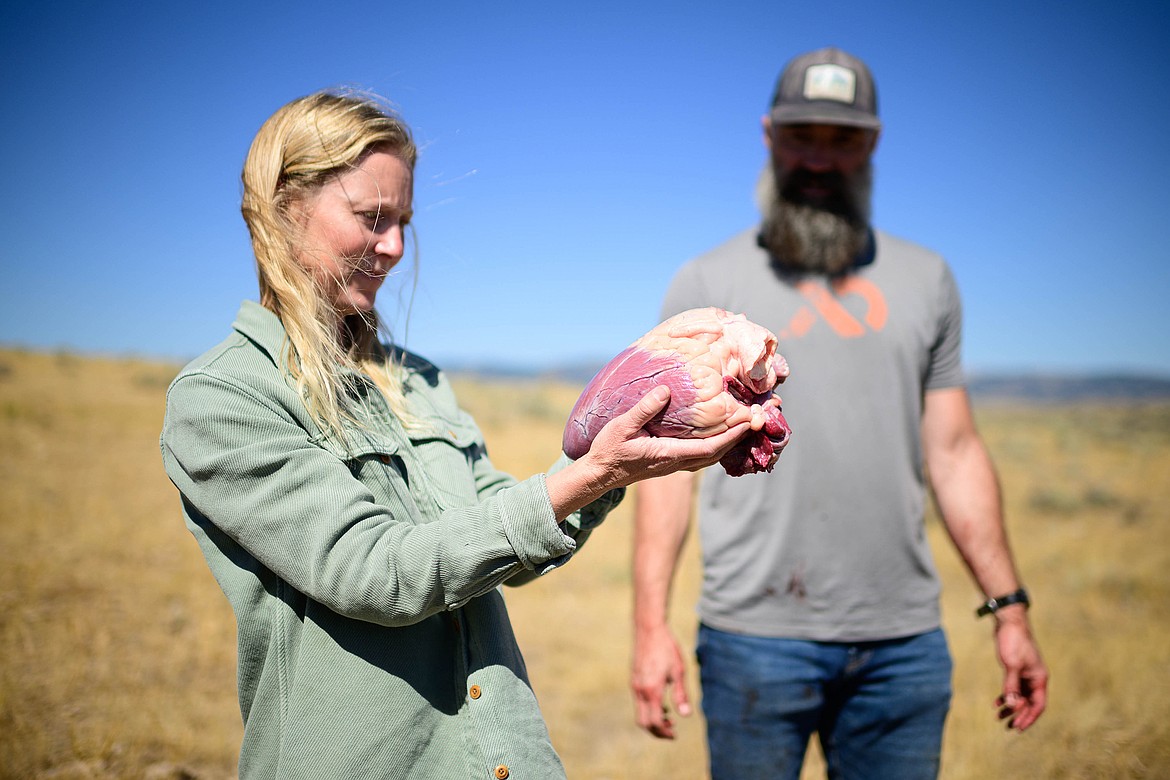
In this shot from The Real Yellowstone, a woman holds a bison heart as she observes a hunt to connect with animals in the food system. (Tony Bynum photo)
The Real Yellowstone is set to bring the voices of rural Montana ranchers to the Whitefish Performing Arts Center on Sunday, Aug. 17 at 7 p.m.
Produced by Flathead Valley based filmmaker Tom Opre, The Real Yellowstone is sequential to Opre’s first film, Killing the Shephard.
Killing the Shephard is about a rural community in Zambia, led by a woman chief who wanted to break the bonds of poverty by waging a war against wildlife poaching.
Opre said at a screening in Montana, people watching said, “‘We do these things too.’”
And so the idea for The Real Yellowstone started to form.
“They’re very different stories, but they have a common theme,” Opre said.
Killing the Shepard ending up winning awards for social justice and indigenous and human rights.
“I wasn’t expecting it, but I was like, I get it,” Opre said.
“If the natural resources for rural people provide benefits – if they take care of the [resources], those benefits directly relate to their human rights: a good paying job to pay for food, access to health care, education.”
It’s the same premise that carried over to his second film based in the highlands in Scotland, called The Last Keeper, where he said there’s a “war between land use and ownership between the haves and have-nots.”
Opre said many people who reside in the densely populated cities of Scotland are unaware of what goes on in the countryside.
“It goes back to feudalism,” he said. “There’s always conflict over resources. It hasn’t stopped today. Those issues are echoed here in the western United States.”
Here in Montana, efforts to give access to public lands come with a mindset that a public asset shouldn’t be commercialized, he said.
Yet the ranchers who commercialize also provide to both humans and wildlife.
Opre – who also has a 30-year background in directing nationwide TV commercials based in the outdoors – formed a nonprofit in 2020 to help fund the films, utilizing his background and connections to get people involved.
“I saw this huge disconnect in our urban society,” he said. “So I got together with wildlife filmmakers and outdoor photographers, and utilize our talents to educate the urban populations about what nature is, what land stewardship is, what wildlife and habitat conservation is.
“Mother nature doesn’t practice conservation. Humans do. To be a conservationist, you must conserve. It’s not a state of mind, it’s not an emotion,” he added.
The nonprofit, called Shepards of Wildlife Society, helped fund The Real Yellowstone.
“The Real Yellowstone is about multigenerational ranching families, and others working on the landscape, and giving a voice to rural people,” Opre said. “It’s a powerful voice. These are people that have a connection to the land.”
In the film, Opre interviews dozens of different ranchers across rural Montana. Many of them have the mindset of the “Save the Cowboy” campaign, taking issue with out of staters buying land – even sometimes in the name of conservation – particularly the American Prairie Association’s efforts to grow a large public lands nature reserve in Central Montana.
The film also touches on other conservation challenges and topics, including regenerative agriculture, hunting ethics, connection to food and land, grizzly and wolf livestock conflicts and the policies behind them, and a disconnect among politicians and interest groups.
The film has already had a number of sold-out screenings across the state. Opre said in Lewiston, the queue outside the door got so long, they had to schedule another showing.
Opre described a few challenges that have come up in conversations and panels about The Real Yellowstone.
Cooper Hibbard of Sieben Livestock Company, a 60,000-acre generational operation in north-central Montana, shared at a panel how their company lost hay this year with a late cold snap, followed by alfalfa fields that have been too wet to cut the hay.
Meanwhile, elk are feeding on the hay they can’t cut. Now, they might have to go buy hay.
In another example, Opre described how Trina Jo Bradley, a smaller-operation rancher on the Rocky Mountain front on the edge of the Blackfeet Reservation, could face huge losses from predation.
“Whatever they get from the steers sent to market, that’s what they live off of,” Opre said. “That’s all you get for the next year. Can you imagine losing $20,000?”
Opre said sometimes, calves are even lost to coyotes.
“The coyotes come to eat the afterbirth. They’ll circle around the mama, and the mother turns in circles to face the threat, until the mama ends up stepping on the calf and kills it.
“At the end of the day, we hope that people in cities understand this is how it works. These are real people. They’re not the Duttons in the TV show. They don’t have money coming in.”
MAKING The Real Yellowstone was about three years from idea to screen, with up to 180 days of filming.
Opre said the Flathead Valley, with its escalating grizzly conflicts and rapid growth, would resonate with the film.
“I remember my first visit in the valley was Moose’s [Lodge],” he said. “The speed limit was called safe and prudent... I don’t think we’re going back to that anytime soon. That’s part of why I make these films.”
For those who do see the film, they’ll be handed a survey before and after, to help Shepherds of Wildlife Society gauge if the film is educational and impactful.
The Real Yellowstone will also be available Aug. 15 for digital, 48 hour rentals, for one month only, with profits going to the Shepherds of Wildlife Society to help fund future films.
In the works for Opre is a film about the culture of black hunters.
Tickets for the show, $25, and more information are available at shepherdsofwildlifestore.com/pages/therealyellowstone
ARTICLES BY KELSEY EVANS
Solid freshman class to bolster track and field teams past adversity
The sunny and brisk Monday afternoon was a pseudo first day of practice for the Bulldogs, who have to sharpen up quickly after spring break for this weekend’s debut meet: the ARM Invite.
Skimo North American champion hails from Big Mountain
Whitefish eighth grader Porter Shehan skinned, climbed and skied his way to a skimo North American title and a national title this season.
Casual eatery Grouchy Grizzly to open in Whitefish this summer
Whitefish’s Last Chair Kitchen and Bar, a restaurant at Lakeshore Drive and Reservoir Road, has been sold and will undergo a phased transformation, into a casual, fun-focused eatery called Grouchy Grizzly.