
PUD moves forward with eminent domain process for Quincy area line
R. HANS MILLER | Hagadone News Network | UPDATED 7 months AGO
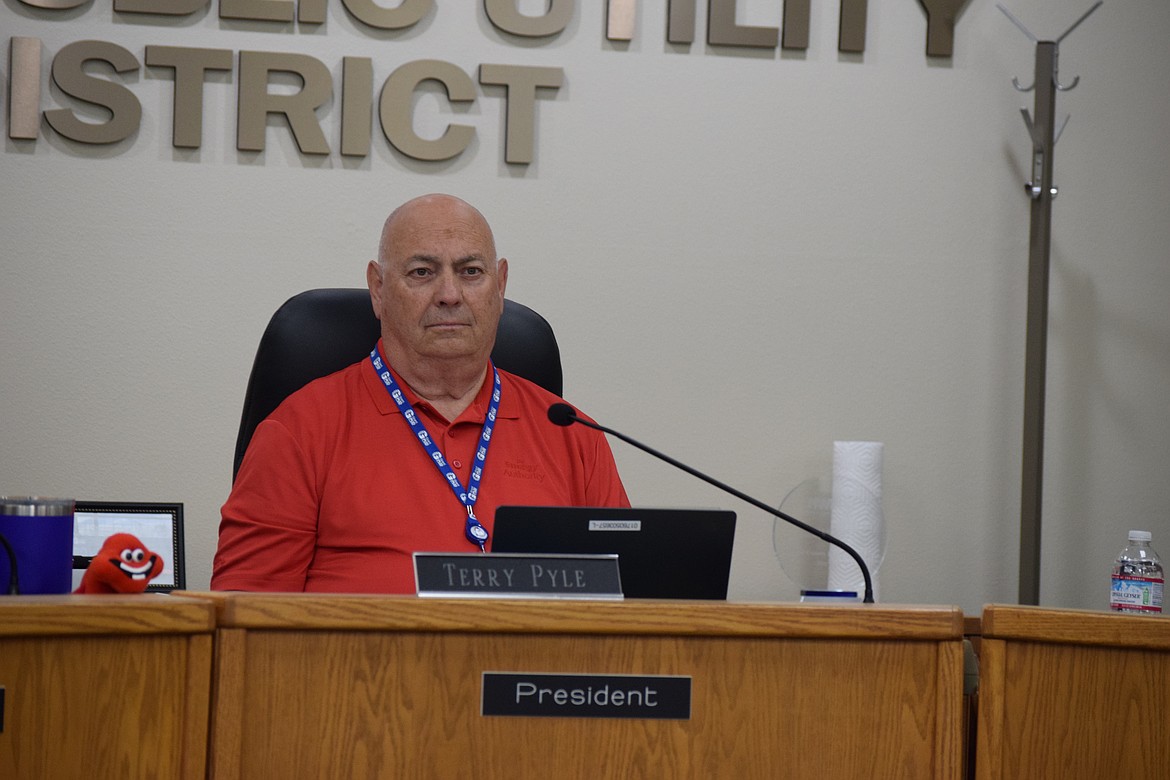
Grant County PUD Board of Commissioners President Terry Pyle listens to testimony regarding the eminent domain proceedings the district decided to move forward with Tuesday. The commissioners are in a difficult position as they look at the needs of the PUD and all of its customers versus the property rights of those who would be impacted by the land grab.
R. HANS MILLER/COLUMBIABASINHERALD
Managing Editor Rob Miller is a 4-year U.S. Army veteran who grew up in Western Montana in a community about the size of Soap Lake. An honors graduate of Texas State University, he enjoys spending time with his wife, Brandee, and their three dogs, Draco, Pepper and Cinnamon. He has one son, William. During his free time, he enjoys photography, video games, reading and working on the house he and his wife bought in Ephrata. He is passionate about the First Amendment and educating communities. | August 26, 2025 6:02 PM
EPHRATA – The Grant County PUD Board of Commissioners voted unanimously Tuesday to proceed with the condemnation of privately owned lands intended to help establish a route for a new transmission line from its dams on the Columbia River south of the Vantage Bridge to the Quincy area.
A condemnation of this sort is not done because the property is unfit for habitation, but rather as part of Washington state’s eminent domain process. The process is outlined in RCW 8.24.010 and related state statutes.
“With the unanimous vote today to move ahead with the condemnation, that doesn’t mean that the commission won’t continue to work with customers to try to find solutions to each of their individual concerns,” said PUD Public Information Officer Christine Pratt. “It just means that we’ve been talking about this with them for a lot of months now, and we’re just moving ahead with the legal case. And really, that’s better for everyone because that way, whatever differences we can’t decide between ourselves and the landowners could be decided in a court, and that’s what the courts are for.”
Property owners affected by the eminent domain process in this situation expressed several concerns regarding the manner in which Grant PUD has communicated the establishment of the route and the timing of public information meetings held specifically about the topic. They claimed many of them had not received any directly addressed written notification of meetings related to the eminent domain process as required under the Revised Code of Washington. Further, they said attempts to have a special, formal meeting with the PUD board had been denied and they’d been told they could only provide public comment during regular board meetings, though they also acknowledged that some commissioners had visited them at their properties to hear their concerns.
While the landowners also indicated no door hangers or registered mail documents had been sent to them, state law does not require such notifications.
Pratt said she was not aware of how each landowner had been notified of the various steps in the eminent domain process.
Jacque Rasmussen and her husband, Alan Rasmussen, testified before the vote during the board’s public comment period. Jacque said the land the Rasmussens own was where they’d resided for 31 years.
“It’s where we raised our children. Where our memories reside, and where we plan to spend the rest of our lives. What you’re considering today isn’t just about running high voltage power lines, it’s about forever altering the only home we’ve known for more than three decades,” Jacque said.
The Rasmussens said they’d reached out to realtors to ask how the power lines would affect property valuation for them. One of the multiple letters they received came from Parrish Real Estate and Property Management in the Tri-Cities area. Terry Parrish, managing broker for the firm’s Kennewick office, said the impact would be significant.
“For over 20 years, I have been practicing as a real estate agent and property manager,” Parrish said. “The negative impact that these structures will have on your property is no small ordeal. The actual monetary impact will only be known and felt when you go to sell your property, not to mention health concerns that may be experienced once the said lines have been installed.”
Board Vice President Larry Schaapman said during the meeting that he felt such concerns were exaggerated.
PUD commissioners and staff defended the selection of the route, known as Route 4B, during and after the meeting. Pratt said the route allows for ease of access for maintaining the lines once they’re installed and utilizes existing rights of way as much as possible to avoid negative impacts to landowners. It was also cost-effective.
“It was just considered to be the best and most cost-effective option for us,” Pratt said. “A huge portion of it is along an existing right of way, right next to ... Beverly Burke Road, which provides easy access for repairs and things.”
The PUD had worked with a contractor to analyze the route possibilities, she said.
Landowners were also concerned about the value assessments of their properties. The PUD had informed them that they would be paid 25% of the land’s assessed value, or 40% of the assessed value, if the land were irrigated. However, the district disagreed on how values were established and had vaguely told them that the wrong type of assessment was done for their land. The assessments provided by the PUD compared to those done by the landowners' consultants varied significantly, they said.
Next steps in the process could lead to a courtroom or be resolved through discussions out of court, Pratt said. The PUD remains hopeful that a simpler solution than a court decision may be reached.
Additional coverage of this issue will be provided in upcoming editions of the Columbia Basin Herald as we discuss the process to date with Grant PUD representatives and landowners, as well as those state agencies that oversee eminent domain proceedings.
RCW 8.24.010: Condemnation authorized — Private way of necessity defined.
An owner, or one entitled to the beneficial use, of land which is so situate with respect to the land of another that it is necessary for its proper use and enjoyment to have and maintain a private way of necessity or to construct and maintain any drain, flume or ditch, on, across, over or through the land of such other, for agricultural, domestic or sanitary purposes, may condemn and take lands of such other sufficient in area for the construction and maintenance of such private way of necessity, or for the construction and maintenance of such drain, flume or ditch, as the case may be. The term "private way of necessity," as used in this chapter, shall mean and include a right-of-way on, across, over or through the land of another for means of ingress and egress, and the construction and maintenance thereon of roads, logging roads, flumes, canals, ditches, tunnels, tramways and other structures upon, over and through which timber, stone, minerals or other valuable materials and products may be transported and carried.
ARTICLES BY R. HANS MILLER

Court cases in March 2025 shooting death of Moses Lake teen moving forward
EPHRATA — Jose D. Beltran Rodriguez, 21, of Moses Lake, and Matthew Gabriel Valdez, 19, also of Moses Lake, remain in custody at the Grant County jail after being arrested in connection with a March 21, 2025, drive-by shooting in Moses Lake.

Sentencing hearing set in 2022 Moses Lake murder case
EPHRATA — Juan Gastelum, the suspect in the March 2022 killing of Yanira Cedillos, changed his plea from not guilty to guilty on March 3. He is now scheduled for an April 28 sentencing hearing. According to court documentation, Gastelum, 32, of Hermiston, Ore., pleaded guilty to Murder in the Second Degree with Sexual Motivation. The minimum sentence Gastelum may receive under the law is two years in prison, but the maximum is life imprisonment and up to a $50,000 fine. However, the sentencing hearing is under Special Set Sentencing, an option under Washington state law which allows adjustments to sentencing if a suspect pleads guilty.
Court case in Nov. 2025 Moses Lake shooting moving forward
EPHRATA — The trial into the shooting of a 23 year old Moses Lake man is progressing through Grant County Superior Court. Darwin Nahun Tejada Martinez, 29, of Seattle is on trial facing a single charge of Assault in the First Degree after investigators say he shot the victim in a Nov. 25, 2025, incident.