
Rising rivers could push Lake Coeur d'Alene to maximum levels
HAILEY HILL | Hagadone News Network | UPDATED 8 months, 3 weeks AGO
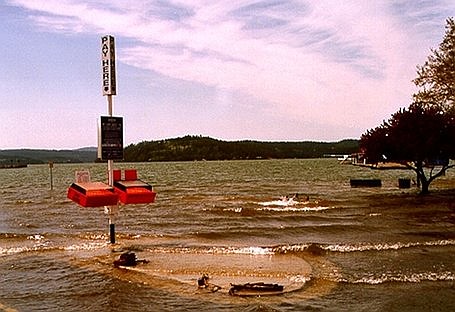
Lake Coeur d'Alene jumped its banks in the spring of 1997, flooding City Beach and the nearby parking lot.
CDA Press file photo
COEUR d’ALENE — Water from swollen tributaries could substantially increase the elevation of Lake Coeur d’Alene as heavy rains continue to impact the Pacific Northwest.
In a Thursday interview with the Press, Patrick Maher explained that “anything above that maximum summer level is considered flooding.”
As of Friday afternoon, the lake’s elevation was measured at 2,126.6 feet — less than 2 feet below its normal maximum summer level, according to Avista's daily report on water flow.
The elevated water levels stem from a powerful weather pattern that has brought above-average precipitation and heavy rain on top of early December snowfall. That combination rapidly increased runoff into the Coeur d’Alene and St. Joe rivers, both of which drain into the lake, overwhelming river channels and spilling into lower-lying areas.
And while winter flooding is not unprecedented in the region, Maher noted that runoff of this magnitude is rare for December and usually occurs in the spring after snowmelt.
Such was the case in the spring of 1997, when Lake Coeur d’Alene spilled over its banks, flooding City Beach and surrounding areas and threatening homes along the Spokane River.
The last winter flooding event of significance on Lake Coeur d’Alene fell on Christmas of 1933, Maher shared, rising over 11 feet above the normal summer level at 2,139.5 feet.
The extent to which the lake's elevation will rise this time will depend on how much water is passing through the Spokane River, its natural outlet restriction. The Post Falls Dam will ultimately pass whatever water flows out of Lake Coeur d’Alene.
Water levels at the Post Falls Dam were measured at 2,121.43 feet Friday, about 6 and a half feet below normal summer level, according to Avista’s daily report on water flow.
“We expect the level of the water above the dam to remain about the same over the next week,” the report read.
Local emergency responses were mobilized this week as the rivers rose. Shoshone County declared a state of emergency Thursday due to flooding in areas along the Coeur d’Alene and St. Joe rivers, prompting road closures, sandbagging efforts and rescue operations. One water rescue was conducted Thursday by Silver Valley Fire Rescue in the North Fork Coeur d'Alene River area.
Looking ahead, rainfall is expected to taper, though Maher cautioned that even as rivers begin to recede, lake levels will likely continue rising toward their maximum.
Temperatures may fall next week, which could bring snow back by the latter half of the month.
ARTICLES BY HAILEY HILL

MAY NIBJ: No 'slow' season with ski season
Winter is often considered a “slow” season for tourist destinations — but that’s not necessarily the case in North Idaho.

APRIL NIBJ Work-life balance emerging as top job priority for employees
Having a “work-life balance” means something different for everyone. For Post Falls resident Niko Salinas, it means being able to leave work behind at his desk at the end of a workday.

Summit highlights restoration efforts in North Idaho
Dam removal expected to open up 14 additional miles of Westslope habitat
A lot of great things are happening in North Idaho, said Kootenai Environmental Alliance board president Dave Muise as he welcomed around 50 attendees to the organization’s third annual Green Summit.