
Weather-beaten Libby awaits results of public water supply tests
HAILEY SMALLEY | Hagadone News Network | UPDATED 3 months, 1 week AGO
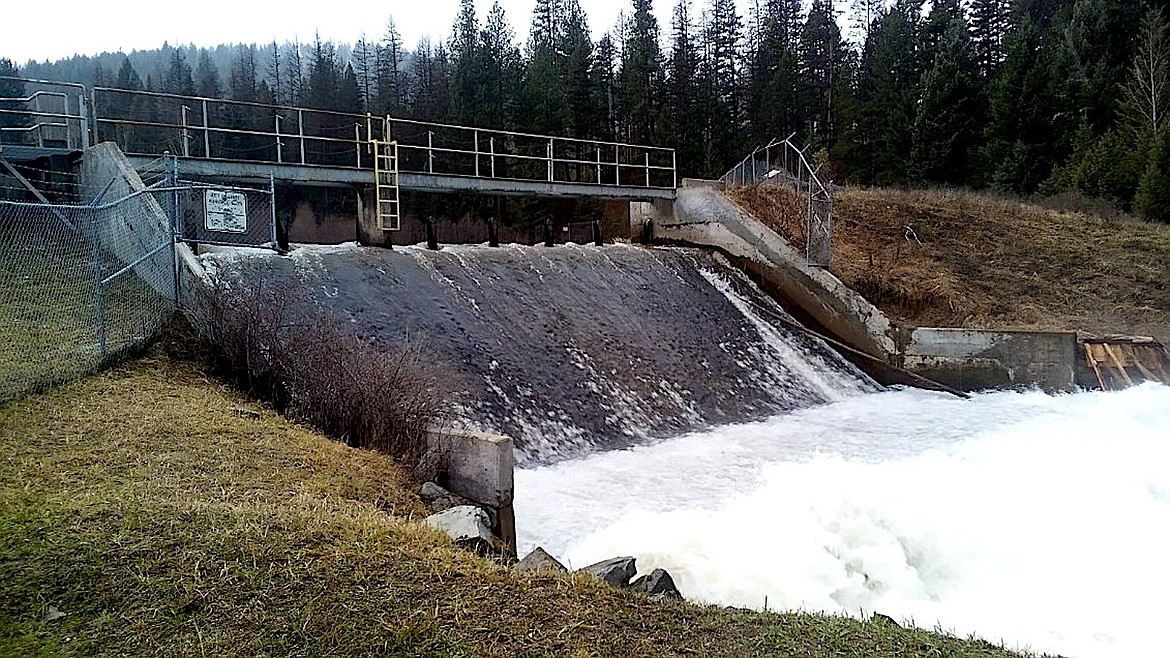
Water from Flower Creek flows over the lower diversion dam on the morning of Wednesday, Dec. 17, 2025. Officials said the facility is stabilized, but an area that washed out on lower right side is cause for further concern. (Scott Shindledecker/The Western News)
A boil advisory remains in effect for Libby residents a week after catastrophic flooding first compromised the city’s sole supply of public drinking water.
More than 1,100 homes and hundreds of businesses and public agencies receive water from the Flower Creek Reservoir above Libby. The manmade lake is controlled by a large concrete dam and a secondary earthen dike. The latter was breached by flood surges for about 12 hours beginning Dec. 11.
Officials implemented a boil advisory that day, citing high levels of turbidity, or cloudiness, in the reservoir. The condition often arises when excess sediments enter waterways.
While turbidity is not dangerous in itself, high-turbidity waters are more difficult to filter and are often associated with disease-causing viruses, parasites and bacteria, according to the Environmental Protection Agency. The risk can be especially pronounced for infants, young children and people with severely compromised immune systems.
Bringing water to a rolling boil kills many of the microorganisms that can cause disease.
Engineers examining the dam noted seepage along one side and soil erosion resulting from the increased water level, said Patricia Spencer, the communications supervisor of the Water Resources Division at the Montana Department of Natural Resources and Conservation.
The water level of the reservoir was lowered by about 2 feet Dec. 14 to reduce pressure on the compromised dam and minimize the risk of a total structural failure. Efforts to stabilize the damaged area continued during the morning of Dec. 15.
The action disrupted hydraulic flow to the city’s water treatment plant and increased turbidity in the water, according to a Dec. 16 request for federal assistance signed by Gov. Greg Gianforte.
The letter stated that officials were concerned about the possibility of metals in the public water supply, even going so far as to state a “do not consume” warning may be circulated if testing revealed unsafe levels of contamination.
“Given the mining history in the area, [the Department of Environmental Quality] is concerned that mixing water in the reservoir may be dislodging sediment with heavy metals that may have been present in the bottom of the reservoir,” said Madison McGeffers, a public information officer for the Department of Environmental Quality.
McGeffers said the state agency requested Libby test the drinking water for 11 inorganic compounds: arsenic, beryllium, antimony, barium, cadmium, chromium, fluoride, mercury, nickel, selenium and thallium. Officials hand-delivered water samples to a lab in Kalispell for testing on Dec. 15 and 16, according to Libby City Administrator Sam Sikes. Results are expected by Friday morning.
“This testing was initiated in coordination with [the Department of Environmental Quality] out of an abundance of caution to confirm that Libby continues to deliver safe and dependable water to its residents,” stated Sikes in an email shared with the Inter Lake.
The reservoir is tested for heavy metals every nine years to comply with state requirements for a public water system permit. Results from the previous two testing cycles show that Libby’s water meets all state and federal safety standards.
Bottled water is currently being distributed from a Red Cross shelter at the Memorial Event Center in Libby.
Nick Holloway, the public affairs officer for the All-Hazards Incident Command Team managing the state disaster in Libby, said widespread power outages have taken priority in recent days. Windstorms toppled trees and powerlines across Northwest Montana starting Tuesday evening. A third of the 6,000 residents in the Libby area were without power Wednesday morning.
“We just need to get through this storm, see where we’re at and reassess,” said Holloway.
PUBLIC SCHOOLS in Libby canceled classes on Tuesday after letting students out early on Monday due to flooding, said Libby Public School District Superintendent Ron Goodman. Classes will resume after Jan. 1.
When school was in session, water fountains were turned off due to the boil advisory, and students were advised to bring their own water bottles to school.
David Nadolny, who works in maintenance for the school district, drove out to the empty McGrade Elementary School where there’s a 165-foot water well. Water in the well was determined to be safe from the contaminated floods due to its depth, Goodman said. Nadolny filled up water containers from the well, loaded them in his pickup truck and distributed the water to the schools.
At the local hospital, there is a substantial inventory of bottled water and ice to meet patient care and staff needs at Cabinet Peaks Medical Center while the boil order remains in effect, said spokesperson Paula Collins in an email to the Inter Lake.
"These supplies have been counted, locations confirmed, and plans are in place to prioritize patients and staff while normal water service is disrupted,” Collins said.
The hospital’s backup generators have enough power to support operations for several weeks in the event of a power outage, Collins added.
ARTICLES BY HAILEY SMALLEY

Winging it through winter: Rare Anna's hummingbird finds shelter in Bigfork backyard
The bird turned out to be an Anna’s hummingbird — a rare find in western Montana. The Montana Natural Heritage Program’s bird distribution database has logged only 158 sightings of Anna’s hummingbirds in the state, including 21 sightings in Flathead County.

Business groups sue to stop proposed ban on political spending in Montana
The Kalispell Chamber of Commerce is one of several organizations to file suit over a proposed ballot initiative to ban corporate spending in politics, arguing it infringes on the free speech rights of businesses.

Mexican man who led deputies on high-speed chase in Kalispell receives federal prison sentence
A Mexican national arrested after a high-speed chase through Kalispell in June 2025 received an 18-month sentence for illegal reentry in federal court last week.