
Advocates challenge city report, call for more housing units
KELSEY EVANS | Hagadone News Network | UPDATED 3 months, 2 weeks AGO
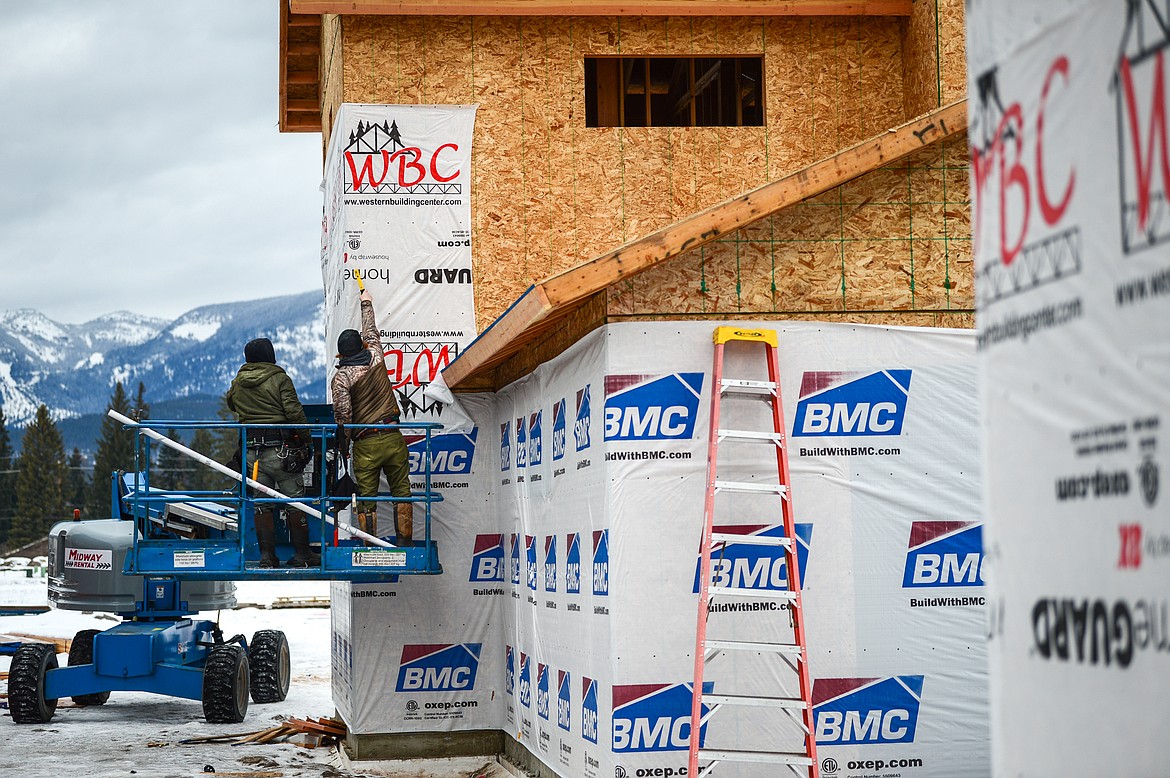
A home under construction at Trailview in Whitefish. (Casey Kreider/Daily Inter Lake FILE)
Whitefish will need to create 930 to 1,500 new housing units by 2035 to keep up with demand, according to a housing needs assessment conducted by the city in August. Yet, one local nonprofit that advocates for more affordable housing says the city’s report grossly underestimates the need for more units.
Shelter WF released its own report last week that claims the city’s assessment captures only 23%-46% of housing needs. Their report says that 3,230 to 4,044 new homes are needed by 2035, so 300 to 400 should be built each year.
“Whitefish must err on the side of overestimating housing need, not underestimating it,” the Shelter WF report states. “Underestimating housing needs has severe consequences.”
The city’s report, the nonprofit claimed, is based on outdated population data, ignores Whitefish’s commuting workforce and sets unrealistic subsidy expectations.
The organization says that underestimating housing needs will only lead to failure.
“The city’s assessment directs us to not change the amount of housing we approve, despite skyrocketing prices,” said Keegan Siebenaler, executive director of Shelter WF.
The Shelter WF report suggests that with higher numbers of housing, the share of rentals requiring subsidy falls to 20-25%, as opposed to the 86% required by the city’s assessment.
Siebenaler said the city needs both robust market-rate construction and expanded investment in subsidized housing
“Blocking housing does not create affordability,” Siebenaler said. “Only building enough homes — of all types — will allow Whitefish to regain its character as a working-class community where everybody can live.”
According to the city’s August 2025 assessment, a critical shortage of workforce and middle-income housing, barriers in planning development, community aversion to growth, unmet needs in senior and accessible housing, and funding gaps are some of the key challenges identified in the city’s report.
The assessment, an update from a 2022 rendition, was made to inform the housing element of Vision Whitefish 2045, the ongoing update to the city’s growth policy.
In its report, Shelter WF acknowledged that raising concerns with the city’s assessment at this time, “is not convenient.”
“The housing element of the growth policy has already been drafted, and the land use element of the growth policy is already well underway,” the report states. “But a study that directs our city to contract the amount of housing it builds, not expand it, is one that demands further scrutiny.”
A discussion of the housing element of Vision Whitefish 2045 is Wednesday, Dec. 17 at 6 p.m. at City Hall. The meeting can be joined virtually on Microsoft Teams.
WHITEFISH’S HISTORIC population growth rate averages about 1.5% annually but accelerated as high as 8% during the pandemic. According to a Montana Department of Commerce model, the growth rate is expected to flatten from 4% to 1% by 2045.
The city’s August 2025 assessment range of 930-1,500 new units is based on the Montana Department of Commerce’s population growth estimates, with a low scenario, 1.25%, middle, and high, 2%.
However, accounting for a rising seasonal population (about 30% of people in Whitefish) that is not included in U.S. Census data would make the growth rate projection 2.6% to 3.23%.
The city’s assessment findings include:
Roughly 19% of Whitefish’s 5,700 housing units are vacant according to the Census definition of vacancy, which includes homes used for seasonal or occasional use.
The city has 404 licensed short-term rental units, representing approximately 8% of total housing inventory.
In the last 10 years, home prices have increased 178% in Whitefish and 150% in Flathead County.
About 61%, or 4,700 employees, commute to Whitefish for work.
As of July 2025, there are 715 new residential units in the pipeline, meaning they are permitted or under construction.
More housing is likely to be built at market rate and achieving even 10-20% of the affordable/attainable housing need would be considered a win.
Given the unpredictability of population and the reality of the market, city planners say the metric is a tool for evaluation rather than a hardline approach.
“Although providing sufficient supply is part of the equation, given the desirability of Whitefish and the cost of land, a successful housing strategy to provide housing for a broader range of income levels must include such measures as addressing the gap between the funding needed to develop and operate a property and the revenue available, often in the form of subsidies to cover construction costs, rents or operating costs,” said Alan Tiefenbach, Whitefish’s long-range planner.
Daniel Sidder, director of Housing Whitefish, said the assessment’s key findings are a good benchmark for representing the challenges Whitefish faces, but implementation on the ground will go further.
“More so than saying the exact number [of units], what I would like to establish and be a part of, is the conversation of how we can be more responsive to housing needs as they change and evolve; and creating a system of housing developers, builders, nonprofits, the city, where we can work in real time to address issues and be nimble enough to change courses when things aren’t working,” Sidder said.
“We certainly know we need more supply, but it’s also cultural, and there’s a lot of external things that we can’t plan for, that will have major impact on housing needs, such as Covid... How we change when things go wrong, says more about the community than the plan.”
The Shelter WF report is online at https://www.shelterwf.org/hna.
The housing needs assessment is online at www.cityofwhitefish.gov/DocumentCenter/View/6103/City-of-Whitefish-2025-Housing-Needs-Assessment.
ARTICLES BY KELSEY EVANS

Solid freshman class to bolster track and field teams past adversity
The sunny and brisk Monday afternoon was a pseudo first day of practice for the Bulldogs, who have to sharpen up quickly after spring break for this weekend’s debut meet: the ARM Invite.

Skimo North American champion hails from Big Mountain
Whitefish eighth grader Porter Shehan skinned, climbed and skied his way to a skimo North American title and a national title this season.
Casual eatery Grouchy Grizzly to open in Whitefish this summer
Whitefish’s Last Chair Kitchen and Bar, a restaurant at Lakeshore Drive and Reservoir Road, has been sold and will undergo a phased transformation, into a casual, fun-focused eatery called Grouchy Grizzly.