
House GOP passes bill restricting Montana voters of “unsound mind”
HAILEY SMALLEY | Hagadone News Network | UPDATED 1 year, 7 months AGO
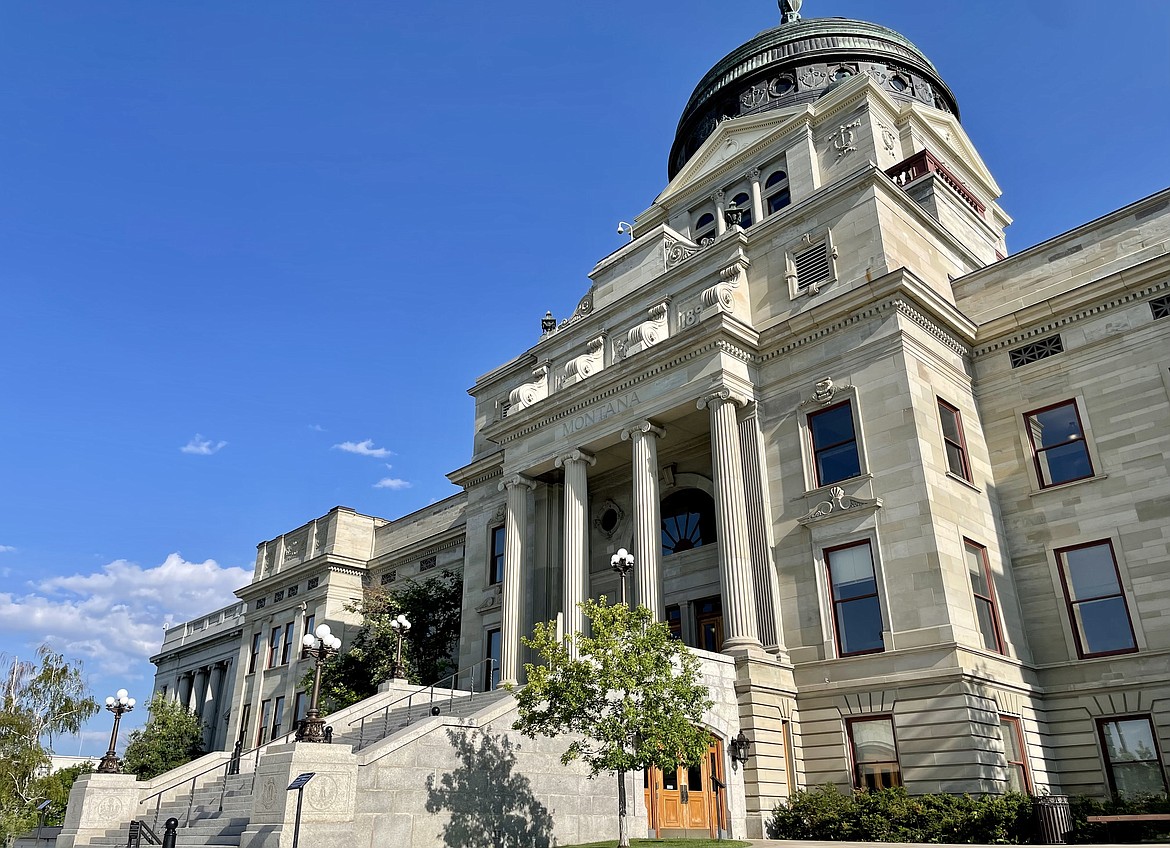
The Montana state Capitol building in Helena on June 16, 2023. (Matt Baldwin/Daily Inter Lake)
A House bill to impose new restrictions on voters of “unsound mind" could affect hundreds of patients in the Montana State Hospital and other state-run facilities.
While Montana code has long prohibited citizens serving sentences in “penal institutions” and those of “unsound mind” from voting, the state has never clarified what these terms mean. Rep. Braxton Mitchell, R-Columbia Falls, said the omission creates a work-around in the voting system for patients serving felony convictions in the Montana State Hospital.
“This bill simply prevents convicted felons from exploiting a loophole that has allowed them to vote,” said Mitchell in his opening remarks for House Bill 395.
The Department of Justice requested the bill after a patient serving a felony conviction at the Montana State Hospital filed a lawsuit last fall, claiming Anaconda-Deer Lodge County had violated his voting rights. The case remains unresolved, but a district judge temporarily restored the plaintiff’s voting rights for the 2024 election after the state Attorney General’s Office admitted that the hospital did not fit the definition of a penal institution and that a court had not found the plaintiff to be of unsound mind.
HB 395 targets similar cases by codifying new definitions for the terms “unsound mind” and “penal institution” in state voting laws and outlining a court process by which defendants may be declared of unsound mind.
While Republicans supported the legislation as a simple solution to a long-term problem, Democrats likened the bill and its implications to Pandora’s box. Of particular concern was the bill’s definition of unsound mind.
“‘Unsound mind’ means a person is incapable of normally managing affairs in a reasonable manner,” reads the bill. “The condition exists when the intellectual powers of a person are fundamentally lacking or when a person is incapable of understanding and acting with discretion in the ordinary affairs of life.”
As currently written, the definition would only be applied to residents at state facilities like the Montana State Hospital. The bill also includes a provision automatically restoring voting rights upon release, but Democrats remained skeptical.
“This gives a lot of power to the courts to decide who can and cannot vote,” said Rep. Peter Strand, D-Bozeman. Strand questioned whether people with dementia and similar illnesses might be considered unfit to vote.
Rep. James Reavis, D-Billings made similar observations in testimony, noting that the bill did not provide protections for patients in state facilities without criminal convictions and that the restoration provision could be easily rescinded in a future legislative session.
“We could be on the path to permanent disenfranchisement of voting rights, and I don’t think that’s something we should do,” said Reavis.
Mitchell claimed other state laws had no issues implementing similar definitions. In email correspondence with the Daily Inter Lake, Mitchell cited Idaho and Utah as examples though neither state references individuals of unsound mind in state voting laws. He also mentioned Minnesota, which has a statue stating that individuals “found by a court of law to be legally incompetent” cannot vote, but Minnesota voting codes do not define the term “legally incompetent.”
Mitchell did not directly respond to an inquiry about possible amendments to the definition, though he maintained his assertion that the claims of opponents are unfounded.
The bill passed the House in a 54 – 45 vote on Monday. A hearing in the Senate has not yet been announced.
Reporter Hailey Smalley can be reached at [email protected] or 758-4433.
ARTICLES BY HAILEY SMALLEY

Trump stumps for Flint in Kalispell as Election Day nears
President Donald Trump, wearing a dark suit, red tie and red USA cap, ambled into the Majestic Valley Arena to the raucous roar of a crowd.
Flathead National Forest greenlights Swan Valley timber project
A 2,307-acre timber project is now under way in the Swan Valley.
Flathead National Forest greenlights Swan Valley timber project
A 2,307-acre timber project is now under way in the Swan Valley.