
Northwest Montana snowpack trending ahead of normal
MATT BALDWIN | Hagadone News Network | UPDATED 1 year, 9 months AGO
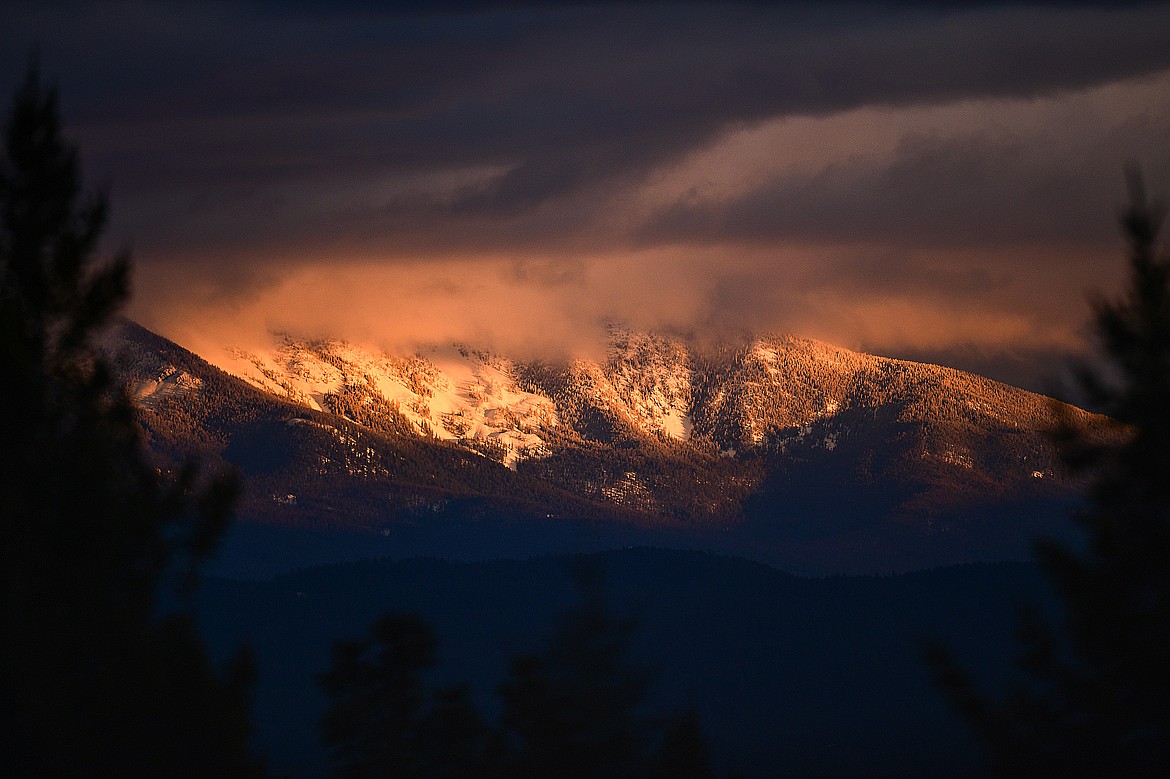
Alpenglow on the Swan Range on Monday, Dec. 23. (Casey Kreider/Daily Inter Lake)
Hagadone Media Montana REGIONAL MANAGING EDITOR Matt Baldwin is the regional editor for Hagadone Media Montana, where he helps guide coverage across eight newspapers throughout Northwest Montana. Under his leadership, the Daily Inter Lake received the Montana Newspaper Association’s Sam Gilluly Best Daily Newspaper in Montana Award and the General Excellence Award in 2024 and 2025. A graduate of the University of Montana School of Journalism, Baldwin has called Montana home for nearly 30 years. He and his wife, Sadie, have three daughters. He can be reached at 406‑758‑4447 or [email protected]. IMPACT: Baldwin’s work helps ensure Northwest Montana residents stay connected to their communities and informed about the issues that shape their everyday lives. | January 8, 2025 11:00 AM
Northwest Montana’s mountain snowpack is trending ahead of average to begin the year, offering a stark contrast to the dire drought that plagued the region last winter.
The Flathead Basin snowpack was at 105% of the median on Jan. 1, while the Kootenai and Lower Clark Fork basins were boasting snowpacks of 117% and 125%, respectively.
A year ago, the Flathead Basin was at 53% of median in January.
The region benefitted from a Pacific deluge in early November, along with the latest snowy onslaught between the Christmas and New Year's holidays. Upper elevations across Northwest Montana have received up to 36 inches of snow since the end of December.
"“Dry conditions persisted for the first half of December throughout most of Montana until the tide began to turn just before the New Year with a true winter system bringing much needed snow to the region,” said Eric Larson, USDA Natural Resources Conservation Service hydrologist.
The Swan Range is holding the most snow, with Noisy Basin's snowpack at 147% of normal. The weather station at 6,040 feet in elevation already shows 95 inches of snow depth.
Moss Peak in the Mission Range boasts 76 inches of snowpack, which is 129% of normal. Meanwhile, the northern Whitefish Range is holding 64 inches of snow depth on Stahl Peak near Eureka, and Flattop Mountain in Glacier National Park is holding 61 inches.
Valley locations, however, present a different scenario. Kalispell recorded its fourth warmest December on record with a mean temperature of 31.3 degrees -- more than 7 degrees above normal. The coldest temperature came Dec. 2 when the mercury dipped to 11. The city has yet to record a low in the single digits this winter.
Meanwhile, less than 3 inches of snow fell in the city last month, ranking as the ninth lowest December total on record. Normally, Kalispell sees about 16 inches of snow in December.
January is off to a more wintery start, with about 5 inches of snowfall so far in Kalispell this month.
While drought conditions are no longer present across most of Northwest Montana, the state's water supply outlook report for January cautions that last year's dry winter could have lingering effects into this spring.
"A below-normal snowpack during the previous season can result in reduced soil moisture and low streamflow levels leading into the current season," the report states. "In such cases, as the snow melts in the spring, the soil may absorb much of the water, potentially reducing available surface water."
Normal to above-normal snowpack conditions this winter will be necessary to offset last year's drought, the report adds.
Looking ahead, the federal Climate Prediction Center shows above normal precipitation for January with temperatures near normal -- a combination that would bolster snowpack moving deeper into the winter.
"There is still a significant portion of winter ahead, and snowpack conditions can change substantially between now and when they are most critical," the forecast report states.
In Montana, the mountain snowpack generally peaks in April.
ARTICLES BY MATT BALDWIN

Region's residents flock to Kalispell for Trump appearance
Slyvia Timboe, 76, said it was the chance of a lifetime to see President Donald Trump speak in person. It took her just 20 minutes to drive to Majestic Valley Arena in Kalispell on Wednesday, where the president was scheduled to speak as part of a country-wide tour to stump for Republican candidates ahead of the midterm election.
Suspect arrested after Whitefish standoff involving SWAT, K-9
A suspect was arrested in Whitefish on Saturday evening following a standoff involving multiple law enforcement agencies and a K-9 unit.
Western Montana on track for season's first winter storm
It's time to pull out the ice scraper and shovel and put away the garden hose.