
Moses Lake students prepare to head to Japan
JOEL MARTIN | Hagadone News Network | UPDATED 1 year, 3 months AGO
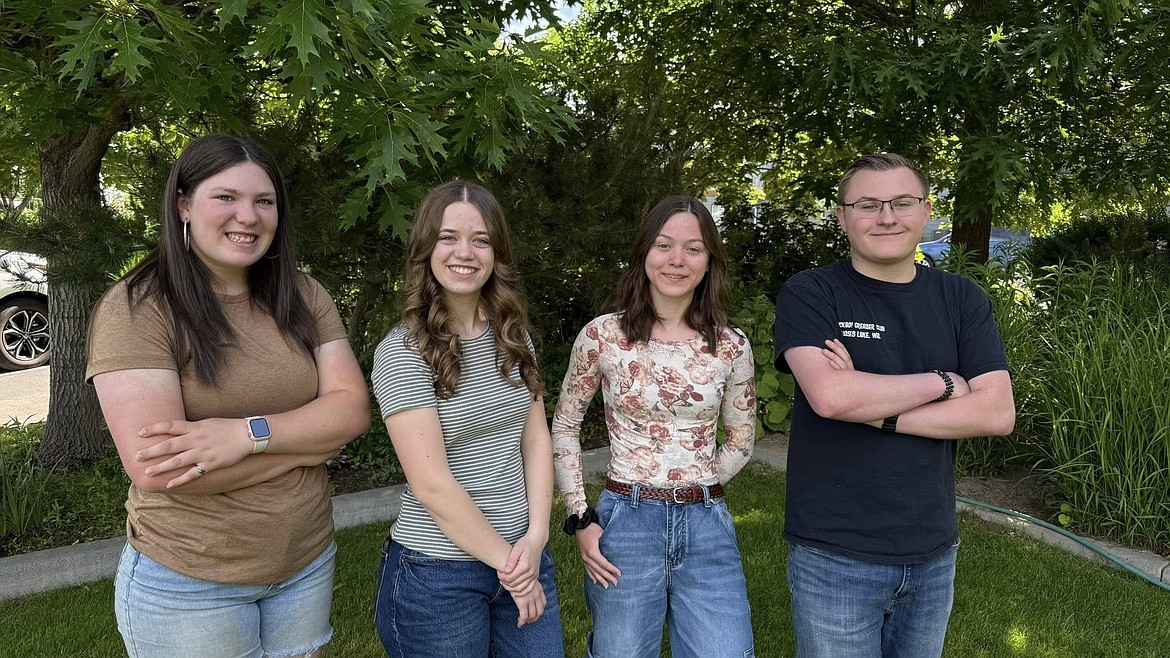
From left: Jenna Baker, Paisley Ashton, Abbi Towne and Donovan Johnson. Ashton, Towne and Johnson are the students selected for the exchange this year to Yonezawa, Japan; Baker is an alternate.
COURTESY PHOTO/MOSES LAKE-YONEZAWA SISTER CITY EXCHANGE
Joel Martin has been with the Columbia Basin Herald for more than 25 years in a variety of roles and is the most-tenured employee in the building. Martin is a married father of eight and enjoys spending time with his children and his wife, Christina. He is passionate about the paper’s mission of informing the people of the Columbia Basin because he knows it is important to record the history of the communities the publication serves. | July 4, 2025 3:00 AM
MOSES LAKE — Three Moses Lake students will head to Japan this month as part of the Moses Lake-Yonezawa Sister City Exchange.
“A lot of people don’t realize that this cultural exchange has been going on for 45 years,” said Moses Lake-Yonezawa Sister City Exchange Program Treasurer Terry Moore. “Everybody knows Yonezawa Boulevard (in Moses Lake), but do they know why it’s called Yonezawa Boulevard? It’s because of the sister city program.”
Paisley Ashton, Abbi Towne and Donovan Johnson are scheduled to fly to Yonezawa, Japan, on July 25 and come back Aug. 4, according to an announcement from the sister city exchange program. A fourth student, Jenna Baker, is designated as an alternate in case one of the other three can’t go.
The American students will spend 10 days in Yonezawa, doing things like visiting a temple, climbing Mount Nishi-Azuma, learning to make noodles and riding a bullet train. Then Aug. 7-16, three students from Yonezawa will make the same trip to Moses Lake, visiting the city hall and police department and experiencing the Grant County Fair and Moses Lake Roundup Rodeo.
The students will stay with one another’s families during the exchange, Moore explained, so they learn about each other’s culture from the inside and form friendships as well.
“We’re still in contact with the girl who stayed with us in 2002,” she said. “I get pictures of her babies all the time.”
The sister city program pays all the expenses for the student exchange, including airfare and activities. In the past that’s been done through a fundraising auction, but it wasn’t feasible this year, according to a letter from Moses Lake-Yonezawa Sister City Exchange Program President Amador Castro. Instead, the students have held their own fundraisers, Moore said.
“This year they did a popcorn sale,” Moore said. “They just had a fundraiser at Aim Gymnastics, a parents’ night out, where people dropped their kids off (for babysitting).”
More fundraisers are planned, Moore said, and donations can be made online. The program is open to Moses Lake students in grades 9-11. Applications for next year’s exchange will open in the fall.
Moses Lake and Yonezawa have one of the longest-running sister city relationships in Washington, dating back to 1978, according to the program’s website. The student exchange was established in 1981 between the Moses Lake-Yonezawa Exchange Program and the publisher of the Yonezawa Shinbun newspaper, but like so many things, it was shuttered during the COVID-19 pandemic. Soon after, the publisher of the newspaper passed away, leaving nobody to coordinate the exchange from the Japanese end for several years. That job was taken up last year by the Yonezawa International Relations Association. This year’s contingent is the second since the pandemic, Moore said.
The program would love to have some more volunteers to help put together an auction next year, Moore said, as well as getting the word out to the community and to students who might like to participate.
The program has sent hundreds of Moses Lake students to Japan over the years, some of them from the same families, Moore said.
“We’ve had students over there whose brothers and sisters have come, and we’ve had students here whose brothers and sisters have gone through the years,” she said.
Donations to help support the program can be made at https://bit.ly/YonezawaExchange25.
ARTICLES BY JOEL MARTIN

Endless battle
Noxious Weed Control Board works to keep invasive plants under control
MOSES LAKE — Some of the nastiest plants in Grant County were the topic of a class led by Jay Johnson, a consultant with the Grant County Noxious Weed Control Board, Tuesday. The Noxious Weed Control Board, as its name would suggest, is tasked with keeping weeds under control in Grant County. That’s not a small job; the board’s website lists 129 species of noxious weeds that are found around Grant County. A noxious weed is defined as an invasive, non-native plant that threatens agricultural crops, local ecosystems or fish and wildlife habitat, according to the Noxious Weed Control Board. Washington state law requires that these weeds be identified and their spread kept to a minimum, if not completely eradicated. “We’re one of those agencies a lot of people don’t really understand,” Johnson said. “We’re a county office and … our funding is tax-based assessment. When you get your tax bill and you look down at all the expenses that you pay for, there we are.”

BASIN EVENTS: Oct. 16-24
COLUMBIA BASIN — Whether you feel like shopping, crafting, learning or seeing a show, there’s something happening for you this week in the Basin. Oct. 16 ‘My Family (Mi Familia)’ screening Spanning three generations, “My Family (Mi Familia)” is a heartfelt drama that follows the Sánchez family as they build their lives in East Los Angeles. Through love, hardship, triumph, and sacrifice, the film explores the immigrant experience, the strength of family bonds, and the traditions that connect one generation to the next. Lowrider show and taco truck before the screening. Sponsored by Columbia Basin Allied Arts, EDUBS C/S and the Moses Lake Creative District. $12 per person. Doors open at 6 p.m., film begins at 7 p.m. at the Moses Lake Civic Center Auditorium, 401 S. Balsam St. Tickets and info: www.cba-arts.org.

Moses Lake author encourages women to look beyond church culture norms
MOSES LAKE — A Moses Lake author’s book, “A Christian Woman Striving to Live Her Faith in a Man-Controlled World,” takes aim at the role to which many churches relegate the female half of their congregations. “It’s to encourage women in the faith,” Linda Curran said. “A lot of churches say, ‘Teach Sunday school, do this, do that, but don’t (evangelize.)’" In her book, Curran recounts a time when she moved to a new community and joined a church there. She was surprised to learn that, as a new female member, she had been automatically assigned church cleaning duties. When she questioned it, she wrote, she was met with condescension and her objections were brushed aside. In other churches, she said, women who were capable of teaching were relegated to “women’s ministry.”