
Grizzly expert looks for coexistence after penning book on 40-year Flathead study
KELSEY EVANS | Hagadone News Network | UPDATED 8 months, 3 weeks AGO
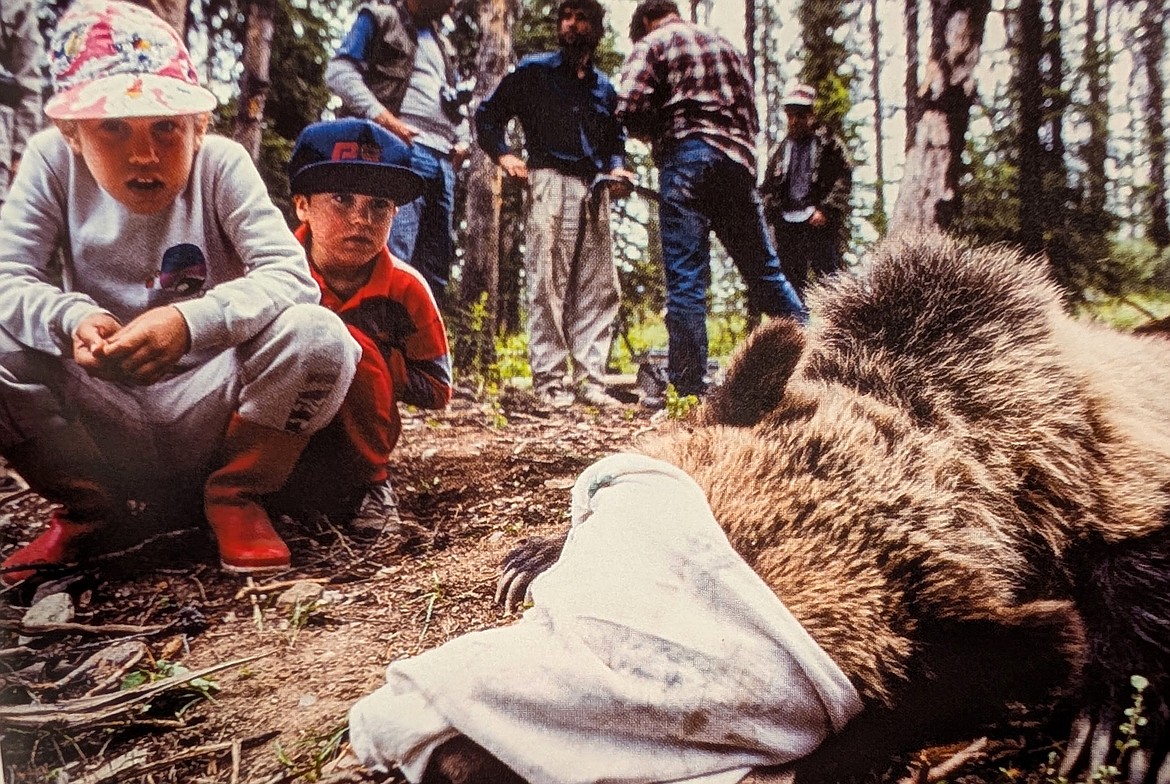
In this photo in the book taken by David Shackleton, the author's children, Michelle and Charlie, then eight and six years old, look at a grizzly during a media day. Both are now scientists themselves.
There are few places on Earth where grizzlies thrive. Even fewer are the places in which a human can reliably observe and study the bears.
In 1978, grizzly scientist Bruce McLellan embraced that challenge, and set out to live in the North Fork to answer one question: Why do bears do what they do?
Over the next four decades, McLellan radio collared over 200 bears. All the while, he and his partner Celine raised two young kids, first living in a cabin in the North Fork, and then in other areas in British Columbia and Alberta.
Between daily bushwacking and beater ski ventures, overcoming fires, floods and avalanches, and encountering all sorts of bears in unexpected places and states, McLellan said it's the stories of the people that are at the heart of his book.
The book, called “Grizzly Bear Science and the Art of a Wilderness Life: Forty Years of Research in the Flathead Valley,” was published in 2023 with the aim of making grizzly science more approachable for the public.
The book was the topic of a discussion at a well-attended speaker series hosted by Glacier Two-Medicine Alliance at the Whitefish Community Center on June 11.
Among many findings, McLellan discussed grizzly mortalities within 42 years of research in the Flathead Valley study, with the region encompassing both Northwest Montana and the Canadian Flathead.
Of the radio collared bears in his study, the vast majority of mortalities came from people, and most were within 170 yards of a road. Of 18 female deaths, five died of natural causes, four were killed legally by hunters, and nine were shot and killed by people for reasons other than hunting. Of 16 male deaths that he recorded, all but one were human caused.
As for natural mortalities, most bears were killed by other bears, primarily adult males. Few bears die of old age, even fewer starve.
McLellan noted that several bears killed by non-hunters were not reported to agencies.
According to Montana Fish, Wildlife and Parks, the agency has a reporting rate of 44% in the Northern Continental Divide Ecosystem.
“We see high reporting rates for just about all causes of death except natural, people need to happen upon a dead bear in those instances, and poaching,” clarified Dillon Tabish, the state agency’s communication and education manager for Region 1.
That number is also “completely independent of management removals, which we know are 100% reported because we are involved in the mortality,” he said. “Given that removals are usually our biggest category, the unreported mortalities end up being relatively small numbers each year.”
MCLELLAN pointed to the Elk Valley, where there are higher densities of bears and people in certain places, to exemplify that grizzly and human populations in the Flathead Valley can coexist as both populations grow.
“People are getting along, we can do it. It’s an encouraging sign,” he said.
McLellan emphasized, however, that coexistence – especially in areas where grizzlies are just now being introduced – will take great effort in management and securing attractants.
He also noted that in his findings, grizzly population trends were driven more by the abundance of berries rather than human-caused mortalities. In the future, climate change and extreme weather could lead to boom-and-bust berry and bear cycles, he wrote in the book.
“The future is bright if conditions remain similar to those of the past half century,” he wrote, “and in particular, if road access continues to be limited, and most importantly, if there are no permanent settlements. Let’s hope that government blunders of privatizing lands in remote areas are forever finished.”
Since retiring, McLellan’s study has continued under the hands of Garth Molwat.
“Fortunately, younger, smarter and stronger people were there, perhaps like saplings, just waiting for old trees to topple,” he concluded on his succession.
The book is available for purchase at Bookworks in Whitefish and online.
ARTICLES BY KELSEY EVANS
Solid freshman class to bolster track and field teams past adversity
The sunny and brisk Monday afternoon was a pseudo first day of practice for the Bulldogs, who have to sharpen up quickly after spring break for this weekend’s debut meet: the ARM Invite.
Skimo North American champion hails from Big Mountain
Whitefish eighth grader Porter Shehan skinned, climbed and skied his way to a skimo North American title and a national title this season.
Casual eatery Grouchy Grizzly to open in Whitefish this summer
Whitefish’s Last Chair Kitchen and Bar, a restaurant at Lakeshore Drive and Reservoir Road, has been sold and will undergo a phased transformation, into a casual, fun-focused eatery called Grouchy Grizzly.