
MLSD takes preliminary look at 2025-26 finances
NANCE BESTON | Hagadone News Network | UPDATED 1 year, 2 months AGO
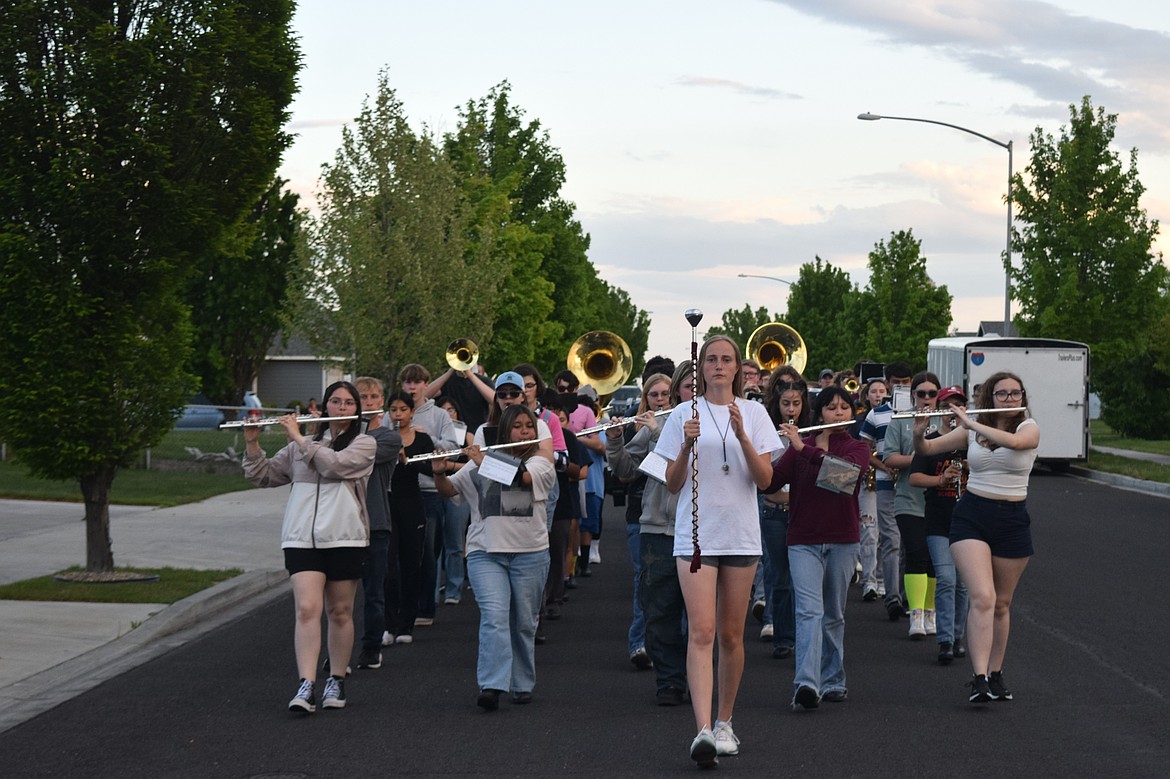
Moses Lake High School Marching Band teacher Pablo Hernandez leads students down Leanne Avenue in May. Activities like band and sports teams have been funded for next year in keeping with promises made by Moses Lake School District leadership during this spring's levy election.
FILE PHOTO
MOSES LAKE – The Moses Lake School District board held a special meeting Thursday to discuss preliminary budget numbers.
“Tonight, we are going to do a fairly high overview of our budgeting process, and then some of the aspects, particularly around our revenue,” Superintendent Carol Lewis said.
There were discussions on potential enrollment, revenues and expenditures. Business Manager Ruby Perez let the board know that current numbers are preliminary because there is still a lot of information missing from the state and federal funding standpoints.
Enrollment
The district is budgeting for 8,242.9 students for the 2025-26 school year.
“Enrollment is the biggest piece to developing the budget,” Perez said. “It is the biggest piece developing the budget. I like to be very conservative but given the history of Moses Lake and the fact that the decline was unexpected, and everything that's going on. I met with (Lewis), and we decided to meet in the middle when it came to enrollment, because I could have gone extremely conservative.”
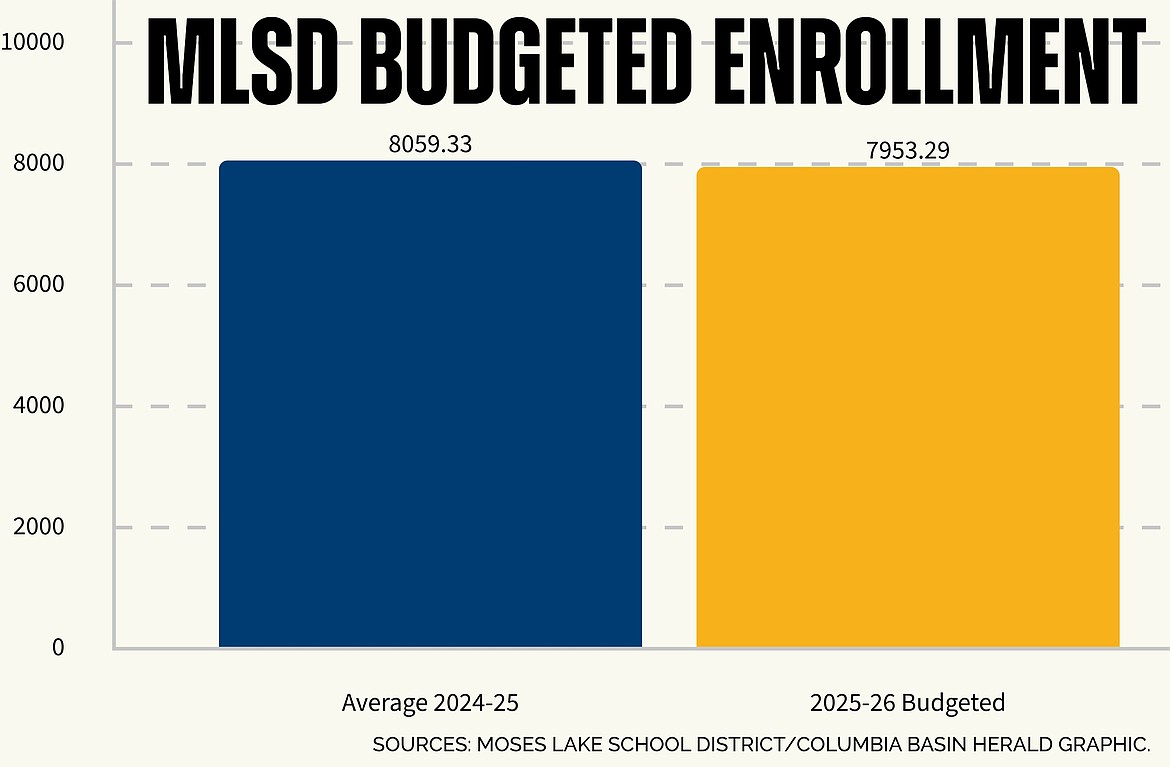
Last year’s average enrollment was 8,059.33, not including career technical education and running start students. Perez said she has budgeted for a 1% decrease from last year, which would bring the anticipated enrollment to 7,953.29 students without the CTE enrollment included there.
Last year, there was an average of 273.66 Running Start non-CTE students and 21.25 Running Start CTE students. This year, Perez has budgeted for 267.55 Running Start non-CTE students and 22.06 Running Start CTE students.
“We kind of went up a little bit (in Running Start),” Perez said. “We're thinking that given the offerings that we have, we might have more of those students coming back next year, is what we're hearing. So, we didn't want to go too conservative with that.”
Last year, the district budgeted conservatively at 8284.41 students, and the actual enrollment was 8354.25 students, or 69.84 more students than projected. Enrollment is considered a full time student for the entire year, so student who only attend a portion of the year lead to portions of students included in enrollment data.
“From those enrollment numbers, it then generates revenues for you. Estimated revenues based on all the decisions that the state has made,” Perez said. “This is exactly where we started to get our revenue numbers.”
Revenues
Perez said she then plugged in the estimated 8,242.9 students into various forms to get preliminary revenues. Perez said she is anticipating around $10.23 million in levy and Local Effort Assistance monies, about $119.8 million in state funds, and around $9.8 million in federal funds. In total, the district is budgeting around $140 million in revenues for the upcoming school year.
Breaking that down further, Lewis said the district is expecting local funds of around $5.9 million from levy monies and $4.3 million from LEA funds to make the $10.23 million.
Going into state funds, the district is expecting around $119.9 million from various sources. This breaks down into eight categories of money. Lewis explained that several of these categories are very restricted where funds can be spent.
General apportionment is around $83.4 million. Special Education is around $20.3 million. The Learning Assistance Program – state funding for students who are falling behind somehow – is about $6.2 million. Transitional Bilingual brings in about $1.9 million from Washington. The Highly Capable program brings in around $263,000. Transportation operations garners about $5.6 million. Early Learning gets about $1.3 million. Then National Board Stipends gives the district around $780,000.
Federal funds are less certain, Lewis explained. As of now, the school district is only budgeting around $9.8 million in federal funds. These include about $1.8 million for special education, around $3.4 million for Title 1, Part A and about $4.6 million for nutritional services.
Lewis said there are five uncertain federal revenues totaling about $1.42 million that the school district isn’t even going to consider in their budget.
“We're not planning for any of this,” Lewis said. “It would be a nice happy surprise if we got any or part of these funding sources, but we're not planning on them.”
The five include Title I, C-Migrant Program for $372,000, Title II-Professional Development for Teachers for $318,000, Title III-English Learner Program for $164,000, Title IV-Healthy Schools and Technology for $224,000 and OSSI Grants for School Improvement for $366,000.
Expenditures
Perez said the priorities for expenditures are levy promises, staffing needs and materials, supplies and operating costs.
“Thank you again for your support, and we're going to do things that we said we're going to do with this money, so that's why that was listed first on Ruby's priority list,” Lewis said.
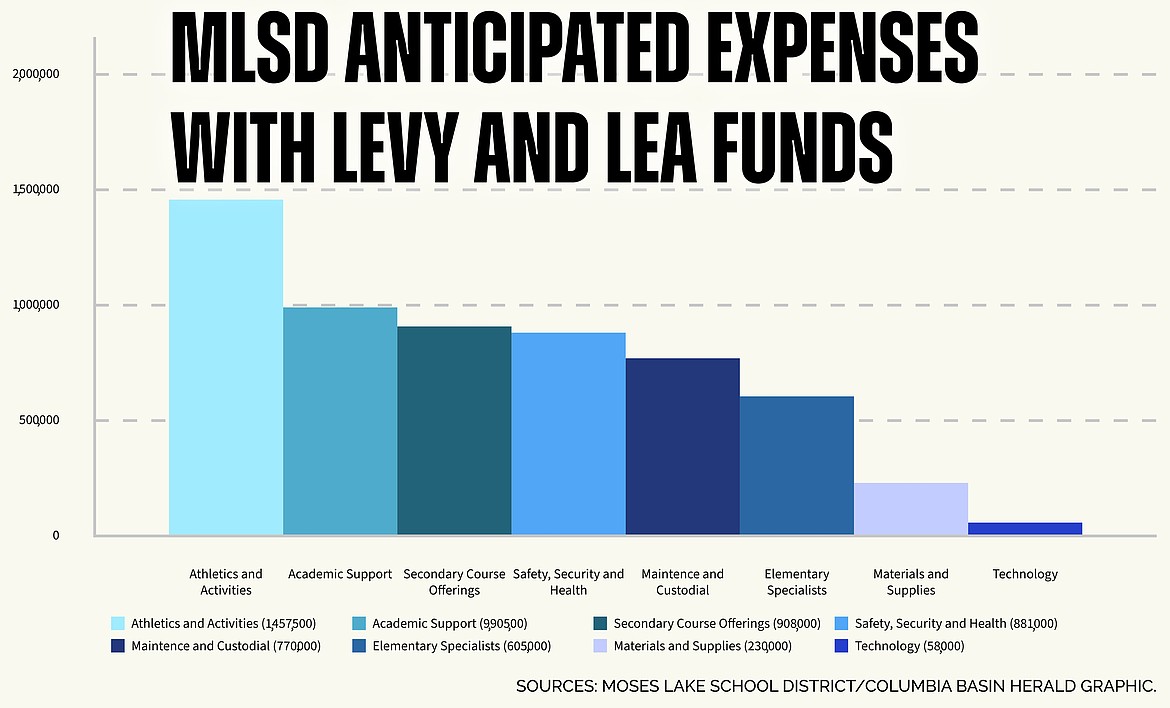
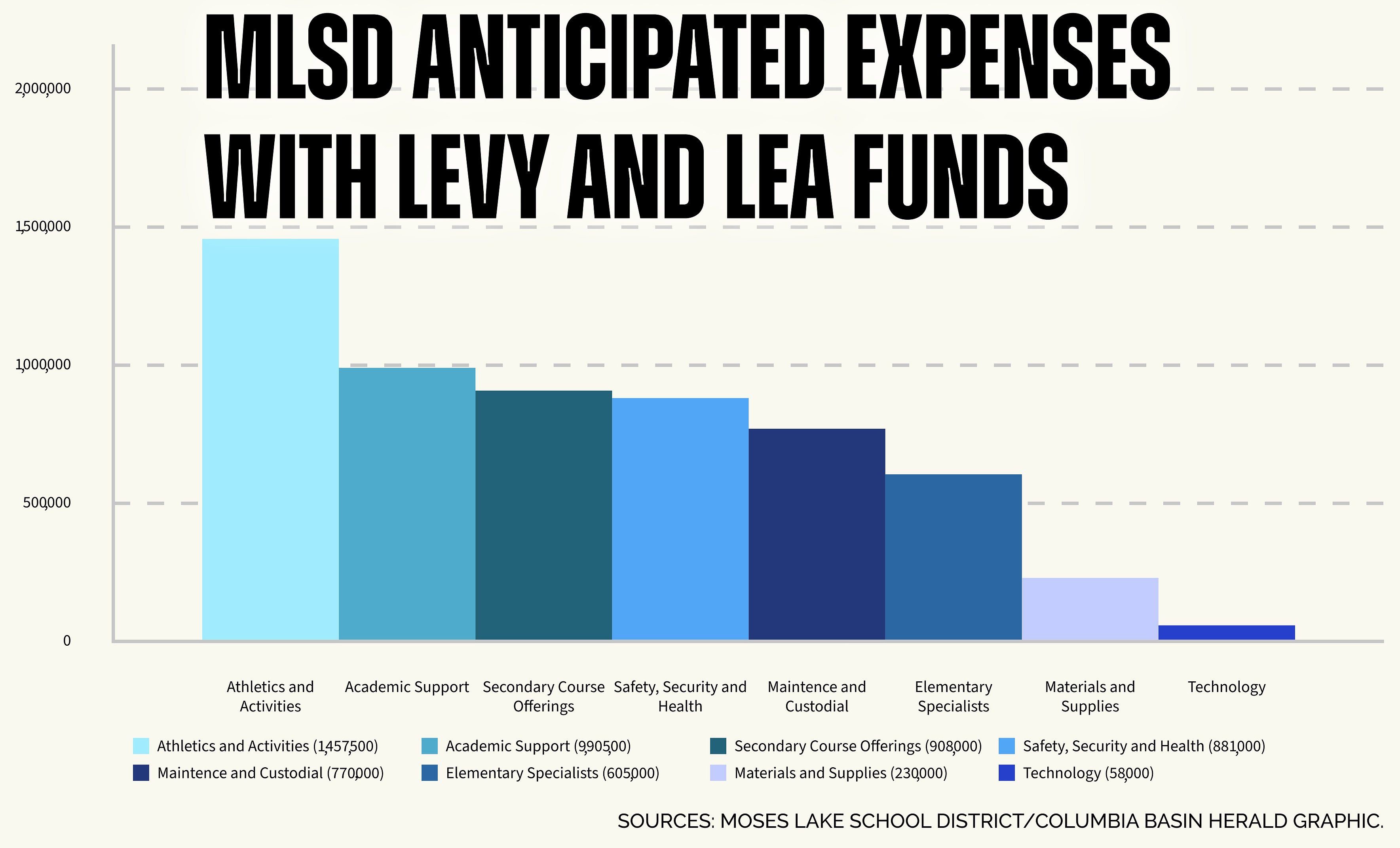
Athletics and activities will cost most of the levy funds, with around $1.5 million going to full pay for athletic coaches and club advisors and then additional materials, supplies and software needed for athletics and activities.
Around $990,500 of expenditures will go to academic support, which includes adding more paraeducators and supporting the Boys & Girls Clubs.
About $908,000 will go to secondary course offerings and adding six secondary teaching positions to support middle and high school courses in career and technical education, science, math and music.
Safety, security and health will cost around $881,00,0 which will continue funding health room paraeducators, school resource officers and security staff. This was one of the only categories that didn’t lose funding with the double levy failure last year.
There will be a cost of about $770,000 to maintenance and custodial which will increase custodial and maintenance hours at all locations around the district.
Elementary specialists will cost around $605,000 for the addition of two physical education teachers, two more music teachers and a focus on equitable services at all elementary schools.
Materials and supplies will cost around $230,000 and increase the supply budgets for all schools and departments.
Technology will cost around $58,000 and will allow the district to purchase internet monitoring software that will allow students to use instructional technology at home.
Lewis reiterated that this is preliminary information that is subject to change. She proposed that the board come up with another date for a follow-up special meeting to evaluate these numbers as things are finalized.
The final budget for the district is due Aug. 31. Lewis said the board will be hearing the final budget proposal at the Aug. 21 regular school board meeting.
MLSD Revenues
Local
Levy $4,332,118
Local Effort Assistance $4,332,118
State
General Apportionment $83,358,575
Special Education $20,295,213
Learning Assistance Program $6,221,478
Transportation Operations $5,649,504
Transitional Bilingual $1,947,133
ECEAP (Early Learning) $1,326,530
Highly Capable $262,848
National Board Stipends $780,004
Federal (Expected)
Nutrition Services $4,589,592
Title 1, A $3,406,398
Special Education $1,841,422
Federal (Uncertain)
Title I, C – Migrant Program $372,000
Title II – Professional Development for Teachers $318,000
Title III – English Learner Program $164,000
Title IV – Healthy Schools and Technology $224,000
OSSI Grants to School Improvement $366,000
ARTICLES BY NANCE BESTON
State burn ban ends; aid sought for E. Washington
OLYMPIA — Washington's statewide outdoor burn ban is scheduled to end Oct. 1, but state fire officials caution the end of the restriction should not be mistaken for the end of fire season. Washington Dept. of Natural Resources Public Information Officer Ryan Rodruck said the state is still waiting for a season-ending rainfall event. “Just because the burn ban is ending does not mean that the fuels out there will not still carry fire,” Rodruck said. “They absolutely will. The chance of large, costly fires has decreased significantly, but we will still continue to see fire on the landscape, potentially, for the next few weeks. We urge community members to use caution and follow local guidelines with any burning they may do following the end of the burn ban.”
Falstad, Homesley outline approaches to election security, public trust
EPHRATA — As Election Day approaches, questions about election integrity, ballot security and public trust remain at the forefront of political discussions across the country. For the fourth installment of the Columbia Basin Herald’s five-part candidate Q&A series, auditor candidates Shannon Falstad and Darci Homesley were asked: “Election administration has become increasingly scrutinized in recent years. What is the most important thing Grant County voters should know about how local elections are conducted, and what additional steps, if any, would you take to strengthen public confidence in the process?”
Soap Lake seeks input on 20-year growth plan
SOAP LAKE — Soap Lake residents will have multiple opportunities over the coming months to help shape the city's future as officials work to update the community's comprehensive plan, a document that will guide growth, housing, infrastructure and development decisions for the next 20 years. The city is hosting a five-part workshop series beginning Thursday at the Soap Lake Community Center, where residents can learn about proposed changes and provide feedback on topics ranging from housing and economic development to transportation, parks and development regulations. City Planner Alex Kovach said the comprehensive plan serves as the community's roadmap for future growth.