
Workforce costs, litigation may challenge timber harvest increases
KELSEY EVANS | Hagadone News Network | UPDATED 8 months AGO
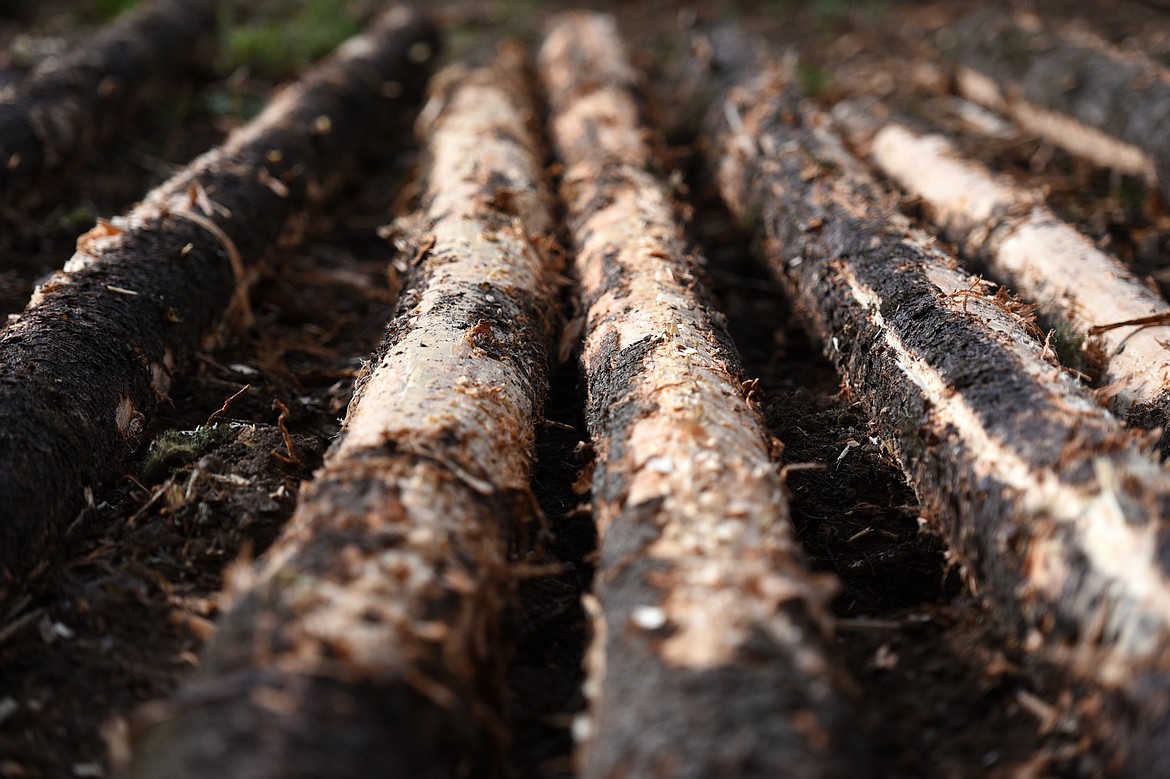
Delimbed logs from the Flathead National Forest are shown in this Daily Inter Lake file photo.
Casey Kreider
Montana and the Forest Service signed an agreement this month to jointly select large-scale management projects to increase the scope of timber production on federal lands.
The agreement establishes a framework to “dramatically increase the pace and scale” of forest restoration, wildlife risk reduction and sustainable timber production, Forest Service Chief Tom Shultz said.
The agreement commits to harvesting an annual sustainable volume of up to 100 million board feet, helping to meet President Trump’s order requiring federal agencies to increase timber production by 25%.
The agreement also includes plans to develop a 200,000-acre project in Northwest Montana.
Julie Altemus, executive director of the Montana Woods Products Association, believes the agreement will accelerate partnerships of the Good Neighbor Authority, which allows state foresters to do critical work on federal land.
It’s a success in taking jurisdiction back to the state level, she said, adding that in her opinion Good Neighbor Authority projects provide a smoother process with less litigation.
A limited workforce for the timber and wood products industry will continue to be the challenge, she said.
The Flathead National Forest will look to keep up with increased timber sales, but the agency has had staff cuts of 25-30%, the Hungry Horse News reported last week.
The Forest Service will also undergo restructuring soon, as Department Agriculture Secretary Brooke Rollins announced last week that the Forest Service will eliminate its nine regional offices.
The Forest Service budget released this month will cut $391 million for fiscal year 2026, although some cut funds will go toward the new U.S. Wildland Fire Service.
A MORE RELIABLE timber supply would be a boost, said Paul McKenzie, vice president and general manager of F.H. Stoltze Land & Lumber Co.
Plus, there is no shortage of land across the state that would benefit from more management, he said.
“Right now, if we have 9-12 months' worth of timber under contract, that’s a good number,” he said. “But it would be nicer to have 3-4 years under contract, to give us stability to be able to make longer-term investments.”
McKenzie said that more stability in the supply would bring similarities to Canada’s timber industry.
“In Canada, the government pretty much guarantees that a mill is going to have what they need,” he said. “It all comes down to supply. If we can reduce that element of risk out of the equation, it allows us to focus on other challenges, and solutions: technology, labor development and markets.”
THE STATE’S AGREEMENT comes on the heels of the proposed recension of the Roadless Rule, which aims to remove protections from 1.1 million acres in Northwest Montana.
However, protections cannot be formally rescinded from Inventoried Roadless Areas without first going through a public participation process and a judicial review, which would start in October.
If the roadless rule is formally rescinded, loggers in Montana won’t be jumping to develop those remote areas, said Beth Dodson, University of Montana forestry professor.
“It is not economical to manage commercial timber harvest in those areas,” Dodson said, describing them as steep and roadless for a reason.
“If the roadless rule truly is repealed, it may make a difference around the edges,” she said. “But we have plenty of forest land in need of management in already roaded areas appropriate for timber.”
Dodson said other policy changes, including the state’s recent agreement, could help expand the timber industry, but only to a certain extent.
“The current capacity could be stretched some, because it is based on the amount of timber that is typically harvested,” she said. “The loggers have some capacity to add equipment and labor. But skilled labor will be a bottleneck.”
Another limitation is Montana’s milling capacity, she said.
“There is some additional milling capacity, but not that much,” she said. “And our milling capacity is so stretched out across the state. There are a lot of areas that need management, that are just so far away from markets, that it’s expensive to haul the logs.”
Last November, Samuel Scott, a forest economist with the Bureau of Business and Economic Research at the University of Montana, said the 2024 closures of Pyramid Mountain Lumber in Seeley Lake and Roseburg Forest Products in Missoula could lead to up to a 20% reduction in Montana's timber harvest if the industry doesn't add processing capacity, Montana Public Radio reported.
The mills are also “completely at the whim of national housing markets,” Dodson said.
McKenzie and Stoltze clarified that the cost of lumber is not the driver of nationwide housing shortfalls.
“The cost of lumber has dropped 65% in the last four years, and the cost of housing has gone up about 27%,” he said.
INTEREST IN WORKING in the timber industry is high, both Dodson and McKenzie said.
However, “any manufacturing in Monana is a challenge because the cost of living is high,” McKenzie said. “The higher wages we pay to allow people to work in our industry and live in the valley translates to a higher cost for production.”
But there are solutions, McKenzie said.
“It’s about building strong businesses. It’s what we do – we find solutions. With a certainty in supply, we can make investments in technology and equipment.”
They can also find or develop other markets that recognize the value of their wood, he said.
Future litigation is an additional challenge that may impact timber harvests.
Currently, 367 million board feet of timber projects is tied up in litigation in Montana, stemming from the 9th Circuit Court’s Cottonwood decision regarding Endangered Species Acts protection for the Canada lynx, according to Sen. Steve Daines.
Michael Garrity, executive director of Alliance for the Wild Rockies, a nonprofit that has pushed conservation lawsuits for decades, said that Western Montana won’t see an immediate increase in logging, and especially not in roadless areas.
Garrity described the policies as vague promises, and said he’s not concerned.
“Only Congress can make or change laws, and they’re not changing any laws,” Garrity said. “They still have to comply with things like the Endangered Species Act, and the National Environmental Policy ACT and the National Forest Management Act.
“They’re definitely going to try, but I don’t know how they’re going to greatly increase logging without breaking the laws. I also don’t know how they’re going to be faster with fewer employees,” he added.
ARTICLES BY KELSEY EVANS

Solid freshman class to bolster track and field teams past adversity
The sunny and brisk Monday afternoon was a pseudo first day of practice for the Bulldogs, who have to sharpen up quickly after spring break for this weekend’s debut meet: the ARM Invite.

Skimo North American champion hails from Big Mountain
Whitefish eighth grader Porter Shehan skinned, climbed and skied his way to a skimo North American title and a national title this season.
Casual eatery Grouchy Grizzly to open in Whitefish this summer
Whitefish’s Last Chair Kitchen and Bar, a restaurant at Lakeshore Drive and Reservoir Road, has been sold and will undergo a phased transformation, into a casual, fun-focused eatery called Grouchy Grizzly.