
Lower water levels becoming the new normal for Whitefish Lake
KELSEY EVANS | Hagadone News Network | UPDATED 9 months, 3 weeks AGO
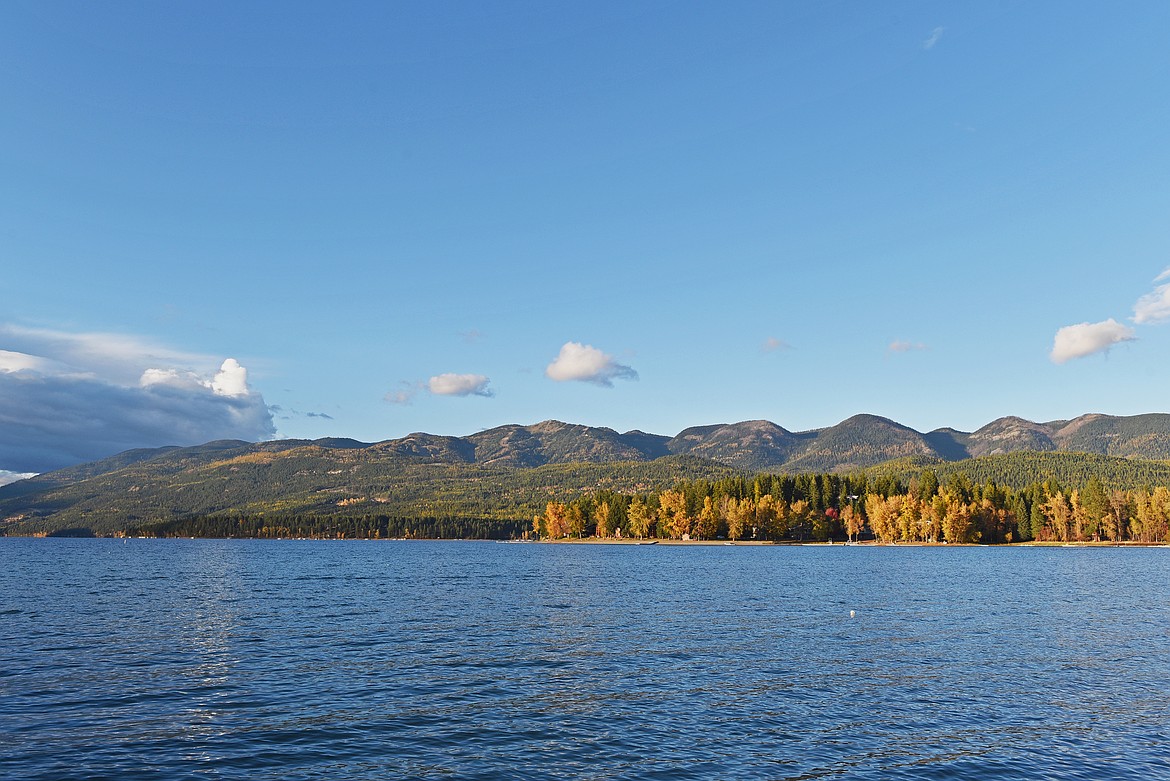
A fall view of Big Mountain from City Beach in mid-October. (Kelsey Evans/Whitefish Pilot)
Lower water levels in Whitefish Lake are becoming the new paradigm, according to data collected from the Whitefish Lake Institute.
The last decade has seen five of the top 10 lowest lake elevation years on record, based on the institute’s analysis of 68 years of data.
“What we’re dealing with is a change in climate resulting in changes to the magnitude and timing of snowmelt,” said Mike Koopal, executive director of Whitefish Lake Institute. “We get the water early, and we don’t have anything left for base flows.”
As of June 9, the snowpack at Stahl Peak in the northern Whitefish Range was at 60% of the 30-year median for that date.
On any given year, the lake’s level fluctuates about 3.8 feet, hitting its highest point in May or June and lowest point by October.
This year, Whitefish Lake hit its peak on May 18 at 2,999.25 feet in elevation.
A mid-May peak is becoming more common than June, Koopal said.
The average low has dropped. In the 1990s it was 2,998.11 feet, compared to 2,998.10 feet in the 2000s, 2,996.79 feet in the 2010s and 2,996.48 feet from 2020 through 2024.
The lake approached the record low of 2,995.96, set in 1988, in both 2023 and 2024.
AN EARLY peak directly affects Whitefish’s water supply.
The city has two water sources: Creeks in Haskill Basin and Whitefish Lake.
The city’s first and preferred option is to get municipal water from Haskill, but at lower water levels, water is pumped from Whitefish Lake to meet demands.
Water is pumped from the lake every year, typically in late June or early July. The hotter and drier the summer, the sooner water is pumped. That will start in the next couple of weeks this year.
Craig Workman, the city’s public works director, said that some water must be maintained in Haskill to respect downstream users.
Water taken for consumption is a mere fraction of what is lost to evaporation, however.
Pumping 90 million gallons – far less than is used in one month for Whitefish – equates to taking the lake down about one inch. Evaporation, meanwhile, will take 2 to 3 feet throughout the summer.
Energy wise, “it’s a double whammy,” Workman said.
Haskill has a hydroelectric plant, generating energy as water is used, whereas lake water must be pumped to the plant, requiring electric energy use.
Lake water also requires more energy for filtering.
The lake water contains more solids and organic matter as compared to streams.
“If you think about high mountain streams, there’s not as much contact with the terrestrial environment,” Koopal said. “But in the lake, it’s the base of the watershed – that water has had more contact, and the nutrients can drive algae.”
Energy use does impact the cost of water.
“The fact that we’re going to produce less and consume more energy is factored into our annual budget, which affects the overall rate,” Workman said.
Conservation always helps, he said.
“It isn’t about using less water, it’s about wasting less.”
WHETHER or not Whitefish Lake sees a record low this year will depend on the weather, with precipitation being the largest factor. Heat waves also drive the evaporation of the lake.
The water in Whitefish Lake is flushed out and replenished every two to three years. This flushing rate offers protection from contamination. Lake Tahoe, for example, which is seeing water quality diminish, has a flushing rate of about 700 years.
Whitefish Lake differs from Flathead Lake in that it has a more intact watershed.
Whitefish is fed by six tributaries, the largest source being Swift Creek, which contributes about 70% of the lake’s water. Whitefish’s watershed is primarily on national forest land.
“It’s a natural, run of the river lake, it’s not inundated by any controls or dams,” Koopal said.
Comparatively, Flathead Lake is sourced from the three forks of the Flathead River, and the SKQ Dam inundates the upper three meters.
“[Flathead] has great water coming in from the Bob Marshall Wilderness and Glacier National Park,” Koopal said. “But when it reaches the valley floor, it flows through agricultural land and cities, so there is the opportunity for pollutants.”
EVERY YEAR, Koopal says he receives inquiries from people wanting to raise the levels of Whitefish Lake.
Koopal said that it is natural for sediments to build up in spots like Monk’s Bay on the southeast end of Whitefish Lake.
“Lakes are contemporary landscape features,” he added. “Their natural succession is to fill overtime and become a marsh.”
That might take another 100,000 years or so, though.
For more information and to see real-time data on Whitefish Lake, visit whitefishlake.org.
ARTICLES BY KELSEY EVANS

Solid freshman class to bolster track and field teams past adversity
The sunny and brisk Monday afternoon was a pseudo first day of practice for the Bulldogs, who have to sharpen up quickly after spring break for this weekend’s debut meet: the ARM Invite.

Skimo North American champion hails from Big Mountain
Whitefish eighth grader Porter Shehan skinned, climbed and skied his way to a skimo North American title and a national title this season.
Casual eatery Grouchy Grizzly to open in Whitefish this summer
Whitefish’s Last Chair Kitchen and Bar, a restaurant at Lakeshore Drive and Reservoir Road, has been sold and will undergo a phased transformation, into a casual, fun-focused eatery called Grouchy Grizzly.