Shoshone County secures additional fire mitigation funding
JOSH McDONALD | Hagadone News Network | UPDATED 10 months, 3 weeks AGO
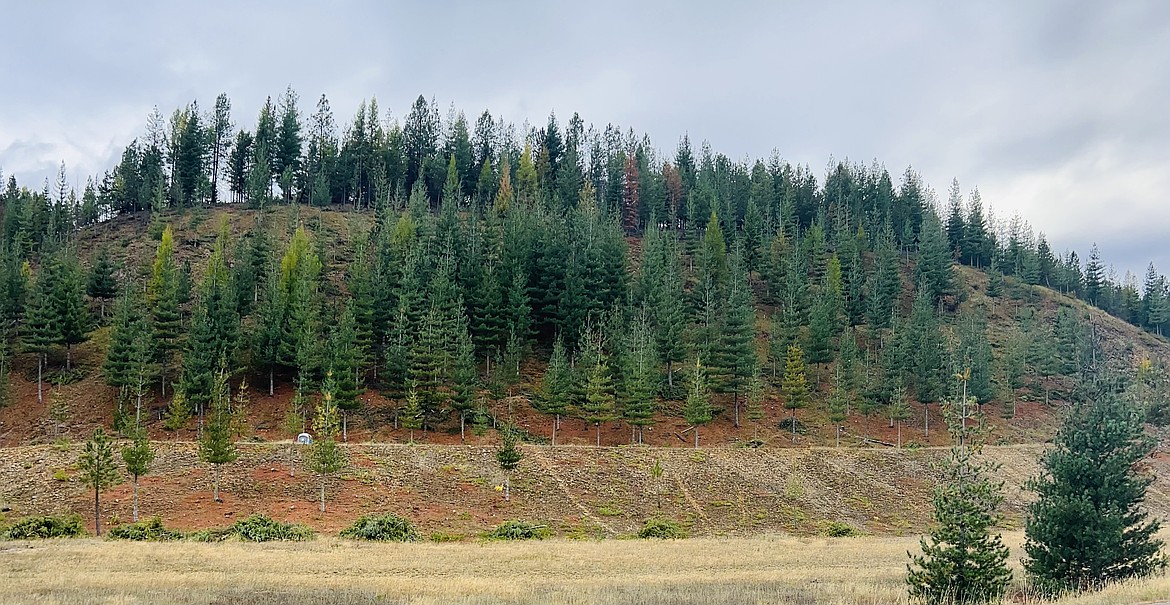
This section of wildland-urban interface (WUI) has undergone fire mitigation efforts and is an example of what residents can expect during an upcoming mitigation project along the I-90 corridor according to Shoshone County Fire Mitigation Director Bill McLeod.
JOSH McDONALD
WALLACE – Shoshone County is preparing to launch several fire mitigation projects across the region after securing multiple grants from state and federal sources.
Last week, the Idaho Department of Lands (IDL) announced it had received a $7.5 million Community Wildfire Defense Grant (CWDG) from the U.S. Forest Service, the largest mitigation grant the agency has ever received, to support work along Shoshone County’s I-90 corridor.
During a meeting with the Shoshone County commissioners last Tuesday, Fire Mitigation Director Bill McLeod announced the county had also received three additional state-funded grants totaling nearly $1 million for further mitigation efforts.
These include a $500,000 Private Landowner Protection, Resilience, and Restoration Assistance (PRRA) grant, a $200,000 Bark Beetle grant, and a $240,000 Western Fire Managers (WFM) grant.
According to McLeod, both the Bark Beetle and WFM grants already have designated project areas.
The Bark Beetle grant will fund 50 acres of fuel mitigation around Jacobs Gulch in Kellogg, specifically targeting the wooded areas near Kellogg High School and Shoshone Medical Center. Work is expected to begin next summer after school is out.
The WFM grant will support 50 acres of mitigation in the East Elizabeth Park area outside of Kellogg. However, McLeod noted the county may opt to decline that grant and instead use funds from the CWDG to complete the project.
Much of the meeting focused on the large-scale I-90 corridor project funded by the CWDG grant.
The $7.5 million initiative will address 18,890 acres of high-risk forestland along the corridor and treat 1,275 acres of private property, with a focus on the Wildland-Urban Interface (WUI), areas where wildland and residential zones meet and fire risk is highest.
McLeod said he was surprised the IDL received the grant, given recent funding constraints at both the state and federal levels.
“I really didn’t think we were going to get this one,” he told commissioners. “Just because all of the government stuff that went on this year and is still going on.”
Mitigation work in Shoshone County began in 2002, and McLeod said the goal is to integrate upcoming projects with past efforts to create a more continuous and effective fuel break.
“In the long run, it’ll be more effective for the communities and hopefully save homes,” he said.
The work will begin at the county’s western boundary and continue along I-90 to the Idaho-Montana border.
McLeod pointed to previous mitigation efforts between the Bunker Hill Mine and Galena Ridge area of Kellogg as a model for what future work may resemble. He is currently developing a plan and intends to present it at upcoming community meetings to gather public input.
“We do want public input because it will help us put the projects together,” McLeod said. “Hopefully, we can get as many landowners as we can.”
Commissioner Jeff Zimmerman expressed enthusiasm for the projects, emphasizing their importance for community safety.
“The 1910 fire was not too long ago,” Zimmerman said. “We can see the hazard we have right now, and this is the time we need to start really cleaning stuff up and getting ready for ‘just in case.’”
Project components are expected to begin in spring 2026 and wrap up by the end of 2030. Shoshone County will post updates and project maps on its website as they become available.
ARTICLES BY JOSH MCDONALD
Wet weather could help contain Dudley Fire
Wet weather could help contain Dudley Fire