
Turning the power back on
CAROLYN BOSTICK | Hagadone News Network | UPDATED 3 hours, 15 minutes AGO
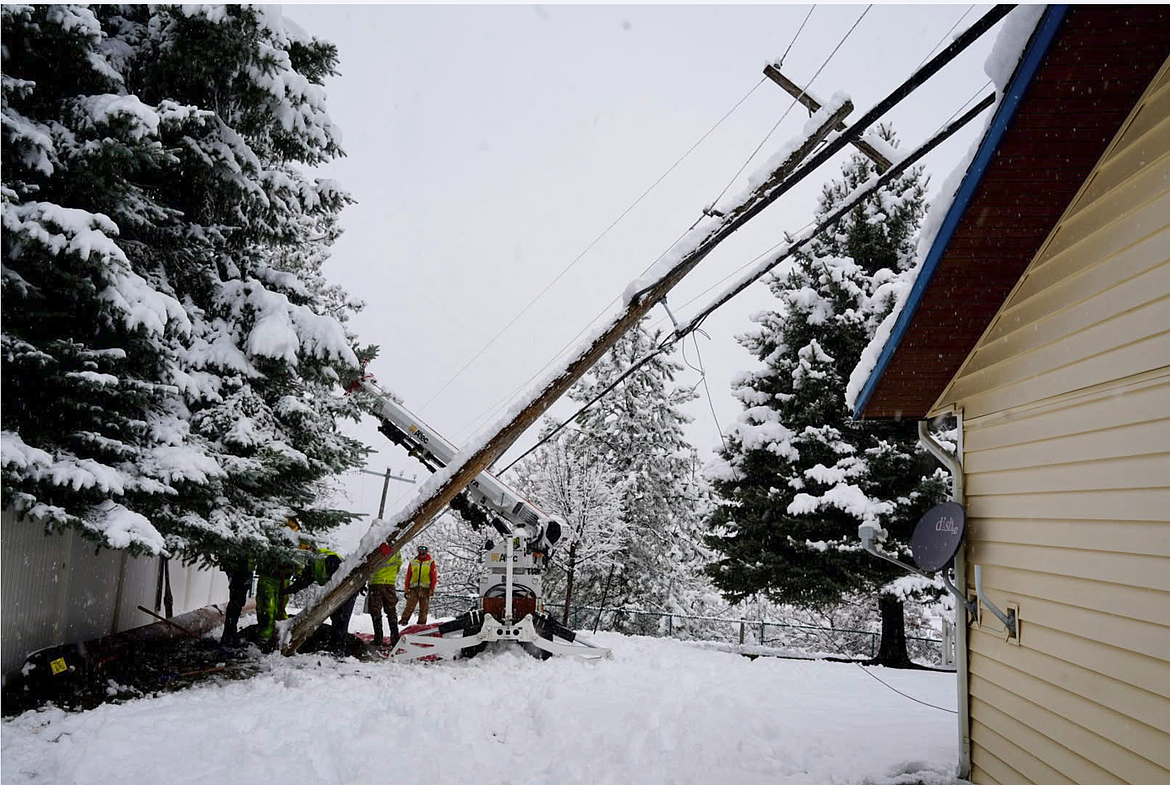
Repairs to a single telephone pole downed in Coeur d'Alene helped turn the power back on for about 300 people after the March 12 windstorm, according to Avista estimations.
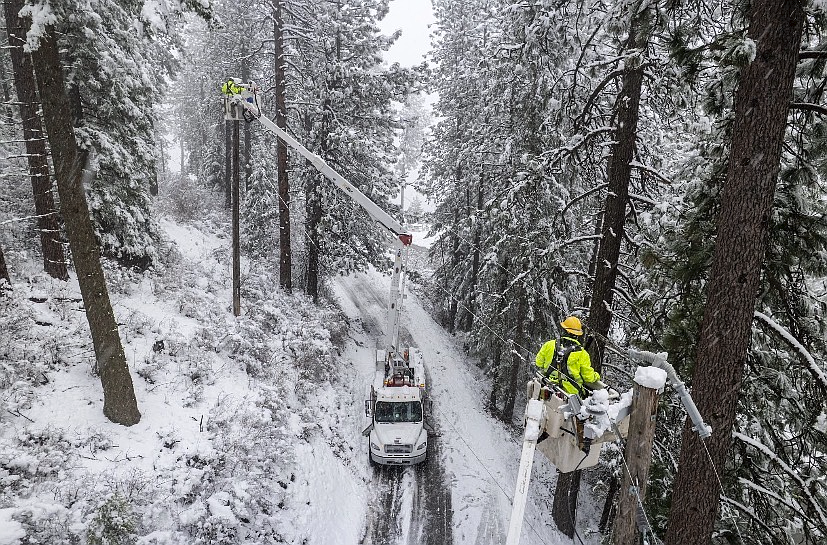
Rapid snowfall slowed repairs especially in Shoshone County for line crews after the March 12 windstorm, Avista utilities reports.
Carolyn Bostick has worked for the Coeur d’Alene Press since June 2023. She covers Shoshone County and Coeur d'Alene. Carolyn previously worked in Utica, New York at the Observer-Dispatch for almost seven years before briefly working at The Inquirer and Mirror in Nantucket, Massachusetts. Since she moved to the Pacific Northwest from upstate New York in 2021, she's performed with the Spokane Shakespeare Society for three summers. | April 21, 2026 1:00 AM
The scale of a windstorm’s damage is difficult to comprehend.
After recent windstorms in March and December causing massive outages, the level of coordination and boots on the ground to begin to tackle to gargantuan task begins days before weather conditions take a turn for the worst.
Avista Spokesman David Vowels said from the lineman and contract crews ready to deploy to the support staff behind the scenes, cleaning up the effects of a storm requires a sea of hands to remedy.
“It’s a big logistical lift,” Vowels said.
The March 12 windstorm created outages for more than 60,000 people. About 80,000 were affected by outages in the storm on Dec. 17.
As the Director of Operations for Avista, Paul Good is used to looking at the big picture for storm damage.
Avista is a member of the Western Region Mutual Assistance Group and in the days leading up to weather indicating a major storm, the utility company begins putting out a message for other utilities and contractors that a request for help may be coming.
“We'll put out a request or a notice that we have significant weather coming into our area and that we may need support from other utilities, Good said. “Likewise, we receive them as well and figure out how many resources we could release.”
Avista staff also begin checking with contract loggers across utilities. Once major outages occur, the contractors will go to the utilities they contracted with and ask to be released.
“As the storm hits, we're looking at where it’s hitting, how it’s hitting. We know pretty quick how much damage is happening to the system that we need to ask for external help,” Good said.
Avista coordinators sort through the fastest arrival times for contractors to ensure that outages are being repaired swiftly.
“With us bring disbursed across multiple districts, it is an all hands-on deck approach for the company,” Good said.
Peak response for the March storm came to more than 50 Avista line crews, 17 contract crews and 16 vegetation management crews. Contract crews came from the Boise area and Umatilla, Ore.
But that only makes up a portion of the picture.
“We had about hundreds of folks that were not in the field that were supporting, from coordinating lodging for these crews to getting materials from one area to another depending on where the damage was to providing meals,” Good said. “That’s a 24/7 effort.”
Scott Dahl is a lineman with International Line Builders and said storm repairs often throw up complicating factors to restoring power.
“The number one thing for me is safety,” Dahl said. “We have to make sure our crew are all safe assessing the situation and coming up with a plan as a crew for getting the lights back on.”
Ensuring there aren’t hazards and the team is working smart to work safely at speed is an art.
Difficulties like restoring structures carrying the transmission lines take time, but methodical work that is safe is faster at the end of the day.
“It's what we do,” Dahl said.
A journeyman lineman by trade, Dave Garegnani now also represents the International Brotherhood of Electrical Workers (IBEW) as its business representative for union coverage in Idaho, Washington and Montana.
“It’s odd. You usually work in a certain area where you know the specs,” Garegnani said.
Being dropped into a new area to get the turn on the light sometimes mean a “bird dog” or local guide will show them where to go and assist with a contract crew as another set of boots on the ground to support efforts.
Vowels noted that the electrical linemen help and service and stepping up after major weather is part of what makes the industry what it is.
“It is a brotherhood, they enjoy helping each other,” Vowels said.
Avista provides energy services and electricity to 422,000 customers and natural gas to 383,000 customers for eastern Washington, North Idaho, and parts of southern and eastern Oregon.
With a 24-hour command, each Avista service district has a manger that's running it as well as a backup. They coordinate efforts through overlapping 16-hour shifts.
Similarly, the line crews of three-four people are doing the same things working 16 hours on and eight hours off.
Start and stop times are staggered for 24-hour operation.
“Crews also have the ability to at any time of a crew feeling fatigued or if anything happens to take a break,” Good said. “These are all professionals and we have multiple meetings throughout the day checking in.”
Paul Good noted that the first 36 hours after storm damage is the most critical.
“Especially in those first hours of the storm, we’re really assessing what damage has taken place. In these last two storms, we’ve had significant winds so we had a lot of trees downed on public roads,” Good said.
To even begin accessing the damaged infrastructure, Good said trees crews had to cut into the areas to start power restoration.
The March storm also posed additional weather complications.
“We had the wind come through and then about 20 hours later, we had a significant snowstorm up in the Kellogg area up towards Mullan. We got almost two feet of snow. We also received damage due to the snow because there were trees weakened by the wind,” Good said.
He said that it sometimes makes plugging the holes in the power outage map doubly harder when the weather slows recovery times.
“It just makes the restoration that much harder,” Good said. “We had a plan and then that snow rolled through and it caused a bit of a stall in our restoration efforts because we got more outages coming in.”
 Rapid snowfall slowed repairs especially in Shoshone County for line crews after the March 12 windstorm, Avista utilities reports.
ARTICLES BY CAROLYN BOSTICK
Turning the power back on
The scale of a windstorm’s damage is difficult to comprehend. After recent windstorms in March and December causing massive outages, the level of coordination and boots on the ground to begin to tackle to gargantuan task begins days before weather conditions take a turn for the worst.

Post Falls vows to save parade
City says staffers will lead drive to organize annual event
Post Falls staff are working to save the 2026 Post Falls parade. City Administrator Shelly Enderud shared that after the Post Falls Community Ambassadors stated that 2025 would be their final year managing the parade, city staff sought out a community group to manage and sponsor the annual event.

Families get 'READY!'
Program to boost kids comes to Mullan Trail Elementary
Families of young children in the Post Falls School District got a jump-start on practical ways to teach their kids Wednesday through the READY! for Kindergarten program. For Serena Behrens, the program is a way for her to learn ways to more actively create learning moments for her three-year-old son, Blake, before he gets to school. “I’m not totally sure, but it’s about whatever we can do to support learning at home,” Behrens said.