
Stillwater trio competes in Presidential AI Challenge
HILARY MATHESON | Hagadone News Network | UPDATED 6 months AGO
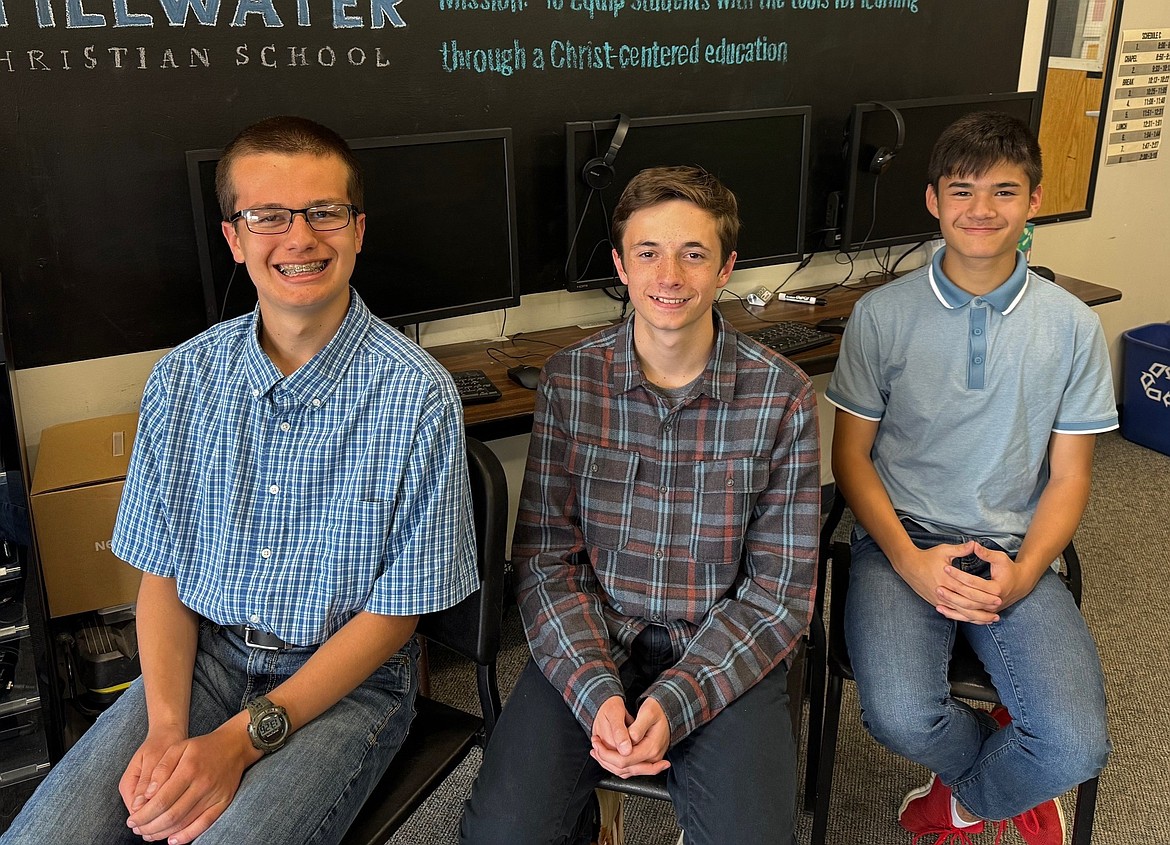
Stillwater Christian School freshmen John Schaefer, Ryder Scott and Xavier Irby made it to the regional level in the first Presidential AI Challenge. (Hilary Matheson/Daily Inter Lake)
EDUCATION REPORTER Hilary Matheson covers education for the Daily Inter Lake. Her reporting focuses on schools, students, and the policies that shape public education across Northwest Montana. Matheson regularly reports on school boards, district decisions and issues affecting teachers and families. Her work examines how funding, enrollment and state policy influence local school systems. She helps readers understand how education decisions affect students and communities throughout the region. IMPACT: Hilary’s work provides transparency and insight into the schools that serve thousands of local families. | April 24, 2026 12:00 AM
Three Stillwater Christian School freshmen represented Montana at the regional level of the first Presidential AI Challenge, competing against students from other western states.
The competition invited elementary, middle and high school students and teachers to develop or use artificial intelligence tools to address community issues. The goal of the challenge is to promote interest, competence and innovation in AI, according to ai.gov, as part of President Donald Trump’s AI Action Plan.
Stillwater teammates John Schaefer, Ryder Scott and Xavier Irby advanced to the regional round after winning at the state level in the high school “track 2” division. In this category, the Stillwater students submitted written and video narratives, explaining how AI could be used to solve an issue in the Flathead Valley, while evaluating its accuracy and challenges or innovations discovered during their research. The students also reflected on what they learned about AI technology and its appropriate and responsible use.
The project was completed as part of a science, technology, engineering and math assignment in Stillwater teacher Bradley Dahl’s class. Students discussed AI and worked on their projects for about a month.
“We would talk about AI and what it should be used for,” Dahl said. “How do you use it responsibly? Instead of creating brain rot, how do you use AI that’s going to benefit society?”
Five class projects were submitted to the competition and explored topics ranging from rural health care and low-income housing access to finding judicial bias.
Schaefer, Scott and Irby zeroed in on road construction, with multiple projects underway in the valley. They focused on AI to increase efficiency in developing procurement logs — documents that track and monitor material orders, quantities, suppliers and delivery dates.
"One of the big downfalls of construction is if they run out of materials,” Dahl said. “Whether it’s building a house, or road construction — not having the right materials everything comes to a screeching halt.”
Scott said their system would analyze available materials and generate detailed procurement logs.
“The AI will look through all the available materials and based on that, will create a procurement log, meaning, like the exact models and serial numbers of everything that they need and how many weeks in advance they need to buy each thing,” Scott said. “Right now, it’s the project manager that makes the procurement log.
The students emphasized that AI should support, not replace, workers.
“Even with ordering stuff, someone needs to check it,” Irby said. “The AI would be able to get a rough scope, but it would still need to be checked.”
The group also considered additional applications, such as apps to show construction progress and detours or using cameras with AI to analyze traffic patterns and reduce congestion, Irby and Dahl said.
For their video submission, Scott filmed his drive to school to highlight construction and traffic delays. Schaefer and Irby recorded narration and edited the final product.
For the regional level, the students had a brief online video interview with judges who asked additional questions about their project.
“They asked about just the feasibility of it. Would this take away any jobs? Would this benefit the company?” Schaefer said.
Although the team recently found out their project did not advance to the national level, Dahl said it was a valuable experience for the students.
Reporter Hilary Matheson can be reached at 406-758-4431 or [email protected]. If you value local journalism, pledge your support at dailyinterlake.com/support.
ARTICLES BY HILARY MATHESON
Musically inclined students perform at the 2026 All-State Music Festival
Top high school musicians from the region performed at the All-State Music Festival Gala Concert Oct. 16 in Bozeman.

Evergreen educator named Montana Teacher of the Year
Evergreen Junior High special education teacher Kenny Ross is Montana's Teacher of the Year.

FVCC faculty issues no-confidence vote amid president contract negotiations
The FVCC Education Association, the Flathead Trades Instructors Association and the Federation of Flathead Valley Community College Adjunct Faculty have voted no confidence in FVCC Executive Director of Human Resources Karen Glasser, saying they have lost trust in her leadership and judgment.