MAY NIBJ: Mining resurgence driving economic recovery in Shoshone County
JOSH McDONALD | Hagadone News Network | UPDATED 3 weeks, 6 days AGO
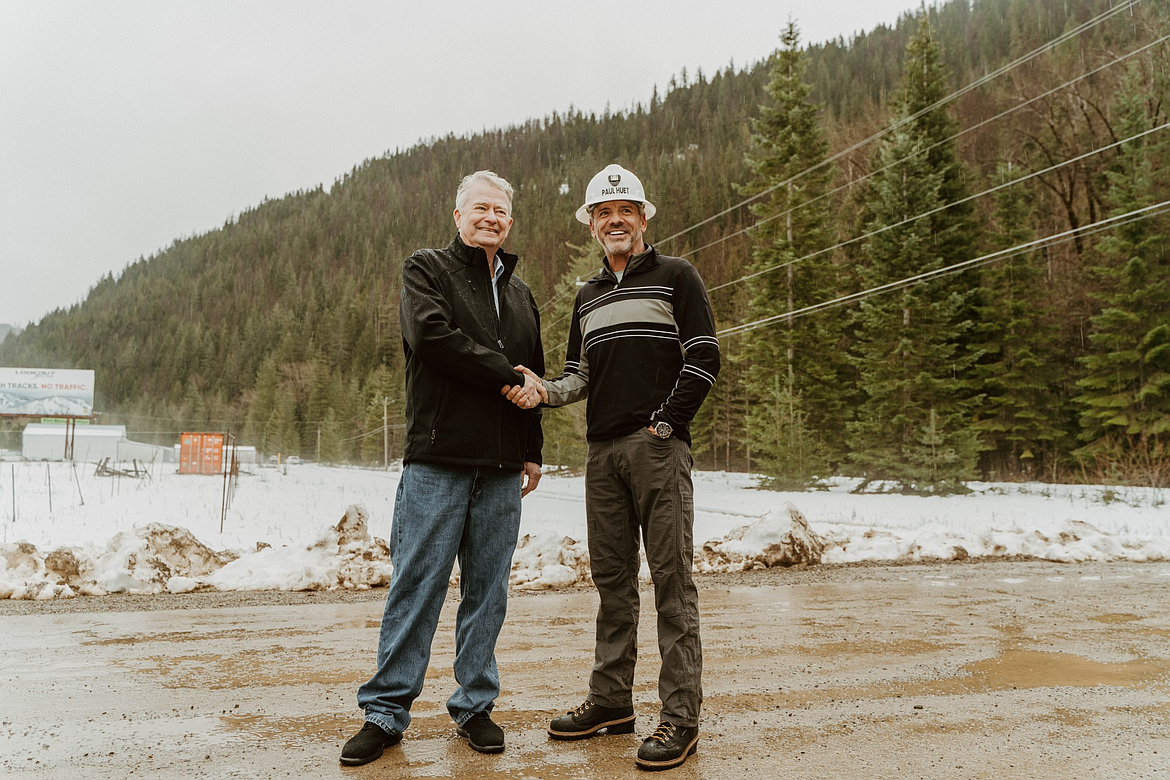
Idaho Governor Brad Little and Americas Gold and Silver Chairman and CEO Paul Andre Huet shake hands at the future site of the antimony processing facility at the company's Galena Complex in the Silver Valley.
Courtesy photo
WALLACE — Employment conditions in Shoshone County have improved over the past year as declining unemployment has coincided with renewed mining activity and steady growth in several service industries, according to labor statistics.
The county’s unemployment rate was between 5.0% and 5.1% in December 2025, down from 5.9% a year earlier, reflecting higher employment and a smaller pool of job seekers, according to the Idaho Department of Labor. The rate remains above Idaho’s statewide unemployment level of approximately 3.5%, continuing a long-standing trend in the rural, historically mining-dependent county.
Mining has played a visible role in the recent improvement. The planned restart of the Bunker Hill Mine in Kellogg is expected to create as many as 250 jobs.
“The team at Bunker Hill is growing quickly as we move towards a June restart,” Bunker Hill CEO Sam Ash said. “We now have three mining crews and have just started seven-day operations underground. We have additional operational, technical, and staff positions open and I encourage anyone who might be interested in being part of the Bunker Hill restart to check our website for job openings or drop a resume off at the office in Kellogg.”
Americas Gold and Silver recently announced it is in the early stages of negotiations to build an antimony processing plant at the Galena Complex. The company also purchased the Crescent Mine near the end of 2025.
Other mining operations, including the Lucky Friday Mine near Mullan and the Golden Chest Mine near Murray, have added higher-paying positions while supporting contractors, trucking firms and other local businesses. Economic development officials say those jobs are helping stabilize employment, though workforce availability and housing remain limiting factors.
Outside of mining, health care and social services, retail trade, construction and hospitality continue to account for much of the county’s workforce, according to labor profiles compiled in early 2026. Small businesses in communities such as Wallace and Kellogg have shown modest signs of recovery following pandemic-era slowdowns.
Income levels remain a challenge. Shoshone County’s median household income is about $55,527, well below Idaho’s statewide median, according to census-based estimates. At the same time, the county’s cost of living is near the national average, with housing costs continuing to rise faster than wages.
Local officials say continued mining activity, paired with infrastructure investment and workforce housing, will be critical to sustaining growth. While employment trends are improving, they caution the county must diversify its economic base to achieve long-term stability.
Silver Valley Economic Development Corporation Director Paige Olsen said she is encouraged by what she is seeing and believes the region’s economic momentum will have a lasting effect.
Shoshone County struggled following the COVID-19 pandemic as many businesses adapted to increased regulations. During that time, some industries adopted more cost-effective operating practices, many of which have remained in place.
“Our community’s foundation in essential industries really helped Shoshone County stay steady throughout the pandemic. We’re now seeing an influx of public and private investment in our essential industries, specifically the mines,” Olsen said. “And some of our more historically famous mines are coming back online. These high-paying jobs will help stabilize our county's median income and continue the ripple effect into our community. One mining job doesn't just create one job. It increases our tax base, keeping money local and trickling into all aspects of our community.”
ARTICLES BY JOSH MCDONALD

Sheriff urges safety as holiday brings people to Shoshone County
Sheriff urges safety as holiday brings people to Shoshone County