
Hungry Horse News at 80: Mel Ruder, the man who started it all
CHRIS PETERSON | Hagadone News Network | UPDATED 4 hours, 54 minutes AGO
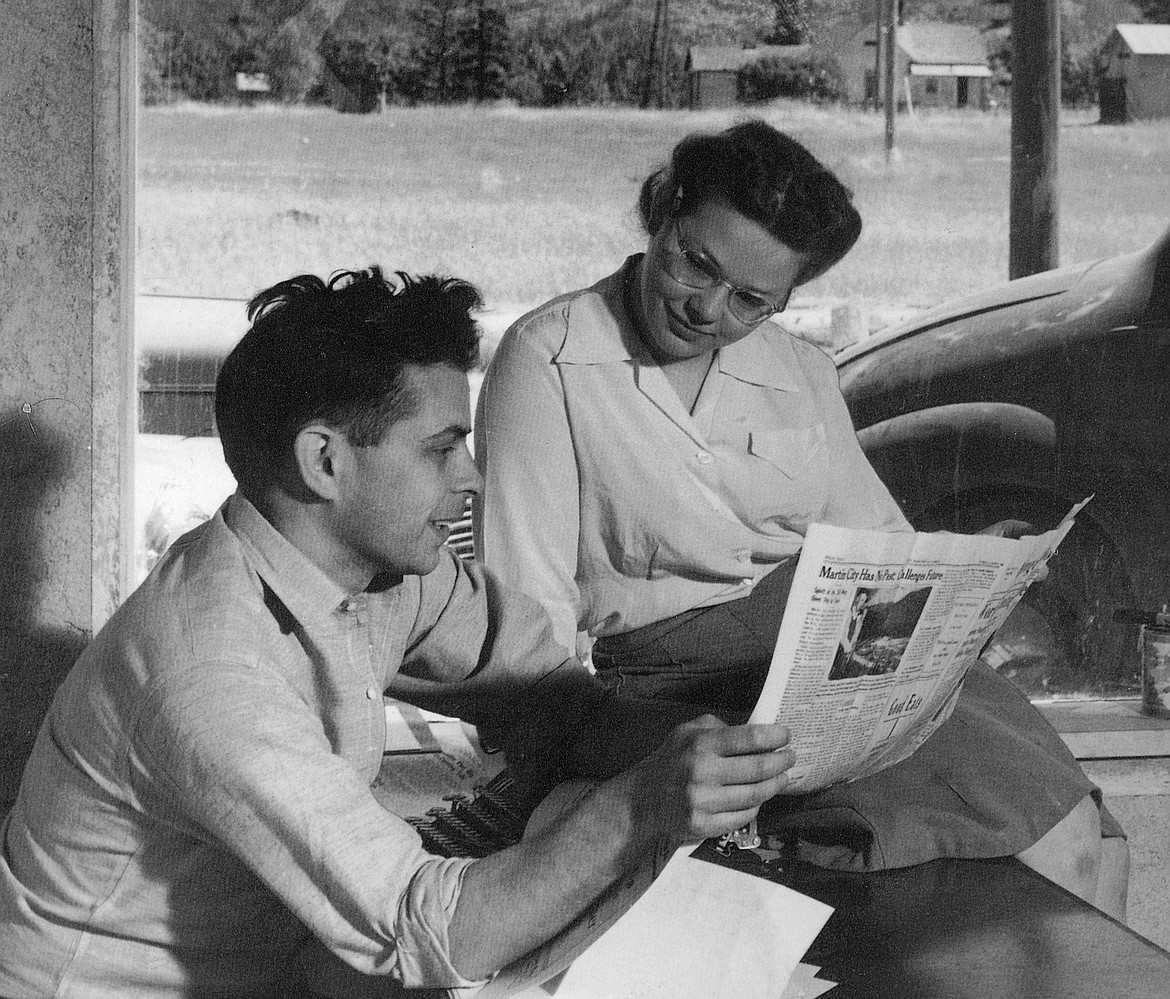
Mel Ruder and Gladys Shay at the newspaper offices on Nucleus Avenue in 1946.
Chris Peterson is the editor of the Hungry Horse News. He covers Columbia Falls, the Canyon, Glacier National Park and the Bob Marshall Wilderness. All told, about 4 million acres of the best parts of the planet. He can be reached at [email protected] or 406-892-2151. | August 5, 2026 6:10 AM
When Mel Ruder founded the Hungry Horse News in 1946, his plan was to start a newspaper in Columbia Falls (which had none at the time) and then sell it five years later.
A Navy veteran and Eagle Scout, Ruder was 31 years old and Gladys Shay was his first employee. They started in rented space on Nucleus Avenue.
Chris Raaen, who was also the mayor, owned a liquor store and a radio shop and carved out space for Ruder. When the liquor shipment came in, Ruder helped unload the booze. Rent was $25 a month.
Dorothy Downen, who was just a youngster at the time, recalled he also had the library at his office and she’d go there and get books, as the city didn’t have a formal library at the time. Ruder was paid $15 a month salary as the librarian.
The first edition was printed on Aug. 8, 1946 and featured a photo of an exploratory well rig drilling bore samples for the Hungry Horse Dam in the South Fork of the Flathead.
Ruder, who was renown for his photography, developed the 4-by-5 sheets of film from his Speed Graphic using a drawer in a chest of drawers. Back then, a single picture cost about $8, he once noted, which was very expensive for the time. Still, by 1947 he was running up to seven photos on the front page.
Ruder didn’t stay in the rented space long. He had a log cabin built at the intersection of Highway 2 and 40 on the hillside. It was completed in December of 1947 and remains the newspaper’s home today.
He had an fantastic eye for photography and many photos were obviously posed, yet he still had a knack for making them look natural.
The Graphic was no joy to use. It’s a complicated camera. One loads the film into holders and each holder holds two sheets.
You then load the holders in the camera, set the exposure, pull out the black slide, cock the shutter and then take a picture, with or without a flash, which at the time were one-use bulbs.
You then had to remember to slide the black slide back into the holder and then you flipped the holder around to take a picture on the other piece of film. The advantage, if you did everything right, was the negatives were huge, with virtually no grain.
Ruder’s photos were incredibly sharp, a testament to his skill, but also to the excellent lens attached to the camera.
He used this setup through most of his career, only “downgrading” to a slightly smaller medium format camera in 1975, just three years before he sold the newspaper in 1978.
Ruder started his photography career working for Haynes, a photographic company, in Yellowstone National Park. The Graphic was a heavy and bulky camera, but Ruder lugged it everywhere he went, making weekly trips to Glacier National Park as well as across the Flathead Valley.
He also had an excellent relationship with the Blackfeet people and John Tatsey of Heart Butte was a longtime columnist for the newspaper.
Ruder was named honorary chief Spotted Calf in 1965 by the Blackfeet tribe.
You knew where Ruder had traveled by the photos in the newspaper.
Printer Greg Sorenson recalled that Ruder was an incredibly hard worker. Producing a newspaper was not only mentally demanding, but physically demanding as well. Ruder would develop his film in a little darkroom off the front office, and then they would go off to Whitefish to have prints made.
Meanwhile, stories were written on an old manual typewriter, Sorenson recalled, and once proofed, were typeset into a linotype machine, a big beast that melted lead into letters and created the columns of text that one sees in the old newspapers.
Ruder typed with just two fingers, longtime reporter Gladys Shay recalled. The prints of the photos were transferred to zinc plates then added into the holes of the pages later.
The pages were then shot by a big camera and the negative was burned into a plate and the plate went on a press. When Sorenson came to the Hungry Horse News in August 1968, he was a Navy veteran and had been trained as a printer a technical college in Spokane.
Ruder hired Sorenson on the spot.
Sorenson completed his apprenticeship at the Hungry Horse News, and a few years later became the production manager of the newspaper and its commercial printing department until 1999.
The Hungry Horse News was not just a newspaper at the time. It was also a vibrant and busy print shop, with several presses, including a Heidelberg color press was used to print everything from calendars to posters over the years.
Sorenson was a master printer and talked Ruder into several upgrades over the years which saved the business money, most notably by upgrading its cameras used for page production, bringing them in-house rather than outsourcing the work.
Sorenson recalled one incident where Ruder had to have gallbladder surgery. The high school band was making a big trip to Europe and just a few days after the surgery (which was a much more complicated procedure than it is today) he was on a plane, lugging that big camera across Europe, following the band.
Ruder’s wife, Ruth, was also instrumental in making the newspaper a success.
Ruder was known to pull ads rather than stories. The newspapers were typically eight pages, sometimes 12, until the June 8-9 flood of 1964 hit.
He printed several editions that week as he covered the disaster. Afterward, noted author Dorothy Johnson, who was also a good friend, nominated him for the Pulitzer Prize. People to this day think his 1965 award was for photography, but it was not. It was for Distinguished Local Reporting.
In Ruder fashion, he recognized all the winners of the Pulitzers that year, not just his own, in a modest story on the front page.
“I guess I can die now,” Shay recalled Ruder saying upon learning he won the award.
He continued publishing newspapers until 1978, when, after a distinguished 32-year career, he sold the paper he planned to hold for just five years, to Sage Publishing of Wyoming.
Ruder said in a 1996 interview with Brian Kennedy, that part of his success was luck.
The Hungry Horse Dam was built, then the aluminum plant, and Plum Creek a year before he started the paper.
Also, tourism to Glacier National Park continued to grow.
“I had some breaks and the timing was good,” Ruder recalled.
The photographic formula for success was simple: Babes, beauties and beasts.
People loved the photos. As for his writing, while Ruder could turn a word, most of his stories were very short, sometimes frustratingly so. He left out articles like “The” from sentences as the words took up space. It was not a conversational style of writing by any means.
But it got the job done and left space for photos.
Ruder died Nov. 19, 2000 at the Montana Veterans Home.
He had suffered a stroke the year before. He was 85.
ARTICLES BY CHRIS PETERSON
Hungry Horse News at 80: A sea of change in the past 28 years, more ahead
“We’re moving to Montana,” I told my wife one day in late March, 1998.
Hungry Horse News at 80: Mel Ruder, the man who started it all
When Mel Ruder founded the Hungry Horse News in 1946, his plan was to start a newspaper in Columbia Falls (which had none at the time) and then sell it five years later.

Families move into new Habitat for Humanity townhomes; applications being taken for others
Habitat for Humanity dedicated four new townhomes in Columbia Falls last week and has six more under construction on Railroad Street.