
Sheriff Wehr praises progress after BOCC removes admin fee from proposed budget
JOSH McDONALD | Hagadone News Network | UPDATED 2 days, 22 hours AGO
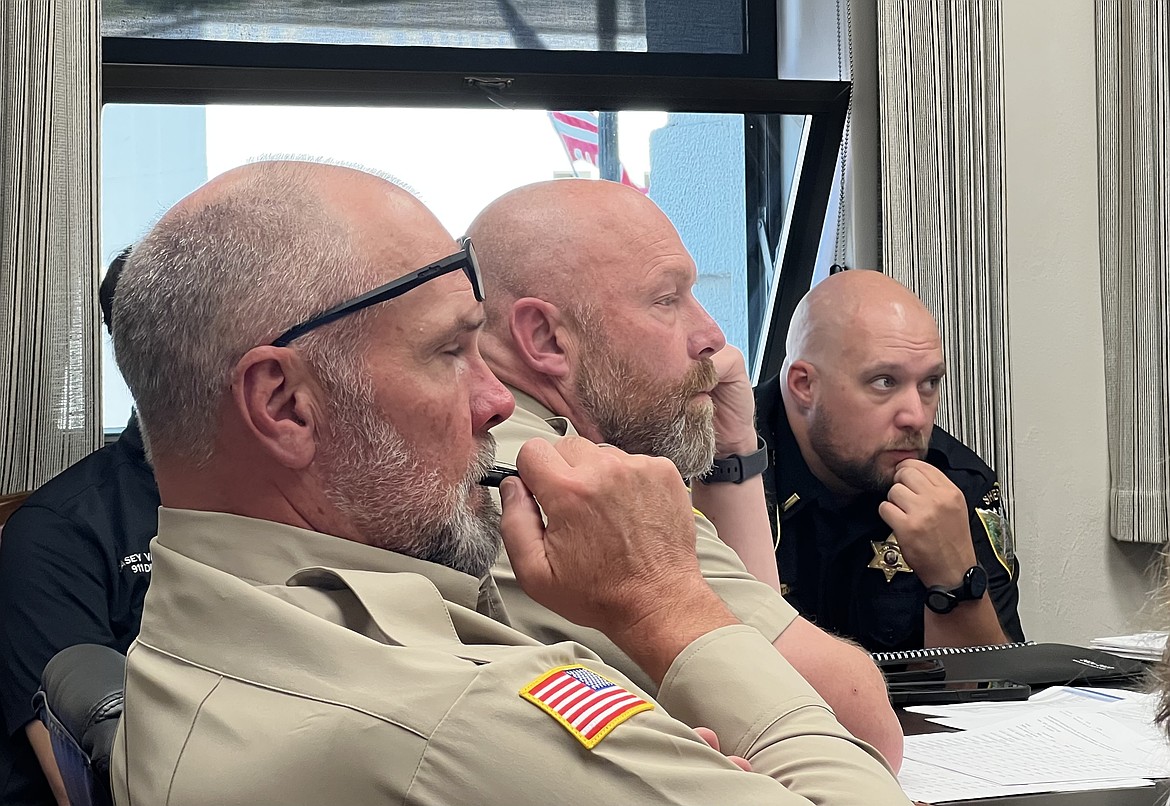
Shoshone County Undersheriff Travis Skinner (foreground) and Sheriff Shawn Wehr discuss the department's proposed budget with the county commissioners during a workshop last week at the Shoshone County Courthouse.
JOSH McDONALD
WALLACE – Shoshone County's largest office was the focus of a budget workshop last week as commissioners continued work toward adopting a final budget for Fiscal Year 2026.
The board has spent the past several weeks reviewing budgets for county departments, but the largest piece of the annual budget remains the county's justice fund.
A year ago, discussions surrounding the justice fund helped spark the destabilization of the Shoshone County Sheriff's Office. This year's conversation took a markedly different tone.
The two-hour workshop last Thursday covered much of the fund's budget, though discussions on facilities, communications and capital requests remain. The meeting ended with participants on both sides expressing optimism about progress toward a final spending plan.
The justice fund includes the Shoshone County Sheriff's Office, the public safety building, jail operations and some public defense costs. For FY26, the justice fund accounted for 31% of the county's proposed budget, or $5.3 million of the county's $16.9 million spending plan.
County justice funds are considered protected funds under Idaho law. Generally, a protected fund contains money restricted by law, regulation, grant requirements, voter approval or county policy and cannot be used for general government spending.
During Thursday's workshop, Sheriff Shawn Wehr and Undersheriff Travis Skinner presented a proposed Sheriff's Office budget of $3.8 million for the portions of the budget that were discussed. The clerk's office had recommended a budget of $4.03 million.
Included in the clerk's recommendation was $325,000 in administrative fees, which commissioners removed during the meeting.
Administrative fees charged by a county clerk's office to other departments typically cover centralized services such as payroll, accounting, budgeting, records management and procurement support. For restricted funds such as a county justice fund, those charges should reflect actual administrative services provided and be supported by a documented cost-allocation method to ensure expenditures remain tied to authorized justice-related purposes.
With the administrative fee removed, the clerk's recommended budget is $96,000 less than what Wehr and Skinner requested.
Following the meeting, Wehr said he was pleased with the outcome, specifically citing the commissioners' decision to eliminate the administrative fee.
"We're back to an even playing field," Wehr said. "Overall, that was very positive for us."
Wehr said he believed the administrative fee allowed money to be removed from a protected fund. The fees were a source of frustration during previous budget discussions and became a major factor in the rift between county commissioners and the Sheriff's Office one year ago.
Skinner said the county's final justice fund could be approved at $5.4 million if the county opted for a bare-bones approach, but he hopes the final budget will land closer to $5.6 million.
The Sheriff's Office is currently projected to finish FY26 about $600,000 in the black and hopes to use those funds to address its aging patrol fleet, which has not been significantly updated in several years.
Wehr praised Skinner's work on the budget proposal.
"Undersheriff Skinner has done a great job with his proposal," Wehr said.
The workshop was recessed and is scheduled to resume Monday, Aug. 10.
ARTICLES BY JOSH MCDONALD
Shoshone County eyeing Opportunity Zone benefits

Increasing fire danger prompts restrictions in Shoshone County