
Libby Dam bats get vaccine for deadly fungal disease
HAILEY SMALLEY | Hagadone News Network | UPDATED 2 months, 1 week AGO
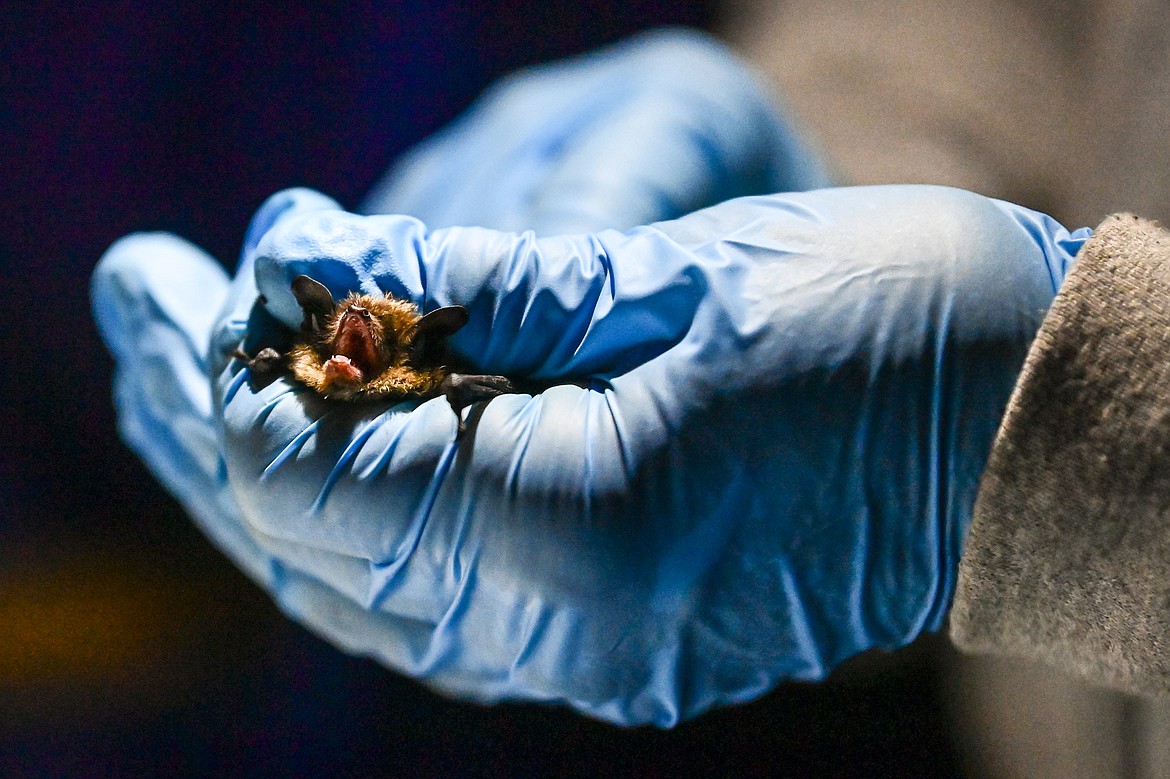
Glacier National Park biologist Lisa Bate holds a bat as she takes measurements during a "Going Batty" field trip in the park on Thursday, July 9. (Casey Kreider/Daily Inter Lake)
Casey Kreider
Montana Fish, Wildlife and Parks vaccinated nearly 900 bats at Libby Dam against the fungus that causes a deadly condition known as white-nose syndrome.
A crew of 43 people from the state wildlife agency and seven partner organizations worked for two hours on the night of July 29 to administer the oral vaccines to one of the largest maternity bat colonies in the state after traces of the fungus were discovered in bat boxes outside of Libby Dam during routine monitoring last summer.
While the disease has devastated some bat colonies in eastern Montana, the positive result marked the first time the fungus was observed in the Treasure State west of the Continental Divide. None of the 1,500 little brown and Yuma myotis bats in the colony had developed symptoms of white-nose syndrome when technicians confirmed the presence of the fungus, but Montana Fish, Wildlife and Parks Statewide Bat Biologist Shannon Hilty was still devastated by the results.
“I thought we had more time before it jumped the Continental Divide,” she said at the time. “I think we all did.”
Since it was first observed in New York in 2006, white-nose syndrome has killed millions of bats across the U.S. and Canada, often devastating entire colonies in one fell swoop.
The cold-loving fungus colonizes on the skin of some bat species. As it grows, the fungus eats lesions into the bat’s wings and disrupts physiological cycles, including hibernation. Infected bats wake up more frequently during the winter, causing them to quickly deplete fat reserves and starve to death.
In Montana, the fungus first appeared in Azure Cave in Cascade County in 2020. Within two years, about 98% of the 2,000-strong bat colony in the cave perished from the disease.
White-nose syndrome does not affect humans or other animals. Still, the disease's high fatality rate makes it a legitimate ecological and economic threat to communities in Northwest Montana. All 15 bat species native to Montana are insectivores and provide the state with the equivalent of $680 million a year in agricultural pest control, according to Montana Fish, Wildlife and Parks.
“Bats might be tiny, but they play an incredibly important role in Montana’s ecosystem health and agriculture production,” Hilty said in an Aug. 12 press release from the state wildlife agency. “Many of us have been watching the massive population declines move westward with white-nose syndrome. Having management tools, like the vaccine, has finally given me some hope that we can help bats persist.”
The oral vaccines that technicians administered at Libby Dam are not 100% effective in preventing white nose syndrome. Instead, the drug acts as an immune boost, helping bats that have been colonized by the fungus fight off the infection.
In field trials throughout the western U.S., researchers with the U.S. Geological Survey found that bats that had been vaccinated against white-nose syndrome had lower amounts of fungus on their bodies and less wing damage. They were also more likely to return to the same roost the following year, suggesting the vaccine boosted overall survival rates.
While promising, the effects of the vaccine are short-lasting, and the state wildlife agency said that annual vaccinations will be needed to give the Libby Dam colony the best chance of survival against white-nose syndrome.
“Helping bats get through white-nose syndrome is an all-hands-on-deck situation,” Hilty said. “And the clock is ticking.”
Reporter Hailey Smalley can be reached at 406-758-4433 or [email protected]. If you value local journalism, pledge your support at dailyinterlake.com/support.
ARTICLES BY HAILEY SMALLEY

Trump stumps for Flint in Kalispell as Election Day nears
President Donald Trump, wearing a dark suit, red tie and red USA cap, ambled into the Majestic Valley Arena to the raucous roar of a crowd.

Flathead National Forest greenlights Swan Valley timber project
A 2,307-acre timber project is now under way in the Swan Valley.
Flathead National Forest greenlights Swan Valley timber project
A 2,307-acre timber project is now under way in the Swan Valley.