
Montana wildlife commission overhauls recommended wolf quota, questioning state-backed science
HAILEY SMALLEY | Hagadone News Network | UPDATED 2 months AGO
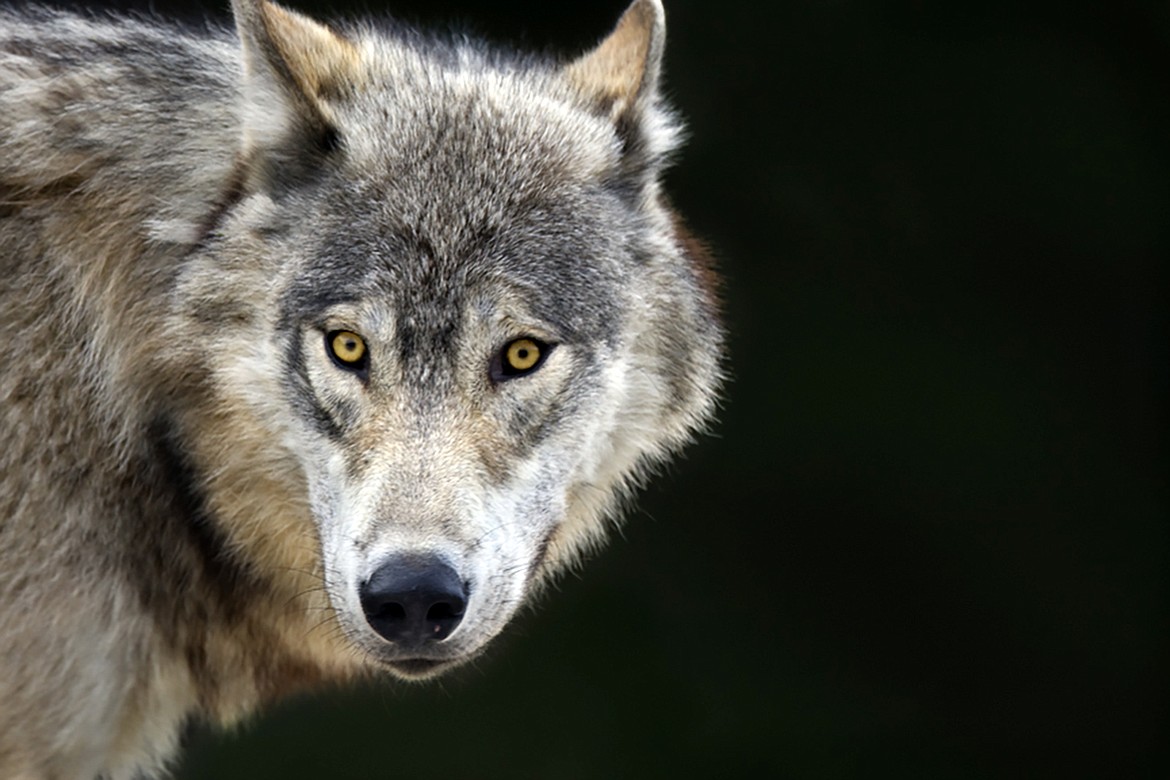
A wolf stops for a brief moment inside Yellowstone National Park. (Jeremy Weber/Daily Inter Lake)
The Montana Fish and Wildlife Commission set a quota of 300 wolves for the 2026-2027 hunting and trapping season, eschewing the recommendation of state biologists while also significantly lowering the number of tags available from last year.
Northwest Montana will account for more than a third of the season's wolf tags under a new regional quota system that Region 1 Commissioner Ian Wargo proposed ahead of the meeting. The final regulations, which passed in a 4-2 vote, set a wolf harvest quota of 131 in Region 1, 92 in Region 2, 33 in Region 3, 28 in Region 4, 6 in Region 5, 4 in Region 6 and 4 in Region 7.
Montana Fish, Wildlife and Parks originally suggested that the commission adopt a statewide wolf harvest quota of 250, marking a substantial departure from last season's statewide quota of 450 wolves. While the department is charged with monitoring and enforcing wildlife regulations, the seven governor-appointed commissioners have the final say in most regulatory processes, including the establishment of hunting and trapping rules each season.
Fissures between the monitoring and rule-making bodies was apparent at the Aug. 19 meeting, as Wargo expressed doubts about the scientific rigor behind the state's most recent wolf report. The document featured a revamped version of the statistical model, referred to as iPOM, that state biologists have used to estimate the statewide wolf population for more than a decade.
Using the updated model, biologists estimated 725 wolves inhabited Montana at the end of 2025. The previous version of the model calculated the statewide wolf population at 1,094 for the same point in time.
"It doesn't make a whole lot of sense to me," Wargo said. "This is a big issue for [Region 2 Commissioner Jeff Burrows] and I, and I guess I'm very passionate about this. I'm confident in what I'm seeing on the ground. I'm going to say it: iPOM 2.0, I feel, is overly conservative."
He said his plan to parse the harvest by region while increasing the overall quota would "prevent a runaway harvest year while it's also not putting an additional layer of handcuffs on us."
Region 1, which includes Lincoln, Flathead, Lake and Sanders counties, has long hosted an outsized portion of the state's wolf population. The most recent estimate suggested around 300 wolves roam the area. Regions 6 and 7 in eastern Montana, meanwhile, may only see a few vagrant wolves each year.
Both dissenters in the final vote, Region 4 Commissioner K.C. Walsh and Region 7 Commissioner Bill Lane, said they liked the idea of a more localized approach to wolf management, but that regional staff should have a chance to provide input on what those specific quotas should be.
"Right now, these are just very random numbers as far as what I can tell, so that's why I don't think this is the right time to do this," Lane told Wargo. "I think we just need to pump the brakes a little bit and get back to letting the biologists have the science side of it. We can't try to do that for them."
"The fact that we were given two numbers to start this conservation, I don't think relying on the biologists, at this point, as much..." Wargo started to respond before trailing off.
"I don't know," he finished.
Wargo was far from the only voice at the Aug. 19 meeting to express distrust in the state biologists. Hunters, ranchers and wildlife advocates alike scrutinized the variation in the wildlife agency's population models as proof of unsound science. Some argued the uncertainty meant the commission should maintain the 450-wolf harvest quota from last year. Others asserted that a total moratorium on wolf hunting and trapping should be enforced until the state provided a more precise population count.
Counting any population of wild animals is inherently messy. State biologists simply don't have the time or resources to track down every single wolf in the state, said Montana Fish, Wildlife and Parks Carnivore Coordinator Molly Parks. Instead, iPOM uses a slew of known numbers, such as the average territory size of a wolf pack and the average number of wolves in a pack, along with reported wolf sightings to estimate the state's total population.
The most recent version of the model replaces outdated nationwide averages related to territory size, pack size and lone wolf dispersal with Montana-specific data that state biologists have gathered through years of monitoring efforts. The updated model also places greater priority on wolf specialist reports, rather than relying on the sightings that hunters and trappers make to the wildlife agency.
The goal, Parks explained to commissioners, was to create a more precise way of estimating wolf populations. The result, when biologists actually ran the numbers, was an overall lower population estimate.
"I think the one thing we've all learned, the most challenging part about this, is it doesn't lend itself well to simple math," Game Management Bureau Chief Brian Wakeling said of the model. "It's got a lot of complexities."
The situation is further complicated by a 2021 state statute that directs the wildlife commission to establish rules "with the intent to reduce the wolf population in this state to a sustainable level, but not less than the number of wolves necessary to support at least 15 breeding pairs." The state has not defined what constitutes a "sustainable level," but Montana Fish, Wildlife and Parks has long maintained that a population of at least 450 wolves is needed to support 15 breeding pairs.
According to the 2025 Wolf Report prepared by Montana Fish, Wildlife and Parks, the statewide wolf population could dip below that threshold in the next few years if the full 300-wolf hunting and trapping quota is continually met.
Last year, 249 wolves were harvested out of a statewide quota of 450, including about 130 wolves in Region 1. Another 43 wolves were removed in response to livestock depredation or other safety concerns.
In addition to the altered harvest quota, Wargo's amendment nixed the state wildlife agency's recommended 100-wolf harvest sub-quota through Dec. 31. Wakeling told commissioners the agency recommended the sub-quota to ensure trappers get their "fair share" of the wolf harvest and keep the take near 250 wolves for the 2026 calendar year. The general harvest season for wolves runs from Sep. 15 through March 15.
WARGO INTRODUCED a second amendment to extend the general wolf hunting season through June 15 in the Bob Marshall Wilderness Complex.
Montana Fish, Wildlife and Parks opposed the amendment, arguing that the overlap with denning season would introduce further uncertainty into the agency's population estimates due to "undocumented loss of dependent pups or entire pack elimination."
Region 6 Commissioner and Commission Chair Lesley Robinson cited the agency's explanation in her tie-breaking vote against the amendment. Lane, Walsh and Region 3 Commissioner Kirby Brooke also voted nay.
The commission fielded more than 2,100 public comments about the wolf and furbearer hunting and trapping regulations ahead of the Aug. 19 meeting, most of them concerning the wolf harvest quota and iPOM. Commissioners heard another two hours of public comments during the meeting before taking a final vote to adopt the amended regulations, which also set quotas and established rules for the harvest of beavers, bobcats, fishers, martens, mink, muskrats and otters.
Reporter Hailey Smalley can be reached at 406-758-4433 or [email protected]. If you value local journalism, pledge your support at dailyinterlake.com/support.
ARTICLES BY HAILEY SMALLEY

Trump stumps for Flint in Kalispell as Election Day nears
President Donald Trump, wearing a dark suit, red tie and red USA cap, ambled into the Majestic Valley Arena to the raucous roar of a crowd.

Flathead National Forest greenlights Swan Valley timber project
A 2,307-acre timber project is now under way in the Swan Valley.
Flathead National Forest greenlights Swan Valley timber project
A 2,307-acre timber project is now under way in the Swan Valley.