
Opposition raised to change in Flathead County septic tank regulations
TAYLOR INMAN | Hagadone News Network | UPDATED 1 month, 2 weeks AGO
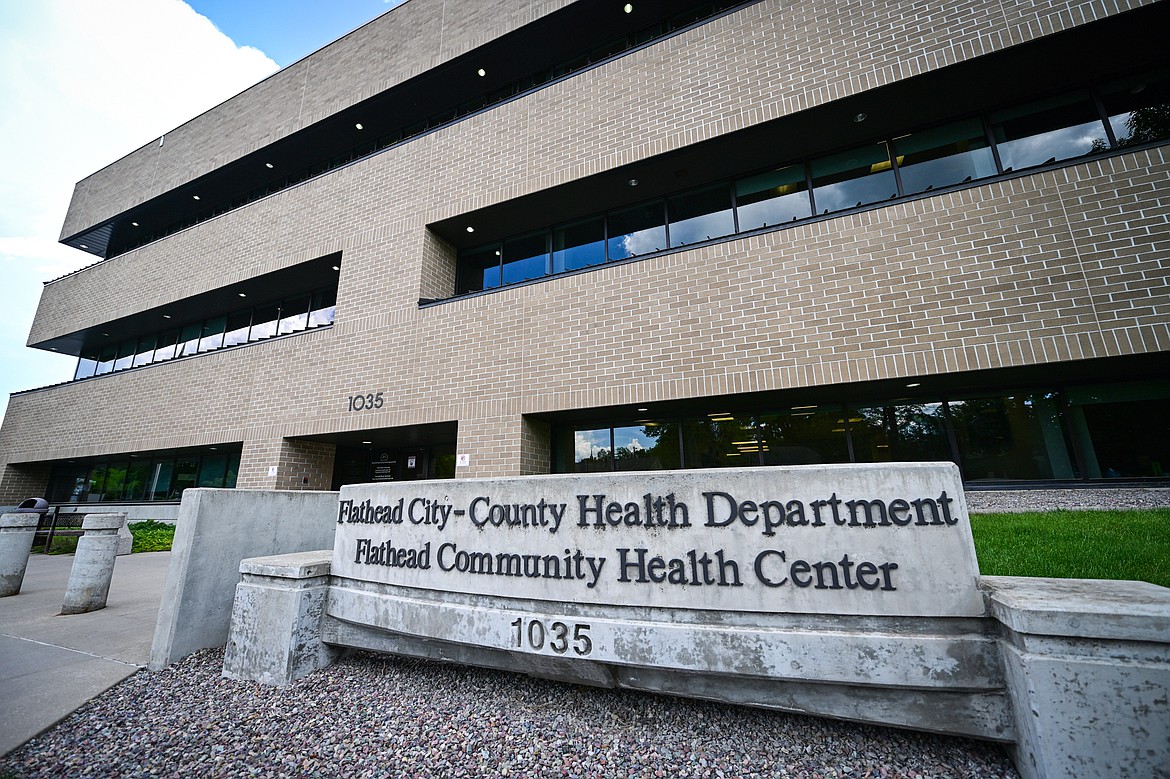
The Flathead City-County Health Department on Tuesday, June 10. (Casey Kreider/Daily Inter Lake)
Casey Kreider
REPORTER AND PODCAST HOST Taylor Inman covers Bigfork and the north shore of Flathead Lake for the Bigfork Eagle and the Daily Inter Lake. Her reporting focuses on local government, community issues and the people who shape life in Northwest Montana. Inman began her journalism career at Murray State University’s public radio newsroom and later reported for WKMS, where her work aired on National Public Radio. In addition to reporting, she hosts and contributes to Daily Inter Lake podcasts including News Now. Her work connects listeners and readers with the stories shaping communities across the Flathead Valley. IMPACT: Taylor’s work expands local journalism through both traditional reporting and digital storytelling. | February 10, 2026 11:00 PM
Proposed changes to Flathead County’s regulations for on-site sewage treatment systems would allow for gravity septic systems, which the county has not permitted since 2004.
Environmental Health Manager Jim Wardensky said some members of the Flathead City-County Health Board see gravity septic systems as another option worth having, particularly for people who live in rural areas.
But not everyone agrees with the proposed change — many residents and advocacy organizations argue that allowing gravity systems is a step backward for septic standards in the county, according to letters submitted during the public comment period.
The health board is set to review and discuss public comments regarding the proposed septic regulation changes at its Feb. 12 meeting.
Wardensky said while most of the updates to regulations include clarifying language, there are some notable changes — including removing sections that require systems to have uniformed pressure for septic drain fields and bringing back gravity septic systems.
In pointing to an instance when a gravity septic system would be an option, Wardensky recalled the example of someone living in the North Fork who may not have electricity on their property.
“A uniform pressure does system requires a power source to run the pump, but if you have somebody in a remote location where they don't have electricity yet and they want to have a septic system, they could accomplish that with the gravity system,” Wardensky said.
Gravity systems typically move sewage through pipes to a drainfield, where it flows with the help of gravity. The sewage ends up in a graveled trench, eventually reaching the surrounding soil, where bacteria and other microbes treat the wastewater by removing pathogens.
Uniform pressure septic systems work in a similar way but use a pump to more evenly distribute effluent into a drainfield.
Pressure systems outperform gravity-flow systems because distribution is more uniform, controlled and can be used in any application, according to the Montana Department of Environmental Quality, and pressure systems should be the “method of choice whenever possible.”
Among those residents who are opposed to allowing for gravity systems is Joe Russell, who was at the helm of the Flathead City-County Health Department from 1998 until his retirement in 2017.
There was a lot of process in determining the need to require uniform pressure systems during his tenure at the health department, Russell told health board members during a Jan. 26 meeting.
“For Flathead County, we have a lot of surface water. We have high groundwater, probably more surface water than any other county in the state ... But there was a need for a higher level of treatment. Uniform pressure was the best way to do it and the most economical,” Russell said.
In his written public comment, Russell outlined his opposition to the removal of a section in the regulations, which requires the use of uniform pressure distribution of sewage in septic systems.
Twenty years ago, during discussions about changing the regulations, Russell noted that municipalities were struggling with the non-degradation requirements established in state law and that “higher level of on-site sewage treatment seemed appropriate.”
Russell said issues could include trickle flows from the tank which result in discharges that are too low to flow throughout the entire subsurface network, or distribution that ends up unequal and localized, or a phenomenon known as “creeping failure” — where part of the drainfield will no longer accept sewage effluent, and the soil treatment area is lost.
“I have a uniform pressure drainfield. It works wonderfully. I know drainfields, I see a lot of them. I know when I'm looking at a healthy system versus a non-healthy system. Mine works awesome, I would never go back to anything like that,” Russell said.
Citizens for a Better Flathead also opposes allowing gravity systems.
“We have been very pleased that this board took the leadership many years ago, under Joe's leadership, to establish the highest standards in the state,” Mayre Flowers, executive director for Citizens for a Better Flathead, said at the Jan. 26 meeting.
Included in her public comment were links to studies from the Western Montana Conservation Commission and the Whitefish Lake Institute, which outline how septic systems impact nearby waterways.
The Flathead Basin Commission’s Flathead Basin Septic Risk Model marks what areas of the county are at the highest risk for underperforming septic systems, that can lead to high amounts of nutrients in local waterways, according to the 2020 study. Moderate to high-risk areas include Evergreen, Columbia Falls, parts of Kalispell, parts of Bigfork and the Lake Blaine area.
A 2012 study by the Whitefish Lake Institute investigated along the shoreline of Whitefish Lake looking for septic leachate, which is the liquid discharged from a septic tank that, when a tank fails can cause contamination to groundwater and surface water. Results found three confirmed sites for septic leachate contamination, along with the two sites with high potential and four sites with medium potential.
In addition to voicing opposition to gravity systems, Citizens for a Better Flathead also requested revising regulations to require a minimum Level 2 Advanced treatment for septic systems, as well as Level 2 advanced nutrient-reduction treatment for replacement of new or existing septic systems that are failing.
In her letter, Flowers requests that the health board follow in the footsteps of Gallatin County, which last year added rules for new septic systems near impaired streams to have a higher level of treatment.
The North Shore Water Alliance, along with the Flathead Conservation District, asked for an extension to the public comment period.
Jennifer Tipton, board chair of North Shore Water Alliance, submitted a letter during the last day of the public comment period on Jan. 30, noting that she just became aware of the changes being proposed.
“There is quite a lot of information to get caught up on. The way the information is presented makes it quite confusing as to what exact changes are being proposed,” Tipton wrote.
She also asked that the board reconsider removing the requirement to have uniformed pressure systems.
Montana Environmental Consultants Association, a group of consultants, engineers and surveyors, wrote in support of gravity systems, noting that it “shall be an available tool in the toolbox.”
Brian Launius, president of the association, said the systems are allowed in most counties in Montana. He said the footnotes from the Montana Department of Environmental Quality standards for gravity systems have specifications that limit installation to soil type, size and depth. Launius also pushed back on the argument that gravity systems are hard to install and hard to inspect.
The public comment period for input on the update closed on Jan. 30, but Wardensky said it’s still valuable for staff and the health board to hear from the public.
Other notable changes to the regulations include the introduction of incinerator systems, which Wardensky said can guard against environmental concerns, like septic leakage. The waste gets vaporized or burnt in the system, so nothing is put into the ground, he said.
The Flathead City-County Health Board is set to review and discuss public comments regarding the proposed septic regulations. The board meets Feb. 12 at 1 p.m. in Conference Room A/B in the Earl Bennett Building.
Register to attend or make public comment online at flatheadcounty.gov/department-directory/health/board-health/.
Reporter Taylor Inman may be reached at 758-4440 or [email protected].
ARTICLES BY TAYLOR INMAN

Plant Land helps customers spring into the gardening season
Heated greenhouses at the Evergreen garden center are filled with pottery, annuals, houseplants and some early season vegetables like onions, lettuces and herbs.

Despite Barnhart objections, county OK’s gravity septics
Flathead County homeowners can now apply to install a gravity septic system for the first time since 2004.

Logan Health physicians raise awareness about colorectal cancer
It’s more important than ever to get screened for colorectal cancer, according to Logan Health gastroenterologist Dr. Kate Wisser, who said catching the disease early saves lives.