
Kriete, Wagner express opposition to bills on sheriff eligibility
R. HANS MILLER | Hagadone News Network | UPDATED 2 months, 1 week AGO
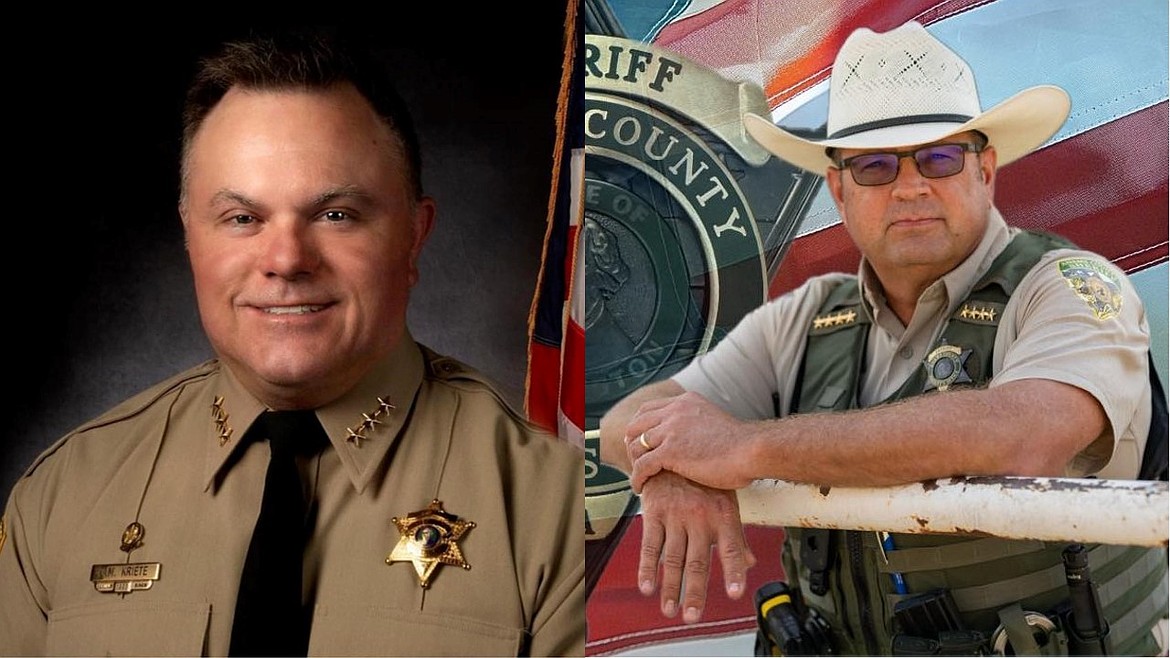
Grant County Sheriff Joey Kriete, left, and Adams County Sheriff Dale Wagner, right, have both come out in opposition of legislation that updates requirements for those who serve in elected or appointed law enforcement positions in Washington.
Managing Editor Rob Miller is a 4-year U.S. Army veteran who grew up in Western Montana in a community about the size of Soap Lake. An honors graduate of Texas State University, he enjoys spending time with his wife, Brandee, and their three dogs, Draco, Pepper and Cinnamon. He has one son, William. During his free time, he enjoys photography, video games, reading and working on the house he and his wife bought in Ephrata. He is passionate about the First Amendment and educating communities. | January 13, 2026 5:21 PM
MOSES LAKE — Grant County Sheriff Joey Kriete and Adams County Sheriff Dale Wagner have both expressed concerns regarding Senate Bill 5974, a companion bill to House Bill 1399, presented to the Washington Legislature this session. The legislation addresses eligibility requirements for leaders, including elected leaders, in law enforcement agencies.
“At the heart of this bill is a proposal that would allow an unelected state board to remove an elected Sheriff from office. My concern is simple: this takes decision-making power away from you, the citizens of our county,” Kriete said in a statement.
The bill, sponsored by Sen. John Lovick, D-Mill Creek, indicates that it is designed to update the requirements of outdated bills saying who can hold positions as sheriffs, police chiefs, town marshals and similar positions. It would require candidates to be U.S. citizens, possess a high school diploma or equivalent, have a record clear of felonies or gross misdemeanor convictions, two years of full-time law enforcement experience, peace officer certification obtained within 12 months of obtaining office and pass a background check. Additionally, veterans would need to have a general discharge under honorable conditions or better to serve in the office they are running for or appointed to.
“The bills also propose broader changes to the Office of Sheriff, including redefining duties and increasing state-level oversight of a locally elected position. While statewide consistency can be important, it is equally important to preserve the connection between local communities and the officials they elect to serve them,” Wagner said in a separate statement.
Kriete said oversight and how an elected sheriff might be removed from office is the crux of the issue. Under the new legislation’s requirement for the law enforcement official in question to be certified, the loss of certification through a process established by the Washington Criminal Justice Training Commission. Kriete says he feels that takes power from voters and puts it in the hands of an appointed board.
Both Kriete and Wagner pointed out that there are already measures in place at the local and county levels to remove elected or appointed law enforcement officials who behave poorly. Those can happen through a recall process or through the local prosecutor’s office.
Kriete said he does feel that laws that establish guidelines for sheriffs and other elected law enforcement officials do need to be updated, but the current versions of these bills take the wrong approach due to the WCJTC panels being involved as they are. Especially given that panels like that often have to address anonymous reports that could be politically motivated or based on getting back at officials involved in criminal cases.
“The way that the sheriff needs to be removed from office shouldn't be an automatic disqualification for the office if there's a decertification, because that decision has not been made by the people that put him in office,” Kriete said.
Instead, Kriete said there is movement on the part of law enforcement officers and organizations like the Washington Association of Sheriffs and Police Chiefs to adjust the legislation or propose alternatives.
“We’re trying to propose (amendments or other legislation) and move forward, to be proactive in this,” Kriete said. “So, it wouldn’t be that if somebody’s decertified, they eliminate them from office, but a proposal, I believe, is out there that if a sheriff is deemed decertified, then it may trigger the recall process for the voters to remove, so we’re trying to work on some language with legislation.”
ARTICLES BY R. HANS MILLER
Court cases in March 2025 shooting death of Moses Lake teen moving forward
EPHRATA — Jose D. Beltran Rodriguez, 21, of Moses Lake, and Matthew Gabriel Valdez, 19, also of Moses Lake, remain in custody at the Grant County jail after being arrested in connection with a March 21, 2025, drive-by shooting in Moses Lake.

Sentencing hearing set in 2022 Moses Lake murder case
EPHRATA — Juan Gastelum, the suspect in the March 2022 killing of Yanira Cedillos, changed his plea from not guilty to guilty on March 3. He is now scheduled for an April 28 sentencing hearing. According to court documentation, Gastelum, 32, of Hermiston, Ore., pleaded guilty to Murder in the Second Degree with Sexual Motivation. The minimum sentence Gastelum may receive under the law is two years in prison, but the maximum is life imprisonment and up to a $50,000 fine. However, the sentencing hearing is under Special Set Sentencing, an option under Washington state law which allows adjustments to sentencing if a suspect pleads guilty.

Court case in Nov. 2025 Moses Lake shooting moving forward
EPHRATA — The trial into the shooting of a 23 year old Moses Lake man is progressing through Grant County Superior Court. Darwin Nahun Tejada Martinez, 29, of Seattle is on trial facing a single charge of Assault in the First Degree after investigators say he shot the victim in a Nov. 25, 2025, incident.