
Neighborhood character deemed a ‘loaded’ term for Whitefish’s growth policy
KELSEY EVANS | Hagadone News Network | UPDATED 2 months, 2 weeks AGO
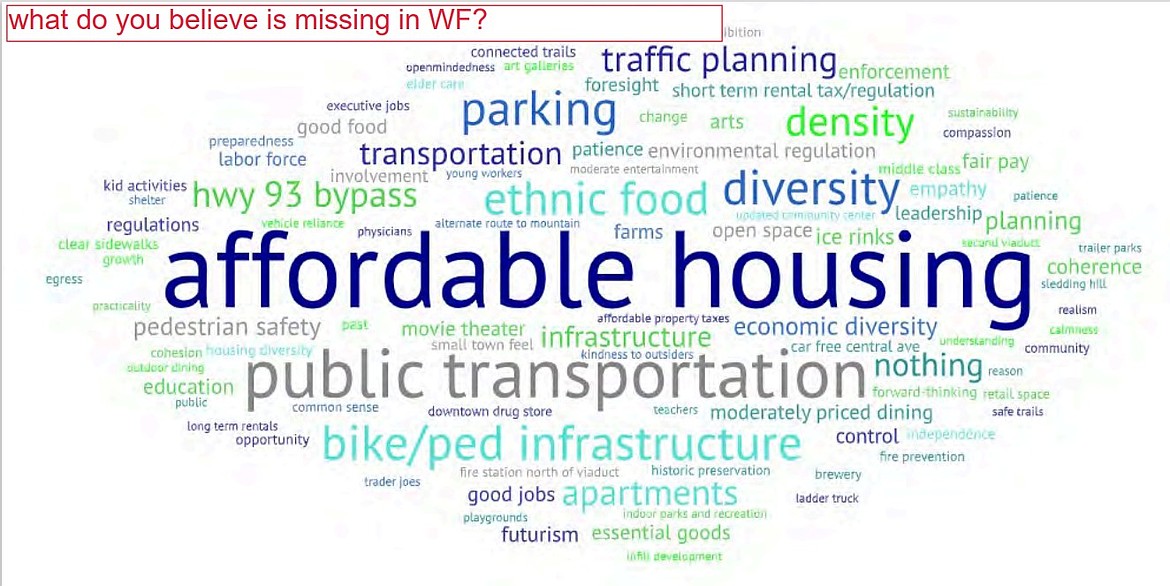
A word cloud produced from responses to the city's first survey prior to beginning the update to the growth policy in 2024.
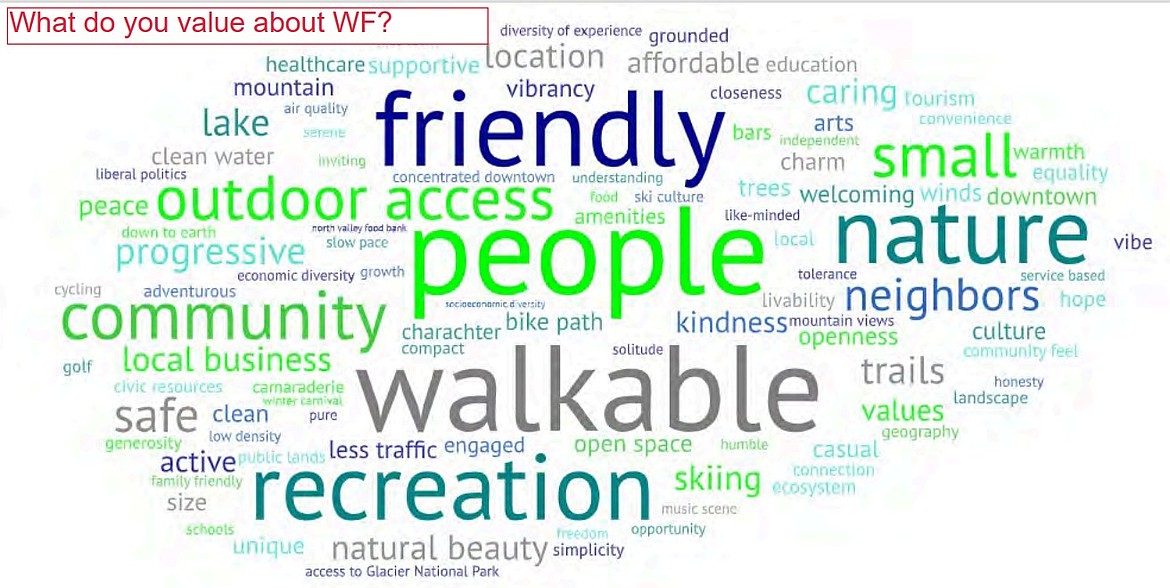
A word cloud produced from responses to the city's first survey prior to beginning the update to the growth policy in 2024.
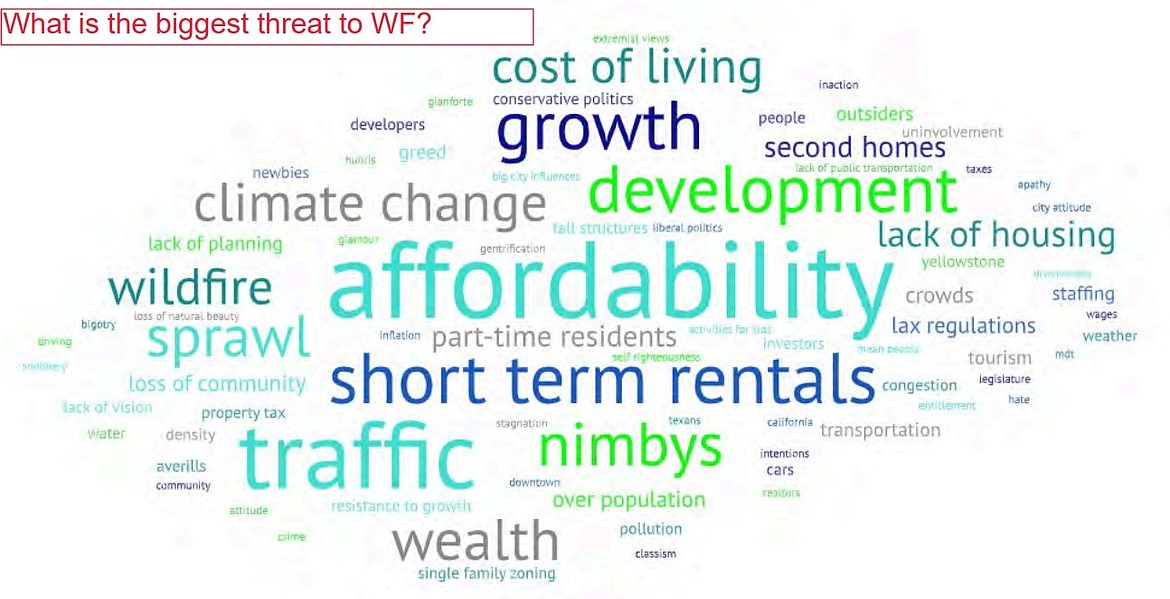
A word cloud produced from responses to the city's first survey prior to beginning the update to the growth policy in 2024.
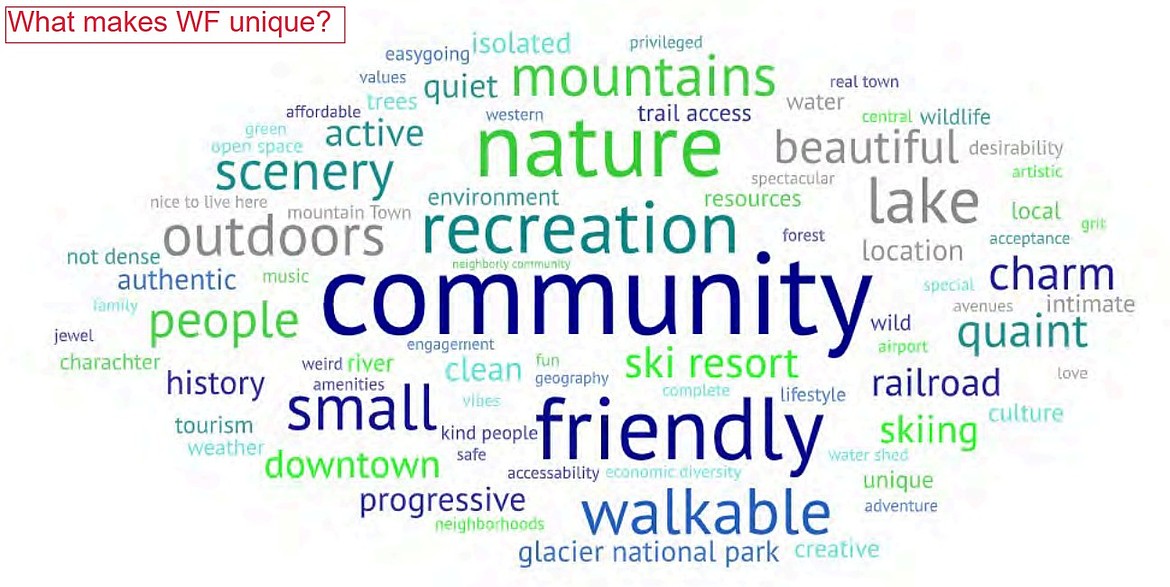
A word cloud produced from responses to the city's first survey prior to beginning the update to the growth policy in 2024.
Neighborhood character has been a leading point as the city updates its growth policy, but some residents say the concept lends itself to inequity.
At a Jan. 7 Planning Commission meeting on the housing element of the Vision Whitefish 2045 planning document, board member Mallory Phillips motioned to remove the phrase “new housing will be complimentary and respectful of existing neighborhoods.”
Planner Alan Tiefenbach explained that the term "complimentary and respectful” was used because it is more suitable than “neighborhood character.”
“Community character is a very difficult term,” Tiefenbach said. “It is a term of great controversy. I tried to limit it and be more cognizant of saying, ‘respect what’s there now,’ because what I heard during visioning, is that that’s one of the top things. Not just small-town character but preserving ‘quaint.’”
Phillips said that putting emphasis on existing neighborhoods “implies that new housing must conform rather than evolve. That also means some neighborhoods are required to absorb all the change in growth while other neighborhoods are protected. This creates an inequity and also creates gentrification, especially when the wealthiest members of our community are allowed to see little to no change in their neighborhoods because they have the organizing power.”
Board Chair Whitney Beckham said she did not take any issue with either term.
“For the past eight years on the planning board, it’s been ‘does this fit with neighborhood character?’ That’s been the crux of things,” she said. “So, it has been used a lot to say, ‘no, this cannot be here.’ And we just heard overwhelmingly in the visioning sessions to preserve neighborhood character.
“I think anything that is added should be complimentary and respectful,” she said.
Phillips said that historically, “language has been weaponized in both code and in process. Existing neighborhood character led to loans not being allowed to be utilized by people of color and poor people.”
Tiefenbach later said, “I'm hoping that the goals and the overall intent of this housing element describe, that that's not what we're trying to do.”
The board agreed that rather than remove the sentence, to add a clarification that a diversity of housing types is encouraged throughout the city.
In another clause in a separate section of the policy, Phillips suggested “incremental development” as an approach to rewording “existing neighborhood character,” because that would allow for neighborhoods to preserve while also slowly changing over time.
Quality, scale and operation, and form and function were also suggested as alternatives to “character.”
The commission approved 5-2 to replace “character” with “form and function.”
As the meeting stretched for four hours, the commission debated how to best address concerns with language in the document. It was considered to add a glossary to define challenging terms, but deemed not possible at the time of the meeting.
At the end of the meeting, resident Rhonda Fitzgerald spoke on the matter.
“Everybody in town said they cared about [neighborhood character] and you guys all know it,” she said. “If you don't like that term, you should ask people to say what they really mean, not just discard it because you think it means redlining, which has never happened in Whitefish, ever. People are more worried about very rich people moving into their neighborhood, scraping their neighbor and building a monstrosity. They're not worried about hardworking workforce.”
Fitzgerald had also questioned the removal of setbacks.
“We feel that setbacks ... retain neighborhood integrity,” she said.
“Otherwise you’re going to get tiny lots next to mansions.”
Fitzgerald also suggested that an objective should be added to hold employers responsible for providing employee housing.
Keegan Siebenaler, director of Shelter WF, said in response, “I applaud the businesses that try to provide housing for their employees, but that’s a symptom ... of a failed system, not a goal. Tying your employment to the place where you live is a terrible outcome, because if you lose your job, you can lose your housing.”
The board later added setbacks back in and approved to add “support and encourage employee housing” to objectives.
The board also approved amendments to use more thoroughly, “attainable” housing in addition to “affordable” housing, a term which is inclusive of all classes.
The board agreed to add a sentence acknowledging that new federal policy could result in Montana receiving 70% less federal funding for affordable housing.
In other public comments, resident John Heberling said more density is fine, but that commercial prospects are a threat to “everybody’s house in the old neighborhoods.”
“The No. 1 value picked in visioning sessions in 2024 was ‘retain small town feel,’ and mixed-use is clearly contrary,” he said.
Daniel Sidder, director of Housing Whitefish, said, “It is very important that no neighborhood should experience rapid change, but no neighborhood should be exempt from change.”
Nathan Dugan anecdotally described a book titled “The Anxious Generation.”
“Design and zone public space with children in mind,” he read. “If we want children to meet each other face to face, and not just on screens, the world and its inhabitants have to be accessible to them. A world designed for automobiles is not one.”
About 70 public comments were received on the population projections used to inform the 2025 Whitefish Housing Needs Assessment.
Tiefenbach said that the policy is not a plan or a study.
“Changing these numbers does not change the objectives and goals to get more housing,” he said.
To address this, the commission added a statement that says the most recent population estimates in the most recent version of the city’s housing needs assessment should be used, under the assumption that both will evolve and be updated.
According to Tiefenbach, because of the mandates to finish the policy by May, city councilors are already reviewing sections of the growth policy – red marks and noted disagreements included – before it receives a recommendation from the Planning Commission.
A work session is scheduled for City Council on the first elements of the plan on Jan. 20.
All drafts of each element of the growth policy, and public comments informing them, are online at engagewhitefish.com
There is an open house on Wednesday, Jan. 14 from 5:30-7:30 p.m. featuring presentation boards outlining the framework for the land-use element.
There is another work session on transportation and housing elements on Feb. 2.
Thereafter the land-use element and zoning are the remaining parts of the policy to be completed. The first meeting on land use is scheduled for Feb. 4.
A public hearing for the full draft is Feb. 19.
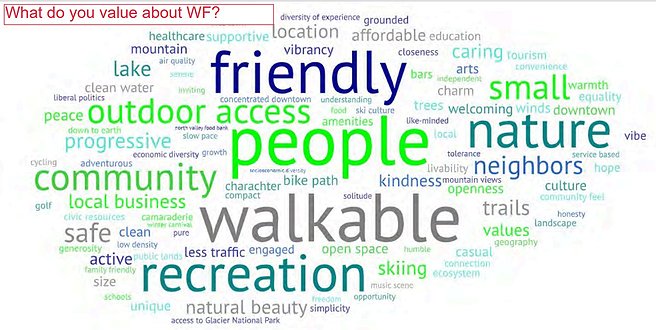 A word cloud produced from responses to the city's first survey prior to beginning the update to the growth policy in 2024.
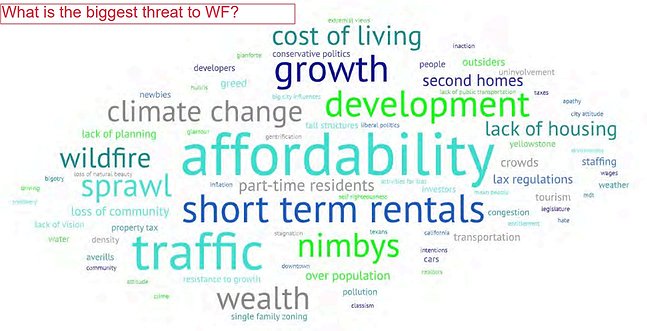 A word cloud produced from responses to the city's first survey prior to beginning the update to the growth policy in 2024.
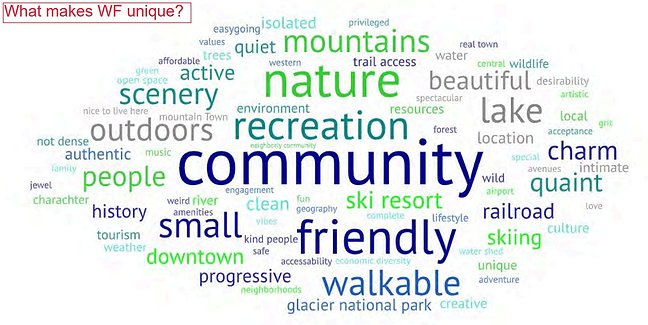 A word cloud produced from responses to the city's first survey prior to beginning the update to the growth policy in 2024.
ARTICLES BY KELSEY EVANS

Solid freshman class to bolster track and field teams past adversity
The sunny and brisk Monday afternoon was a pseudo first day of practice for the Bulldogs, who have to sharpen up quickly after spring break for this weekend’s debut meet: the ARM Invite.

Skimo North American champion hails from Big Mountain
Whitefish eighth grader Porter Shehan skinned, climbed and skied his way to a skimo North American title and a national title this season.
Casual eatery Grouchy Grizzly to open in Whitefish this summer
Whitefish’s Last Chair Kitchen and Bar, a restaurant at Lakeshore Drive and Reservoir Road, has been sold and will undergo a phased transformation, into a casual, fun-focused eatery called Grouchy Grizzly.