
Statewide sampling shows chronic wasting disease detections up from previous years
HAILEY SMALLEY | Hagadone News Network | UPDATED 9 months AGO
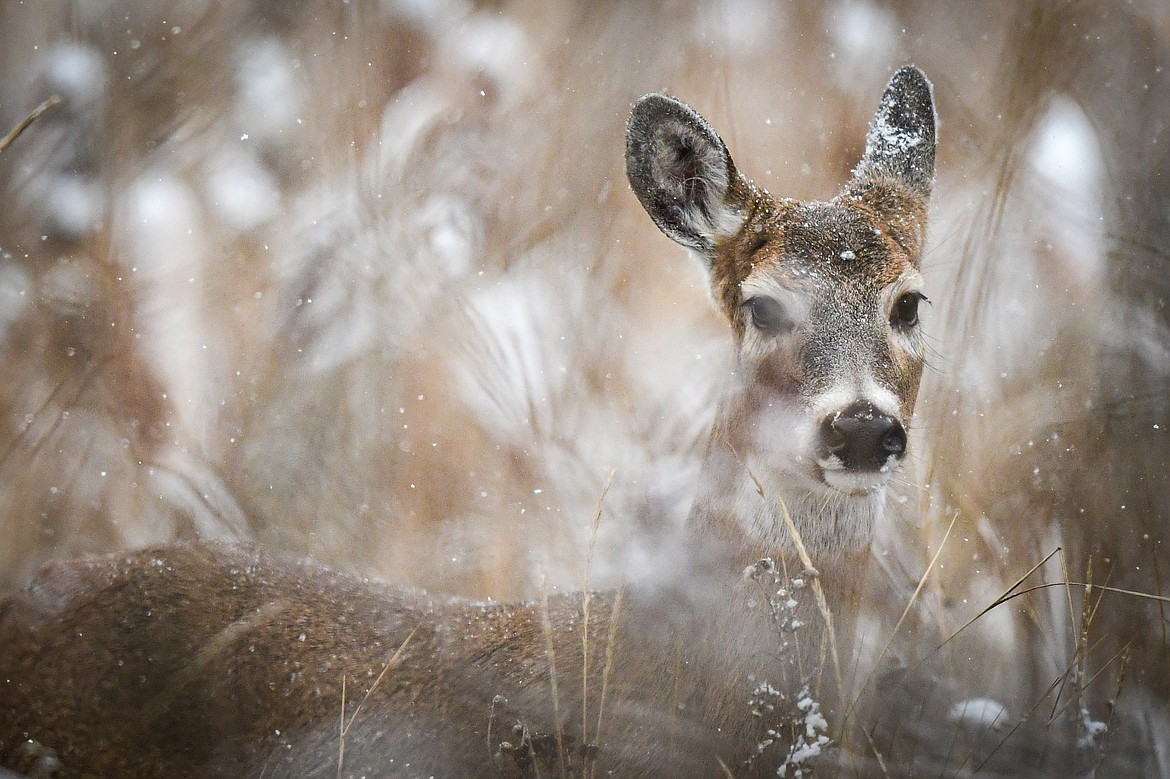
Snowflakes collect on a deer's ear at Lawrence Park on Wednesday, Nov. 20. (Casey Kreider/Daily Inter Lake)
Casey Kreider
State wildlife officials detected upwards of 400 cases of chronic wasting disease during the 2025-26 hunting season, as the fatal illness continues to impact deer and elk populations across the state.
The 100% fatal neurological disorder affects ungulates, including mule deer, white-tailed deer, elk and moose, and spreads through both direct and indirect contact with bodily fluids.
Detection of the disease in Montana’s wild deer populations in 2017 spurred state wildlife officials to create a statewide sampling program, in which hunters voluntarily submit their harvest for testing. A small clipping is typically taken from the lymph nodes, muscle and brains of the animal and sent to a state lab, where biologists run tests on the samples to determine whether the misfolded proteins that cause chronic wasting disease are present.
More than 60,000 samples have been submitted for testing since the program began, giving biologists valuable insights into the prevalence and spread of the deadly disease.
“We really want to know if there are places where it’s taking off,” said Bevin McCormick, a biologist in the state’s wildlife disease program.
That could be the case this season. Just over 5% of the samples submitted for testing between July 2025 and January 2026 tested positive for chronic wasting disease — a notable increase from 3.75% of samples during the 2024-25 season.
The uptick could reflect a spike in the number of chronic wasting disease cases the state is dealing with, but it could also be the side-effect of some other factor, said McCormick. If a greater percentage of samples came from male deer, for example, biologists might expect to see an increase in positive cases because bucks are more likely than does to contract the disease.
“It’s also possible that the greater number of positives is the result of where we sampled,” said McCormick.
This year, state wildlife officials focused extra time and resources on procuring samples from areas in west-central and eastern Montana. The latter is known to have a high prevalence of chronic wasting disease, especially along the northern border with Canada.
Location could also be to blame for a lag in the total number of samples taken. During the 2024-25 season, biologists tested 9,504 samples for chronic wasting disease, compared to just 8,630 for the 2025-26 season.
McCormick said she wasn’t surprised by the decline in samples, given the emphasis on testing in eastern Montana where fewer deer harvests typically occur.
Additional samples will likely be added to the season’s count as some districts implement late season hunts. The agency also partners with some municipalities to test urban deer populations and collects samples from roadkill.
Once the sampling season closes at the end of June, McCormick and other members of the wildlife disease program will sift through the data and produce an annual report, detailing the results of the past year’s sampling efforts. The document provides an opportunity for the team to drill down into the data and determine the drivers behind statewide and local trends, such as this year’s increase in chronic wasting disease detections.
Until then, Montanans can stay abreast of the latest chronic wasting disease detections through the Montana Fish, Wildlife and Parks website. A dashboard run by agency provides real-time data on the number of samples taken and positive cases identified in each hunting district.
Despite the statewide uptick, chronic wasting disease was detected in only 40 of the 2,069 samples collected in northwestern Montana this season.
Half of the positive detections came from Hunting District 100, which includes Libby. Another 18 cases came from Hunting Districts 103 and 104, which span the Cabinet Mountains, and two cases were identified in Hunting District 170, encompassing Kalispell and much of the Flathead Valley.
All four hunting districts have had samples test positive for chronic wasting disease in previous seasons.
Chronic wasting disease has also been identified on the Flathead Indian Reservation.
Reporter Hailey Smalley can be reached at 758-4433 or [email protected].
ARTICLES BY HAILEY SMALLEY

Trump stumps for Flint in Kalispell as Election Day nears
President Donald Trump, wearing a dark suit, red tie and red USA cap, ambled into the Majestic Valley Arena to the raucous roar of a crowd.

Flathead National Forest greenlights Swan Valley timber project
A 2,307-acre timber project is now under way in the Swan Valley.
Flathead National Forest greenlights Swan Valley timber project
A 2,307-acre timber project is now under way in the Swan Valley.