
Idaho doctor shortage persists
CAROLYN BOSTICK | Hagadone News Network | UPDATED 3 months, 1 week AGO
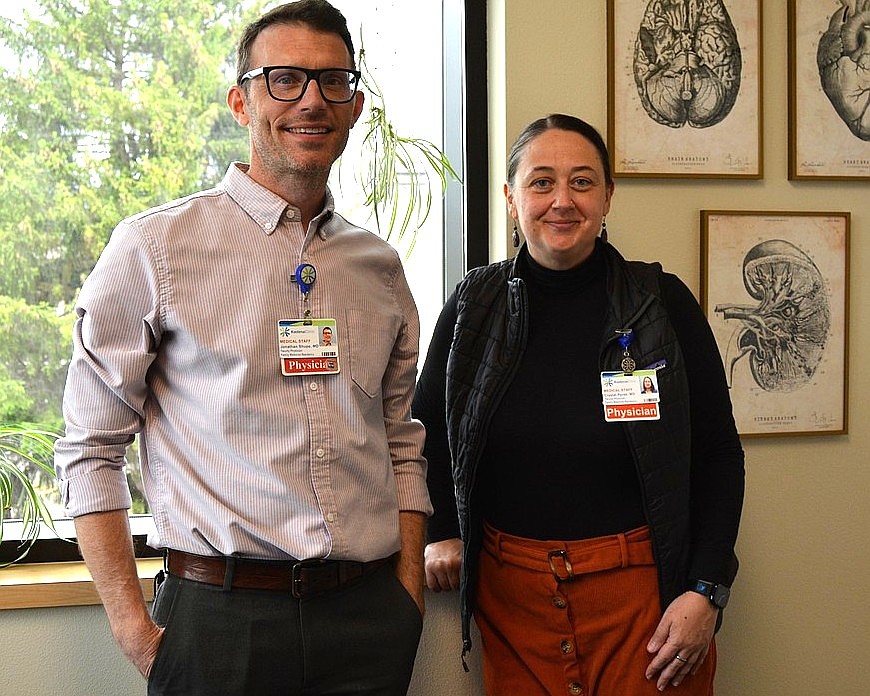
Dr. Jonathan Shupe and Dr. Crystal Pyrak say Idaho needs more doctors.
CAROLYN BOSTICK/Press
CAROLYN BOSTICK/Press
Carolyn Bostick has worked for the Coeur d’Alene Press since June 2023. She covers Shoshone County and Coeur d'Alene. Carolyn previously worked in Utica, New York at the Observer-Dispatch for almost seven years before briefly working at The Inquirer and Mirror in Nantucket, Massachusetts. Since she moved to the Pacific Northwest from upstate New York in 2021, she's performed with the Spokane Shakespeare Society for three summers. | July 14, 2026 1:00 AM
Among health care professionals in Idaho, one concern remains constant: The state needs more doctors.
Dr. Jonathan Shupe said North Idaho's five northern counties are expected to be short about 50 primary care physicians by 2030.
“If we were to fill 1,400 new physician positions tomorrow in Idaho, we would only reach the national average,” Shupe said. “That shows the magnitude of the shortage in our state.”
Health care providers are working to close that gap. Kootenai Health's family medicine residency program trains seven physicians each year.
“Seven physicians a year seems small compared to the need, but that's really our mission,” Shupe said.
The program has been operating for 10 years and has graduated 62 physicians. Of those graduates, 32 remain in Idaho and 16 practice in Kootenai County.
“We know that when people train in a community, they're more likely to stay there,” Shupe said.
Despite those efforts, Idaho remains the only state without a public, in-state medical school, leaving hospitals and health care organizations searching for ways to build a stronger physician pipeline.
Medical leaders are advocating for expanded undergraduate medical education opportunities and more funding for residency programs. Additional financial support would help practicing physicians dedicate time to training future doctors during their three-year residencies.
“At the state level, it would help to expand residency training opportunities,” Shupe said. “A lot of it comes down to dollars and cents.”
Providing financial support for physicians who serve as educators could create more training opportunities throughout the state.
At the same time, Idaho faces the challenge of stabilizing its physician workforce after the departure of many doctors in recent years.
“There are many tens of thousands of people looking for primary care physicians,” Shupe said. “Providers are doing more with less, but that's only sustainable for so long. Unfortunately, people are going without care, and we see that all the time.”
Primary care physicians can help reduce health care costs by identifying and treating health issues before patients require expensive emergency room visits. Shupe said patients who are uninsured or underinsured often end up seeking care in the most expensive parts of the health care system.
Beyond health outcomes, physicians also contribute to local economies. According to the National Center for Rural Health Works, a rural primary care physician practicing in a community with a local hospital generates an estimated 26 jobs and nearly $1.4 million in local income through clinic and hospital operations.
That economic impact is one reason Dr. Crystal Pyrak advocates for physician recruitment through the Idaho Academy of Family Physicians, particularly in rural communities.
“It's a challenge. Burnout is a significant issue for our primary care workforce,” Pyrak said. “Physicians are taking on more patients and doing more because we're also short on specialty services.”
Until Idaho attracts more physicians, family medicine doctors will continue filling gaps traditionally handled by specialists.
“Family medicine physicians are stepping into broader roles in rural communities,” Pyrak said. “We're seeing more family physicians providing OB-GYN services across the state.”
She identified prenatal care, women's health and behavioral health as three of the most significant care gaps in Idaho.
Both Shupe and Pyrak said financial stability is critical to maintaining and expanding health care access. Sustainable reimbursement rates from insurers and government programs would allow providers to serve more patients.
“As reimbursement goes down, the ability to care for broader populations also goes down,” Shupe said.
Despite those financial pressures, Kootenai Health encourages its resident physicians to provide care regardless of a patient's insurance status.
“We train our graduates to be as agnostic to insurance as possible and provide an appropriate level of care,” Shupe said.
The residency program typically receives about 300 applications each year for just seven positions. However, Kootenai Health has recently seen a decline in applications, partly because of challenges international medical graduates face in securing visas.
“Limiting legislative roadblocks to providing care is really important for recruiting future residents,” Pyrak said.
North Idaho's rural nature has also shaped its health care model. Many small communities rely heavily on family physicians who practice a broad range of medicine.
“It leads to very small health care systems staffed by family physicians with an incredibly broad scope of practice,” Pyrak said. “When state laws limit what physicians can do, and those limitations don't align with medical best practices, it can be difficult to reassure applicants that they'll receive the training they need.”
As Idaho continues to face physician shortages, health care leaders say expanding training opportunities, improving recruitment and supporting the existing workforce will be essential to meeting the state's growing health care needs.
ARTICLES BY CAROLYN BOSTICK

AUG NIBJ Growing the next crop of local leaders
Sometimes, leadership is being the only person in the room willing to raise their hand.
Idaho doctor shortage persists
State trying to recruit more physicians, but challenges remain
Among health care professionals in the state, one statement remains a constant: Idaho needs more doctors.
Idaho doctor shortage persists
State trying to recruit more physicians, but challenges remain
Among health care professionals in the state, one statement remains a constant: Idaho needs more doctors.