
Whitefish Lake still free from AIS
JULIE ENGLER | Hagadone News Network | UPDATED 3 months, 1 week AGO
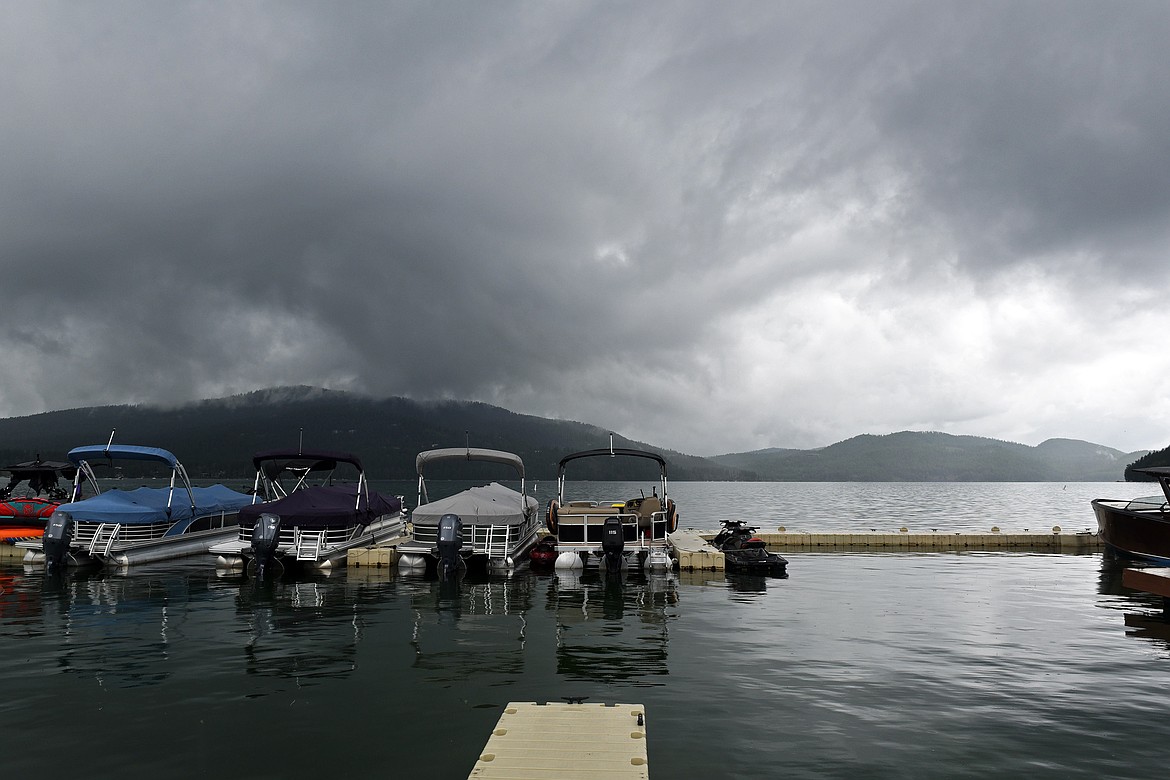
The boat dock at The Lodge at Whitefish Lake during rainy weather on June 26, 2026. (Kelsey Evans/Whitefish Pilot)
Julie Engler covers Whitefish City Hall and writes community features for the Whitefish Pilot. She earned master's degrees in fine arts and education from the University of Montana. She can be reached at [email protected] or 406-882-3505. | July 15, 2026 1:00 AM
Mike Koopal, executive director of the Whitefish Lake Institute, said one of the successes of the partnership between the city and the institute has been the lack of aquatic invasive species in Whitefish Lake.
“We still don't have any aquatic invasive species in Whitefish Lake that we know of, and we're out there looking for it,” Koopal said. “I think Carla and Maria's effort of the inspection stations has been a huge success.”
Maria Butts is the director of the Parks and Recreation Department, and Carla Belski, community services coordinator, runs the decontamination station at City Beach and the two city inspection stations.
Koopal presented a water quality update to the Whitefish City Council last week. He also introduced Jen Parsons as the organization’s new finance administration manager.
“Montana's still clear of dreissenid mussels, which are zebra mussels and quagga mussels, their cousin,” Koopal said. “I'm a little more concerned about quagga mussels in Whitefish, just because they can live and softer substrate at greater depths.”
The number of AIS inspections at both the City Beach and Whitefish Lake State Park stations has stabilized over the last several years. The total number of watercraft inspections and removal of exit seals hovers around 6,000 per year.
Koopal explained that an exit seal is a plastic tie that attaches to the boat trailer and the boat. If the owner goes somewhere else and launches their boat, it'll break that seal. If they don't go anywhere else and they come back to Whitefish Lake with an intact seal, they don't have to go through the same rigorous inspection program.
Koopal said the exit seals have expedited traffic at both Whitefish locations.
So far this year, 21 mussel fouled boats have been intercepted in Montana. At this time last year, there were about 25.
The Whitefish Lake Institute worked with Montana Fish, Wildlife and Parks to kill Eurasian watermilfoil in Beaver Lake since 2012. Koopal said curly leaf pond weed was found in Haskill Creek a few years ago.
"We don't think we're going to ever eradicate this, because some parts of Haskill Creek are a little deeper, and we can't visualize very well,” he said. “Our management, intent here is to keep it from reaching the Whitefish River, so that it doesn't get into the river, go downstream and populate basically the Flathead basin.”
He said there are a couple of aquatic invaders that are relative newcomers to the Flathead — golden mussels and a Chinese mystery snail that is in Flathead Lake now.
“That was probably introduced just by someone taking their aquarium water and dumping it in,” he said.
Koopal recommended the city continue to request regular updates from the Department of Environmental Quality regarding gasoline derivatives BTEX (benzene, toluene, ethylbenzene and xylenes). seepage behind the Town Pump gas station in Whitefish. The contaminated soil has been an issue for nearly 30 years.
About 20 years ago, there were moderate to high levels of benzene at City Beach. In 2024, the amount of the chemical was substantially reduced. Koopal said the interceptor trench and better engine technologies have made City Beach a “much safer place for the kids to swim.”
The level of perchlorates -- used in the propulsion of fireworks -- in the lake spike after July 4 and tail off after about a week at City Beach, but the levels were higher at Les Mason State Park. Koopal points to wind and currents as possible explanations for the change.
The Institute is repeating the study due to the importance of the water quality issue.
Big Mountain Water Company wells were found to contain detectable levels of PFAS, or “forever chemicals” earlier this year.
“We at Whitefish Lake Institute wanted to go out and see if we had PFAS in our surface waters around Whitefish. So, we tested for this in First, Second and Third creeks, Whitefish Lake and Whitefish River, and basically, we found some PFAS in all surface water bodies,” he said.
He said the PFAS in the lakes can combine with the perchlorates and septic leachate, making it difficult to say what the health risk of this “chemical cocktail” is, but he assured the Council, there is a health risk.
"There's a health risk out there and it can be from contact exposure. It could be from drinking it, or you can inhale some of these things,” he said.
He said while the Whitefish Lake Institute has seen several successes both on its own and with partners like the city, Montana Fish, Wildlife and Parks, Forest Service, University of Montana and the Flathead Lake Biological Station and the Whitefish County Water and Sewer District
Successes include Beaver Lake, gas constituent loading at City Beach, and the lack of AIS in Whitefish Lake. A long-term water quality monitoring program is also thriving.
Still, there are still challenges, including contaminants, septic systems, recreational pressure on Whitefish Lake, and lakeshore violations.
Reporter Julie Engler can be reached at 406-862-3505 or [email protected]. If you value local journalism, pledge your support at whitefishpilot.com/support.
ARTICLES BY JULIE ENGLER
Photo: Water tank rises in Whitefish
The tank for the Whitefish south water tower was hoisted on Thursday, Oct. 8.

Whitefish soccer teams advance to state semifinal round
Whitefish soccer continued its winning ways in the quarterfinals of the Class A playoffs at home Saturday.

O’Shaughnessy Center gets upgrades and design refresh
Recent upgrades to the O'Shaughnessy Center have increased the building’s energy efficiency and prepared the nearly 30-year-old facility to serve the needs of the growing community into the future.