
Weed Eaters Inc.: Goat brigade goes to work
KRISTI NIEMEYER | Hagadone News Network | UPDATED 3 months, 1 week AGO
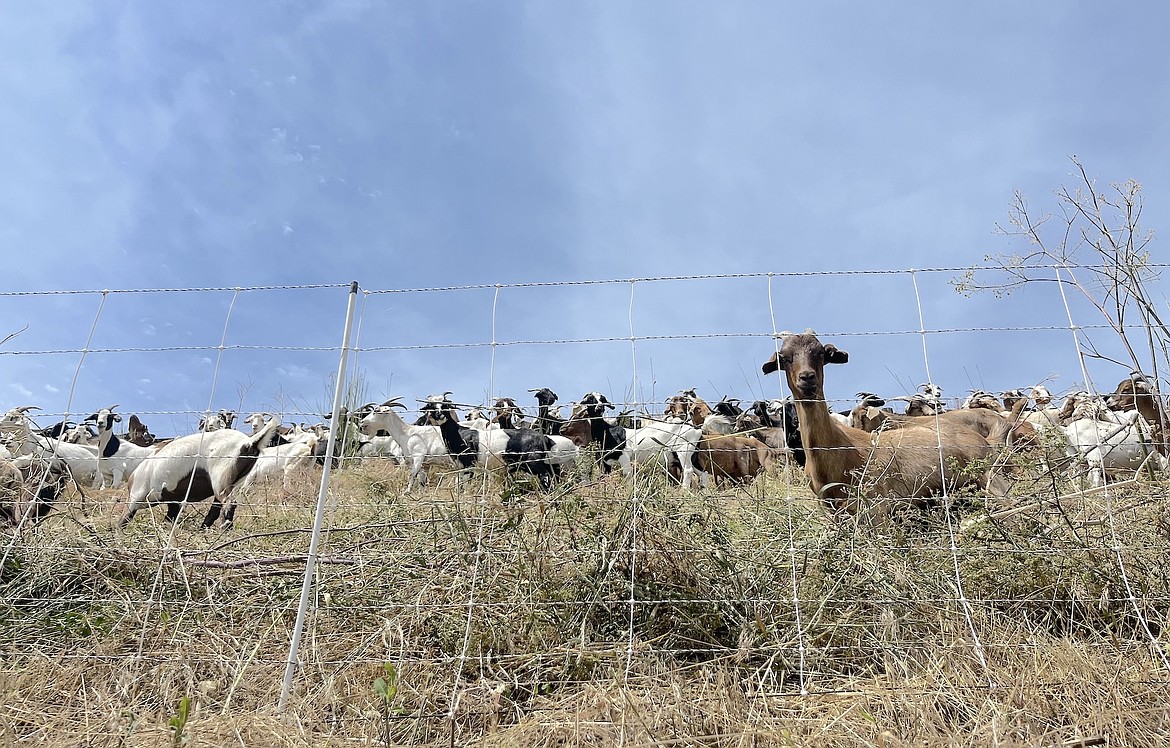
A curious member of the team at Weed Eaters Inc. regards the photographer before returning to her meal at Bear Harbor Condos in Polson, where the goats were stationed this week. (Kristi Niemeyer/Leader)
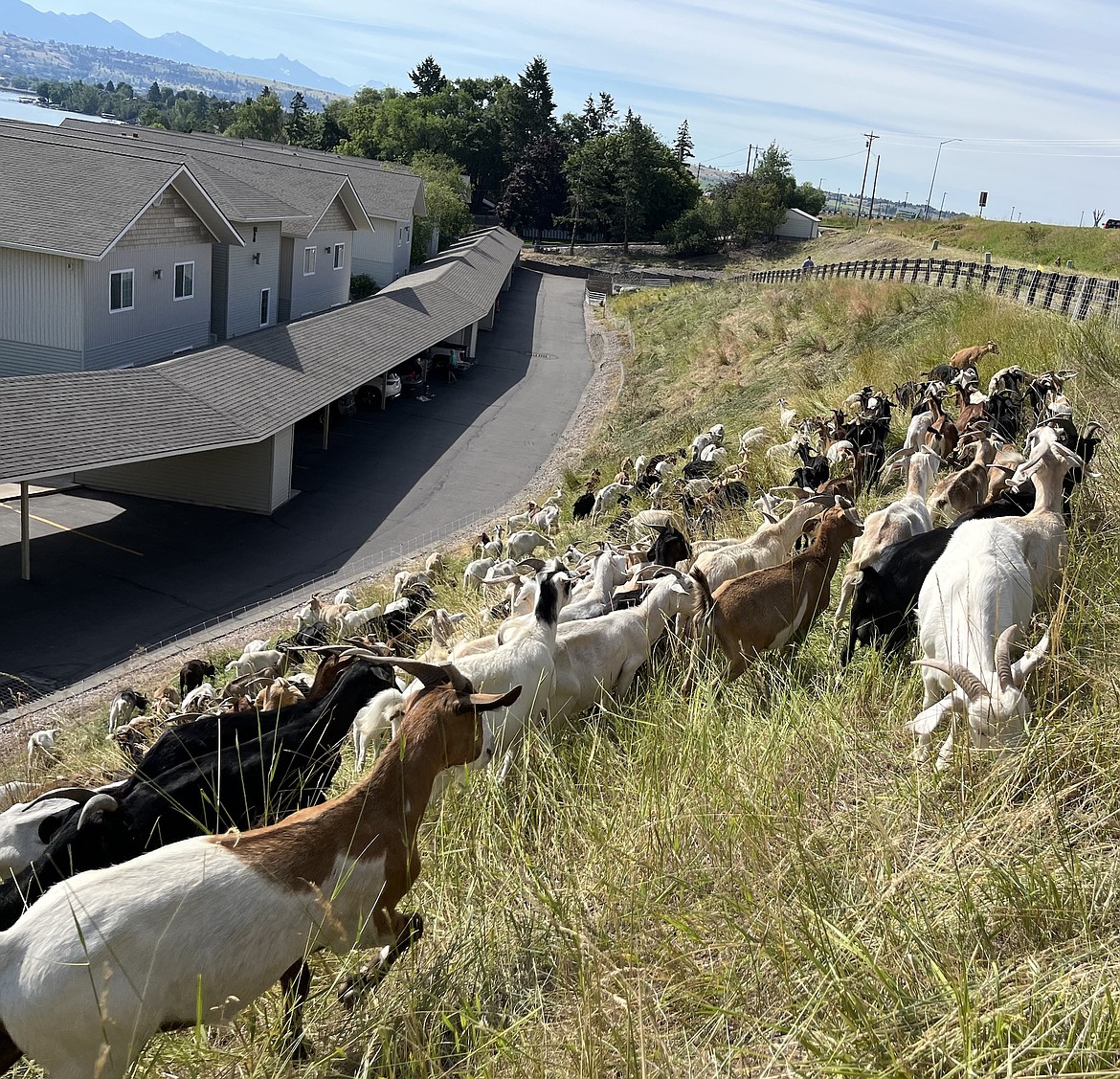
The steep hillside above Bear Harbor Condos in Polson was flooded with 190 weed-eating goats this week. (Kristi Niemeyer/Leader)
Kristi Niemeyer learned her newspaper licks at weekly newspapers, beginning at the Mission Valley News in 1981, then at the helm of the Ronan Pioneer and, eventually, as co-editor of the Lake County Leader until 1993. She launched and co-published Lively Times, a statewide arts and entertainment monthly, before returning to the Leader in 2022, and serving as its editor until July 2026. Reach her at [email protected] | July 16, 2026 12:00 AM
A herd of 190 industrious goats went to work Sunday, devouring weeds and mowing grass on a steep hillside at Bear Harbor Condominiums in Polson.
Foreman and goatherd Will Powell of St. Ignatius said it would take his crew about three days to demolish the weed patch. While the slope is too steep and treacherous for a human to mow, it offers an easy and tasty meal for the sure-footed team at Weed Eaters Inc.
“They can walk, run and play on that hill, and I can't hardly walk on it, it's so steep,” said Powell, who uses an electric fence to confine his workers.
The crew had just finished a job in Big Arm, and was headed next to the Red Lion Inn in Polson, and jobs in Ronan, St. Ignatius and for the City of Missoula before returning to Big Arm. Powell predicted Sunday it would take them about three days to complete the assignment at Bear Harbor, where their services have been procured by the homeowners association for at least three years.
On Sunday, the hillside was flooded with the placid sounds of chewing and bleating as hooves rustled through the overgrown grass and weeds. Abundant rainfall this spring and early summer gave the weeds a head start, but the goats didn’t seem to mind.
Goats are uniquely suited to weed control, said Powell. Instead of grazers, like cattle, sheep and horses, they’re browsers who prefer to snack on trees, broadleaf forbs and bushes. Grasses only make up about 30% of their diet.
Many of the forbs they prefer fall into the category of noxious weeds, including spotted knapweed, Canada thistle, leafy spurge and wild mustard.
White-top, a prevalent weed in the Mission Valley, tastes bitter, so goats only tend to eat the plant when it’s very young or after it goes to seed. “They'll eat it, but it's not their favorite,” Powell said.
Houndstongue, another scourge, is poisonous to goats in its first-year growth stage, so they avoid it. “Once it seeds out, they eat it really, really well,” said Powell, who noted they can be very effective at eliminating a patch.
In addition to their preference for weeds, goats are uniquely well-adapted to digesting seeds. They have what’s called a dental pad, with teeth and molars on the bottom of their mouth and no upper teeth. They use their lips to pluck seeds, stems and leaves from a plant, and because they tend to begin at the top, seeds get eaten first.
“And then they'll put that seed in the back of their jaw, and they just grind it back and forth,” explains Powell. “Once it gets into their system, it's fermented as it goes through all their four-chambered stomachs” before it comes out the other end in little round pellets.
Because goats don’t consume as much water as sheep and cattle, the seeds soak in the digestive enzymes longer, losing their reproductive capacity. Goat manure, said Powell, is a favorite fertilizer with gardeners because it's largely weed-free.
In addition to the 190 goats roaming the hillside in Polson, their 200 offspring reside at the ranch west of St. Ignatius owned by Powell and his wife, Marlee. This year, Powell bred 114 goats, which produced 200 kids, which were recently weaned. The males will be sold for meat in the fall, while the females will be bred as yearlings.
“Part of why it took us so long to get here is because I was waiting to wean the kids,” Powell said. “Last year we brought the kids here, and it worked. But it's a lot more of a hassle, so we decided to leave them home this year.”
Powell, who also works as a farrier, said he and Marlee rarely leave the goats unattended. “She'll come and watch the goats for me a little bit during the week, and I'll go shoe some horses and then be back and forth,” he adds. “It's a lot of work but hey, what isn’t, right?”
 The steep hillside above Bear Harbor Condos in Polson was flooded with 190 weed-eating goats this week. (Kristi Niemeyer/Leader)
ARTICLES BY KRISTI NIEMEYER

Polson Farmers Market takes break after productive season
“My body’s ready for a break, but it’s been a good year,” said Eric Gedenk between sales at the Ploughshare Farm stand. The organic farm in Moiese is a regular vendor at the Polson Farmers Market, which wrapped up for the season last Friday morning.

The Ripple Effect: Poolside party raises more than $20,000 for aquatic center
The Ripple Effect, a fundraiser for Mission Valley Aquatics and Fitness in Polson, drew nearly 200 supporters to the poolside Saturday night for games, drinks, appetizers and auctions.

Incumbent Shelly Fyant faces Republican Charles Headley in HD 91 race
Incumbent Democrat Shelly Fyant is running for a second term in the House of Representatives against Charles Headley.