
Extra fee imposed on Canadian visitors to Glacier Park irks some travelers
HAILEY SMALLEY | Hagadone News Network | UPDATED 2 months, 4 weeks AGO
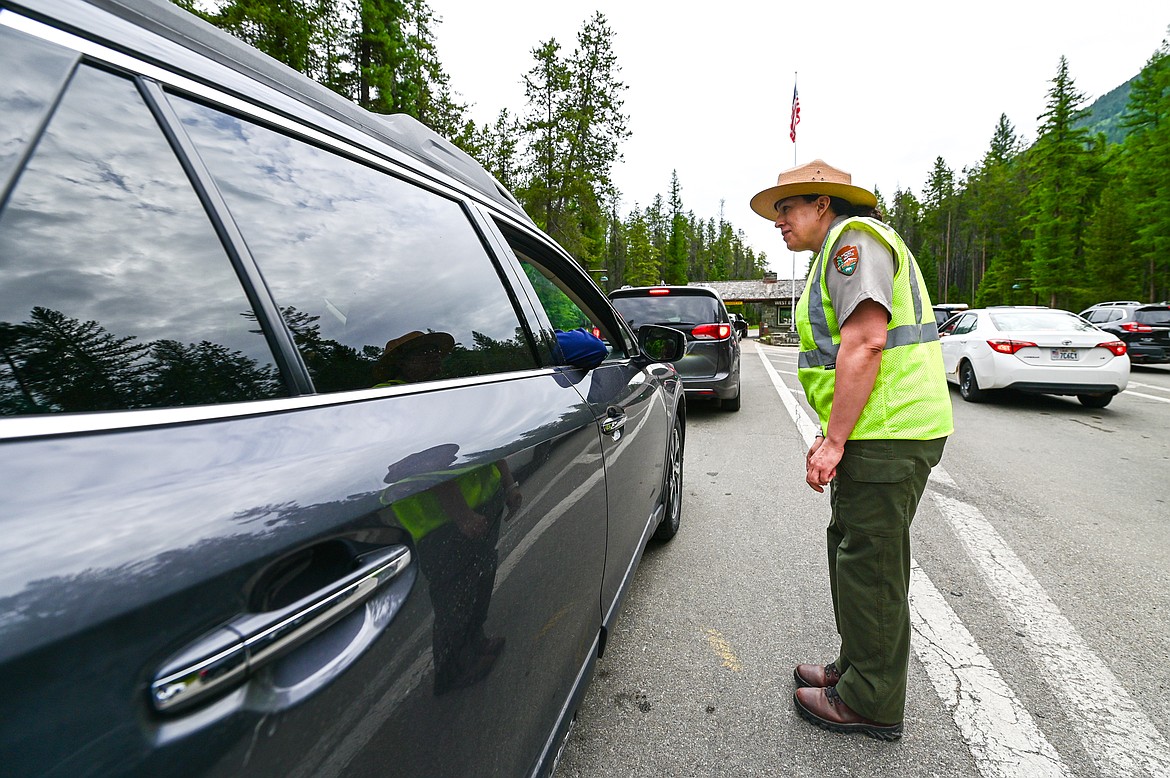
National Park Service ranger Sheryl Campbell greets visitors and answers questions as vehicles wait to enter the west entrance to Glacier National Park on Friday, June 26. (Casey Kreider/Daily Inter Lake)
Casey Kreider
Setting out from their home in Lethbridge, Alberta on the dawn of their 54th wedding anniversary, Rich and Sharon Swihart thought they had planned for everything.
Every year since they first got married, the couple had driven south across the Montana-Canada border, turning west at St. Mary to enter Glacier National Park and taking Going-to-the-Sun Road across the Continental Divide.
After so many years, the preparations for the cross-border journey came second-nature. They had packed their passports and a bundle of freshly exchanged U.S. bills. There was no need for a vehicle reservation this year, but the couple still left at 6 a.m. to ensure they had plenty of time to marvel at the panoramic views in the park.
But pulling up to the St. Mary Entrance a few hours later, something unusual occurred. The park staff member asked whether the couple were U.S. residents.
Confused, the Swiharts explained that they were traveling from Canada. Only then did they learn that the National Park Service was enforcing a new fee structure that charged foreign visitors $100 per person.
“I was so mad I was almost crying,” said Sharon Swihart. “These are God’s mountains for Pete’s sake.”
It isn’t the first affront Swihart has felt from the second Trump administration. The administration’s tariff war and repeated promises to make Canada the 51st U.S. state quickly soured relations between the two countries, which many experts in the tourism industry said has led to a noticeable decline in cross-border visitation.
Canadian visitation to the Treasure State dropped about 41% between 2024 and 2025, according to data from the University of Montana Institute of Tourism and Recreation Research. Visitation from other foreign countries declined 33% during the same period.
It was against that backdrop that the Trump administration introduced steep price hikes for foreign visitors to national parks. Starting Jan. 1, 2026, the price for the America the Beautiful Pass, which allows entry to all sites managed by the National Park Service, increased to $250 for those without U.S. residency. The price for U.S. residents — $80 for an annual pass — remained the same.
At 11 of the most visited national parks, including Glacier and Yellowstone, foreign visitors without an America the Beautiful Pass now face a $100 per person surcharge, on top of the daily vehicle entry rate.
Glacier National Park Public Affairs Specialist Autumn Sifuentes confirmed that park staff are now required to determine whether visitors are U.S. residents to ensure they are issued the appropriate pass.
“Many entrance station employees determine residency by asking a general question such as, ‘Where is everyone visiting from?’ or similar questions about a visitor's place of residence,” she wrote in an email to the Inter Lake. “If visitor responses do not provide enough information to determine the appropriate pass, staff may ask visitors directly whether they are U.S. residents. Employees are not required to ask whether someone is a U.S. citizen.”
Domestic visitors purchasing a daily entrance pass to the park must present a state-issued driver’s license or another form of identification to verify their residency.
While the introduction of the fees has stirred up economic angst for many gateway communities, local industry experts said it is too early to know how the fees will impact Northwestern Montana’s tourism industry.
Visitation to Glacier National Park typically peaks in July and August, and the credit card data that local chambers of commerce rely on to assess the state of the foreign tourism economy lags about 50 days behind real-time.
Even when those numbers become available, Director of Communications for Western Montana’s Glacier Country Lucy Guthrie Beighle said it will be hard to draw any one-to-one conclusions. Most people likely weigh a variety of factors when deciding where to visit and how much money to spend.
“It is difficult to parse out what is what,” Beighle said. “Who knows why people aren’t traveling internationally.”
Along with the increased fees at national parks, Beighle said the decreasing value of the Canadian dollar and ongoing political divisions would likely drive foreign tourism down. The park’s decision to halt its vehicle reservation system, meanwhile, might benefit overseas tourists by making it easier to plan a trip to the park far in advance.
Zeroing in on foreign visitation also distracts from the boom in domestic tourism the region has experienced in recent years. Executive Director for Explore Whitefish Zak Anderson said an uptick in visitors from other states has more than made up for the recent drop in Canadian tourists.
“It kind of buries the lede there,” he said, regarding reports of declining Canadian visitation.
At the same time, Anderson expressed dissatisfaction with the new fee structure. He argued that charging Canadian visitors extra ignores Glacier National Park’s long history of collaboration and shared border with Canada’s Waterton Lakes National Park. The relationship was cemented in 1932, when the two sites were jointly named the world’s first international peace park.
The Trump administration argued that increasing prices for foreign visitors to enter national parks would "ensure fairness” by prioritizing U.S. visitors to U.S. national parks. The revenue from the fees would also be used to chip away at a $22.9 billion maintenance backlog across the national park system, according to an official fact sheet about the new fee structure.
In April, the Department of the Interior reported national park pass sales of $16.7 million, up from $14.3 million during the same four-month period in 2025. It is unclear how much of the increase can be attributed to the hike in foreign visitor fees, and Glacier Field Representative for the National Parks Conservation Association Sarah Lundstrum said she is skeptical Glacier National Park will see the promised economic benefits from the new fee structure.
Federal law mandates that individual parks receive at least 80% of the revenue from entrance fees that are collected in-person. But for many visitors, purchasing an America the Beautiful Pass online is far more convenient than rifling through their wallet at an entrance gate.
“Where the money goes from those digital passes is a bit of a mystery to say the least,” Lundstrum said.
Last month, several news outlets reported that the Trump administration redirected about $90 million in national park fees toward renovations in Washington, D.C ahead of the celebrations for the nation’s 250th birthday. The sum far exceeded past expenditures by the Department of the Interior for maintenance projects in the capitol region and generated concerns about transparency within the agency.
Whether in Glacier National Park or Washington, D.C., Sharon Swihart is sure her money won’t be part of any maintenance projects.
For the first time in 54 years, the Swiharts forewent their anniversary tradition of driving Going-to-the-Sun Road. Rather than pay the extra $200 to enter the park, the couple took U.S. 2 into Kalispell.
Swihart said she doesn’t plan to return to the park as long as the foreign visitor fees remain in place. For her, the slight is just as emotional as it is economic.
“We all have ties there,” she said. “I just took it as a personal insult.”
Reporter Hailey Smalley can be reached at 406-758-4433 or [email protected]. If you value local journalism, pledge your support at dailyinterlake.com/support.
ARTICLES BY HAILEY SMALLEY

Trump stumps for Flint in Kalispell as Election Day nears
President Donald Trump, wearing a dark suit, red tie and red USA cap, ambled into the Majestic Valley Arena to the raucous roar of a crowd.
Flathead National Forest greenlights Swan Valley timber project
A 2,307-acre timber project is now under way in the Swan Valley.
Flathead National Forest greenlights Swan Valley timber project
A 2,307-acre timber project is now under way in the Swan Valley.