
Rubber meets the road when it comes to recruiting more doctors to Idaho
CAROLYN BOSTICK | Hagadone News Network | UPDATED 12 hours, 33 minutes AGO
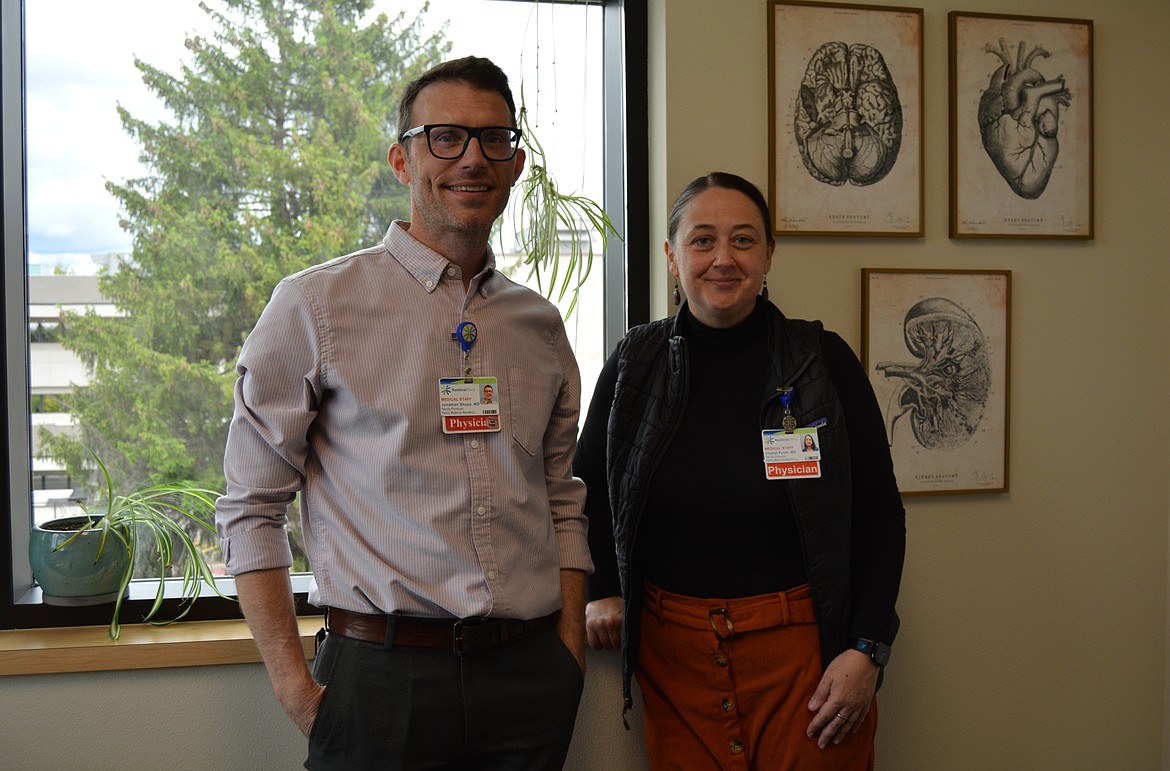
Dr. Jonathan Shupe and Dr. Crystal Pyrak
CAROLYN BOSTICK/Press
Carolyn Bostick has worked for the Coeur d’Alene Press since June 2023. She covers Shoshone County and Coeur d'Alene. Carolyn previously worked in Utica, New York at the Observer-Dispatch for almost seven years before briefly working at The Inquirer and Mirror in Nantucket, Massachusetts. Since she moved to the Pacific Northwest from upstate New York in 2021, she's performed with the Spokane Shakespeare Society for three summers. | June 30, 2026 1:00 AM
Among health care professionals in the state, one statement remains a constant: Idaho needs more doctors.
Dr. Jonathan Shupe noted that the five northern counties will be short about 50 primary care physicians by 2030.
“If we were to fill 1,400 new physicians tomorrow in the state, we would just get to the average across the country, so that shows the lack we have in our state,” Shupe said.
“Kootenai Health has a residency for seven physicians a year to try to make up the gap,” Shupe said. “That seems like a daunting number, but that’s really the mission.”
Strides are being made to make up the difference, but without an in-state public medical school, hospitals and major health care providers are trying to plan for the future.
The Kootenai Health residency program has been in place for 10 years, with 62 grads. Of that number, 32 doctors currently reside in Idaho, and 16 practice in Kootenai County.
“We know the importance that the more people train in an area, the more likely they’re going to stay in an area,” Shupe said.
Medical professionals are trying to flag issues at the state level to expand undergraduate education opportunities and provide financial support that allows doctors to train future physicians during three-year residencies.
"At the state level it would help to expand some of those opportunities for residency training, but a lot of ways come down to dollars and cents and the finances of it,” Shupe said.
If more physicians and teachers in the community are financially able to offload some of their duties, prioritizing medicine will lead to more viable education avenues for health institutions in the state.
Because of a recent exodus of physicians leaving Idaho to practice elsewhere, Shupe said there is a lot of work to stabilize the health care industry as a whole.
“There are many tens of thousands of people looking for primary care physicians,” Shupe said. “They’re sometimes doing more with less, but that’s only sustainable up to a certain point. Unfortunately, people are going without and we see that all the time.”
Having a primary care physician reduces your overall costs within the system because they can flag warning signs before you need to visit the ER.
If people are poorly insured or have no insurance, Shupe said they “end up in areas of the health system that are much more expensive.”
A rural primary care physician practicing in a community with a local hospital creates an estimated 26 local jobs and nearly $1.4 million in income (wages, salaries and benefits) from the clinic and the hospital, according to a study through the National Center for Rural Health Works.
That’s why Dr. Crystal Pyrak values the advocacy she does at the state level through the Idaho Academy of Physicians to improve recruitment, especially in rural areas.
“It’s a challenge. It’s a burnout piece for our primary care workforce,” Pyrak said. “Physicians are taking more patients and doing more for patients because we’re also low on specialty services in the area.”
Prioritizing the attraction of medical graduates benefits everyone in the long term. But Pyrak said that until the tide begins to turn further, doctors at family care practices are having to fill in for more specialized care.
“Family medicine doctors are filling gaps and doing more in rural communities and there’s more family medicine physicians taking on OB-GYN positions in the state now,” Pyrak said.
Prenatal needs, women’s health and behavioral health are three of the biggest issues when it comes to care gaps in the area.
Sustainable reimbursement rates across health services and insurance types would further stabilize health care in Idaho and nationally.
"As reimbursement goes down, the ability to take care of broader populations also goes down,” Shupe said.
Through the residency program at Kootenai Health, doctors-in-training are taught not to focus only on well-insured individuals, even though that can lead to complications with long-term care coverage and the ability to sustain health care services.
“We train our graduates to be as agnostic to insurance as possible and provide an appropriate level of care,” Shupe said.
The residency usually receives about 300 applications annually for seven spots in the program at Kootenai Health.
However, perceptions of care limitations in Idaho have become a barrier to regional recruitment, Shupe and Pyrak pointed out.
Kootenai Health has noted a decrease in applications, due in part to difficulties securing visas for international medical graduates.
“Limiting legislative roadblocks to providing care is really important to our recruitment for future residents,” Pyrak said.
Because of the rural nature of North Idaho and of the state as a whole, one source for medical needs has increasingly become the model.
“It leads to really tiny health care systems that are staffed by family physicians with very broad scope,” Pyrak said. “The issues of Idaho and the legislation of what we can and can’t do as a physician, sometimes going back against best practices in medical training is really hard to relay to an applicant that they’re still going to get the training they need.”
ARTICLES BY CAROLYN BOSTICK
Rubber meets the road when it comes to recruiting more doctors to Idaho
Among health care professionals in the state, one statement remains a constant: Idaho needs more doctors.

N. Idaho pair suffer serious injuries in ATV crash
Sara Weiss loves spending her free time in the woods with her family, but after an ATV crash on Memorial Day weekend, she and her 11-year-old son, Bentley, have been on a long road to healing and recovery.

Post Falls Lions Club plans for Brewfest on Saturday
It’s time to raise your glass for a cause on Saturday. The Post Falls Lions Club has brought back Brewfest for the fourth year.