
Election 2026: Former deputy launches bid for sheriff position
MONTE TURNER | Hagadone News Network | UPDATED 2 weeks, 1 day AGO
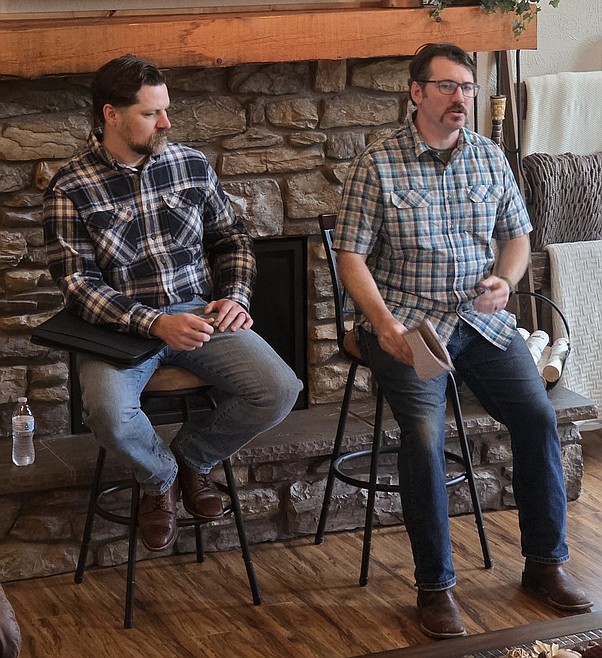
Mineral County sheriff candidate Ben Banks, right, and his choice for prospective undersheriff, Tony Augustyn, a current deputy, speak with a group of Mineral County voters. (Monte Turner/Mineral Independent)
The Mineral County Sheriff’s Office has two candidates running for the position. Incumbent, Ryan Funke who was elected to the position three years ago, and Ben Banks, who is a former deputy of the Sheriff's Office.
Both are Republicans and there is no Democratic candidate, so the primary election on June 2 will determine who will be the sheriff as of Jan. 1, 2027.
Both candidates answered the same questions.
Ben Banks
Ben Banks began his law enforcement career in 2004 as a reserve deputy while earning his degree in criminology from the University of Montana. He served as an Army officer, deploying to Iraq and Afghanistan, and as a criminal investigator and federal supervisory special agent within the Army. A former Mineral County deputy and major crimes agent with the Montana DOJ, Ben and his wife are focused on raising their family and serving their community.
What leadership decisions from your law enforcement career best demonstrate your readiness to lead an entire sheriff’s office?
I am experienced in leading large teams of investigative professionals, responsible for homicide, sexual assault, drug trafficking, domestic violence, fraud cases, etc. Key leadership decisions I have faced include reallocating resources to manage multiple high-profile cases simultaneously, implementing a new evidence management system that improved prosecution outcomes, and professionally mentoring agents during high periods of turnover. As a leader, it was paramount that I established clear policies and expectations across the team and sought experts to rely on in areas where I lacked direct experience, ensuring every part of the office functioned professionally and served the community effectively.
Would you prioritize hiring more deputies, investing in technology, or expanding training, and why?
Of the three options, investing in training is the only realistic solution. New technology is useless without added training, and fewer highly trained deputies outperform more undertrained deputies any day. Besides, additional salaries require consistent and ongoing funding. Trainings can occur incrementally, as funding allows, or without any funding at all. If elected, I would be able to orchestrate many key trainings in-house, including de-escalation, drug investigations, active shooter response, and more. If we include training for reserve deputies to this equation, then our capacity to serve the community greatly expands with relatively little spending.
What would you do if the county commissioners demanded a policy you believed would harm public safety or violate civil rights?
The sheriff’s oath is to uphold the U.S. Constitution and Constitution of the state of Montana. If a proposed policy raised legal or public safety concerns, I would work with the county attorney to conduct a thorough legal review and present those findings to the commissioners. If the policy violated the law or threatened civil rights provided for in the constitutions, the Sheriff's Office would not enforce it. I would clearly explain that position to both the commissioners and the public.
What is your strategy for addressing the most significant crime issues facing this county?
Reducing crime requires strong investigations and strong partnerships. We must focus on improving investigative training so deputies can build solid cases that support successful prosecution. Crimes such as domestic violence, sexual assault and drug suppression require coordinated responses. I support a multidisciplinary team approach that allows investigators, prosecutors, and advocates to work together to support victims while holding offenders accountable. When deputies are properly trained and agencies coordinate their efforts, communities see stronger cases, better support for victims and safer neighborhoods.
How will you ensure taxpayer money is used effectively and responsibly?
Taxpayers deserve a Sheriff’s Office that manages resources carefully. Protecting existing equipment through regular maintenance reduces unnecessary replacement costs. Analyzing past budgets and operational needs allows us to build a realistic plan that accounts for equipment replacement (when truly needed), inflation, and unforeseen expenses. Major purchases must involve competitive and transparent bids and a clear cost-benefit analysis to ensure long-term value. While we should continue pursuing grants, we need to also strengthen partnerships with other agencies to share resources whenever possible. Responsible planning ensures the community receives the highest level of public safety for the dollars invested.
What limits should exist on the power of the sheriff, and who should hold you accountable?
The sheriff’s authority is limited by the U.S. and Montana constitutions, Montana law, and the trust placed in the office by the public. Ultimately, the sheriff answers directly to the citizens of the county through elections and the legal process for recall, if necessary. Accountability also requires transparency. I support regular communication with the public about crime trends, department priorities, and major initiatives. A Sheriff’s Office should never operate behind closed doors. The community deserves to understand how decisions are made and how their law enforcement agency is serving them.
Can you describe a time when you had to stand up to pressure to do something you believed was wrong?
While leading complex investigations, I was often pressured by supervisors to take shortcuts or produce faster outcomes. I unwaveringly chose instead to follow the facts and proper procedures, even when it meant slowing progress. One specific example of resisting pressure involved ensuring legal subpoenas were properly served to individuals within my organization, despite pressure from my superiors to do otherwise. Upholding procedural integrity protects victims, strengthens prosecutions, and preserves public trust. These decisions exhibit my adherence to law and professional standards, which must always outweigh convenience or external pressure.
What are your top three budget priorities for the Sheriff’s Office?
First, develop a realistic operating budget to cover essential staffing, equipment maintenance, training needs and plans for contingencies, thereby avoiding the need for emergency spending. Second, protect prior investments through scheduled preventative maintenance and identify and correct other inefficient practices, such as the current online training subscription and obsolete contracts, thereby reducing long-term costs. Third, implement competitive bidding for purchases and contracts to ensure taxpayers receive the maximum value. These priorities, combined with ongoing grant pursuits and interagency collaboration, ensure the sheriff’s office remains effective, professional, and fiscally responsible while delivering consistent public safety services to the community.
ARTICLES BY MONTE TURNER

St. Regis mill expanding operations, adding employees
Driving along Montana 135 just outside St. Regis, it’s hard to miss the towering stacks of bundled posts and poles, and the large building at Big Sky Forest Products.

Superior students send postcards from the British Isles
Every two years, Superior teacher Jeff Schultz organizes an unforgettable European tour for students and locals touring different countries.

Legion begins refurbishing highway fatality markers
Ray Welch American Legion Post 13 in St. Regis is responsible for maintaining fatality markers along Interstate 90 from Lookout Pass to mile marker 77, just east of Alberton, as well as along Montana 135 from St. Regis to the Sanders County line.