
Additional Odessa Groundwater Replacement Area canals coming
CHERYL SCHWEIZER | Hagadone News Network | UPDATED 8 months AGO
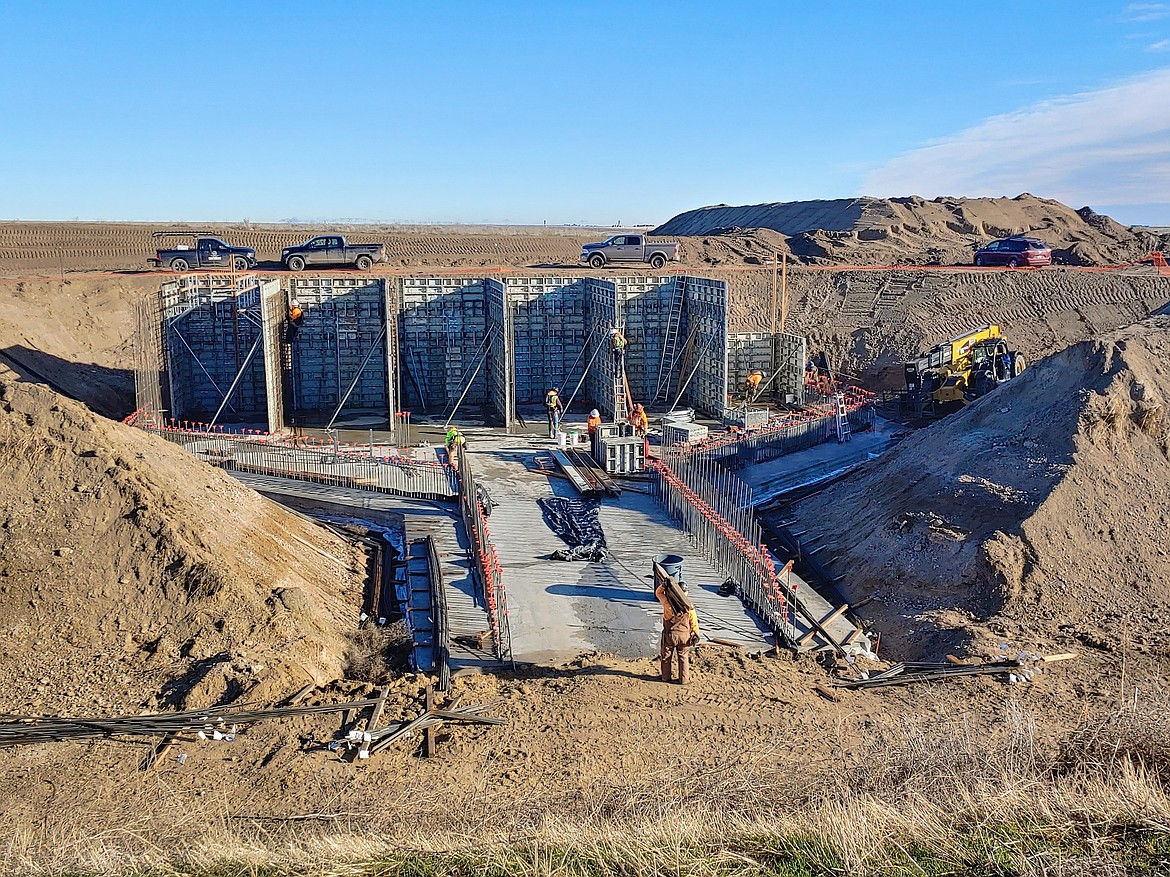
The foundations of a new pumping facility for irrigation water are under construction as part of the Odessa Groundwater Replacement Project.
COURTESY PHOTO/COLUMBIA BASIN IRRIGATION DISTRICT
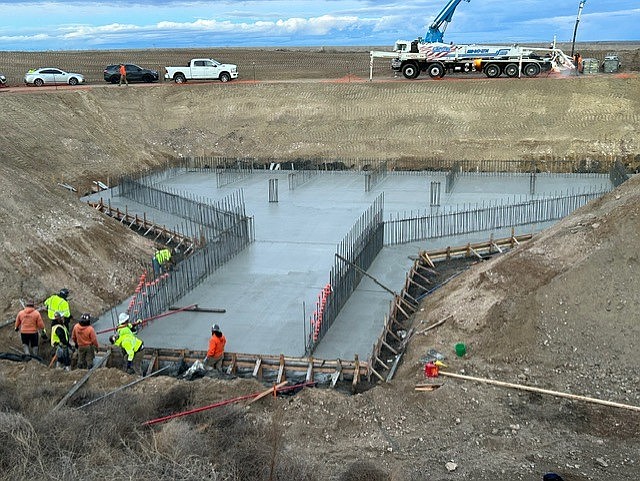
Construction crews pour concrete for an extension of the water delivery system from the East Columbia Basin Irrigation District to the Odessa Groundwater Replacement Project. Irrigation district directors recently approved agreements to extend the system.
Senior Reporter Cheryl Schweizer is a journalist with more than 30 years of experience serving small communities in the Pacific Northwest. She began her post-high-school education at Treasure Valley Community College and enerned her journalism degree at Oregon State University. After working for multiple publications, she has settled down at the Columbia Basin Herald and has been a staple of the newsroom for more than a decade. Schweizer’s dedication to her communities and profession has earned her the nickname “The Baroness of Bylines.” She covers a variety of beats including health, business and various municipalities. | March 23, 2026 3:15 AM
OTHELLO — East Columbia Basin Irrigation District water will be coming to portions of the area north of Warden and east of Moses Lake. Irrigation district directors approved agreements with landowners that will allow the construction of water delivery systems into areas now served by groundwater wells.
Craig Simpson, ECBID secretary-manager, said the district has a contract with the US Bureau of Reclamation to provide water to 90,000 acres in what is called the Odessa Groundwater Replacement Project area. An earlier pilot project left the district with about 87,700 acres in the project area, and Simpson said the new agreements will go a long way to meeting that goal.
“Seven new (memorandums of understanding) that we’ve signed with landowner groups,” Simpson said. “That’s to start the design work for (delivering) to those lands that are interested in being parts of those systems.”
The ECBID has already constructed two water systems to provide water in the project area, with two more nearing completion of the design process. The MOUs approved by ECBID directors will add seven more projects.
Simpson said all the new systems will deliver water via pipe rather than open canals.
“All of these will be pressurized, most likely from a pumping plant,” Simpson said. “We will look for opportunities to make deliveries that are gravity pressure, (but)they'll still be enclosed pipe. It won't be open (canals).”
One of the delivery systems that went into operation in 2025 uses gravity rather than a pumping plant, he said.
“The landowners do have pressure at their delivery points. Low pressure – they still have to boost it a lot of times for their circles. But they have pressure at their delivery point,” he said.
Jon Erickson, chair of the Columbia Basin Development League, one of the organizations spearheading the project, said it’s a big step toward finishing a project that’s been in development for many years.
“We're looking to have all of the 90,000 acres under design and/or contract – and/or contract, that’s important there. Basically, we'll have committed all of the authorized acres in the Odessa groundwater replacement program to a delivery system,” Erickson. “We’re starting to realize those fruits of the decades' worth of efforts that have been put in.”
Many of the existing groundwater wells tap into the aquifer that also provides water for most of the municipalities in the Columbia Basin. Water levels in the aquifer have been declining, and most of that water has been used for irrigation.
The area that uses groundwater wells is bigger than the 90,000 acres, Erickson said, but transitioning some of that area to surface water will reduce pressure on the aquifer.
“It’s a great temporary rescue mission for the aquifer,” Erickson said.
Simpson said it’s too early to determine construction timelines. It takes longer to design a pressurized system than one that uses gravity, he said, and there’s a lot of other work to do before construction can begin.
“If we have a design going, you know, we'll start doing, you know, environmental compliance projects in conjunction with it or in parallel. We'll try to start doing easement acquisitions in parallel,” he said. “We really can’t build until we have an easement.”
The district will be working with the landowners in the project area as well, he said.
“Since it's still voluntary with the landowners, there will be a landowner input, which is why we have the (memorandum of understanding agreement) so we can talk to them about what we want to do,” he said.
 Construction crews pour concrete for an extension of the water delivery system from the East Columbia Basin Irrigation District to the Odessa Groundwater Replacement Project. Irrigation district directors recently approved agreements to extend the system.
ARTICLES BY CHERYL SCHWEIZER

Consumers asked to use caution to avoid charity scams
MOSES LAKE — Christmas is a season of giving, and there are plenty of worthy causes out there – but there are scammers out there working to divert some of that generosity to themselves. In addition, when it comes to defrauding people, scammers aren't content to wait until the holiday season. Scammers will latch on to any incident, any natural disaster in their attempts at fraud. "When there's a disaster such as the Spokane wildfires or an incident that affects a community, such as the line of duty deaths of the two sheriff's deputies in the Spokane area, fraudsters may take may choose to take advantage of people's kindness by creating fake charity accounts," said Kyle Foreman, public information officer for the Grant County Sheriff's Office.

Public hearing Tuesday on 2027 Moses Lake municipal budget
MOSES LAKE — Moses Lake residents will have one additional opportunity to comment on the city's 2027 budget Tuesday. The final public hearing for the budget is scheduled for the Nov. 24 Moses Lake City Council meeting. The city's expenditures will exceed its revenues, but Finance Director Sheila Danielson said it was money city officials anticipated spending. "The use of fund balance is primarily related to expenditures of capital projects," Danielson wrote in response to an email from the Columbia Basin Herald. For all city departments, projected revenues will be about $127.7 million, Danielson said, with expenditures projected at about $136.8 million. Some departments will be using reserve funds, essentially money saved for those projects. Danielson estimated that would be about $9.4 million across all city departments.
Sila announces deal with Panasonic Energy Corporation
MOSES LAKE — Sila Nanotechnologies will be providing materials manufactured at its Moses Lake facility to Panasonic Energy Corporation, according to an announcement released Wednesday. The silicon-carbon battery anode material produced in Moses Lake will be used in Panasonic battery cells, it said.