
An Evening with the Clark Fork Coalition
MONTE TURNER | Hagadone News Network | UPDATED 1 week, 1 day AGO
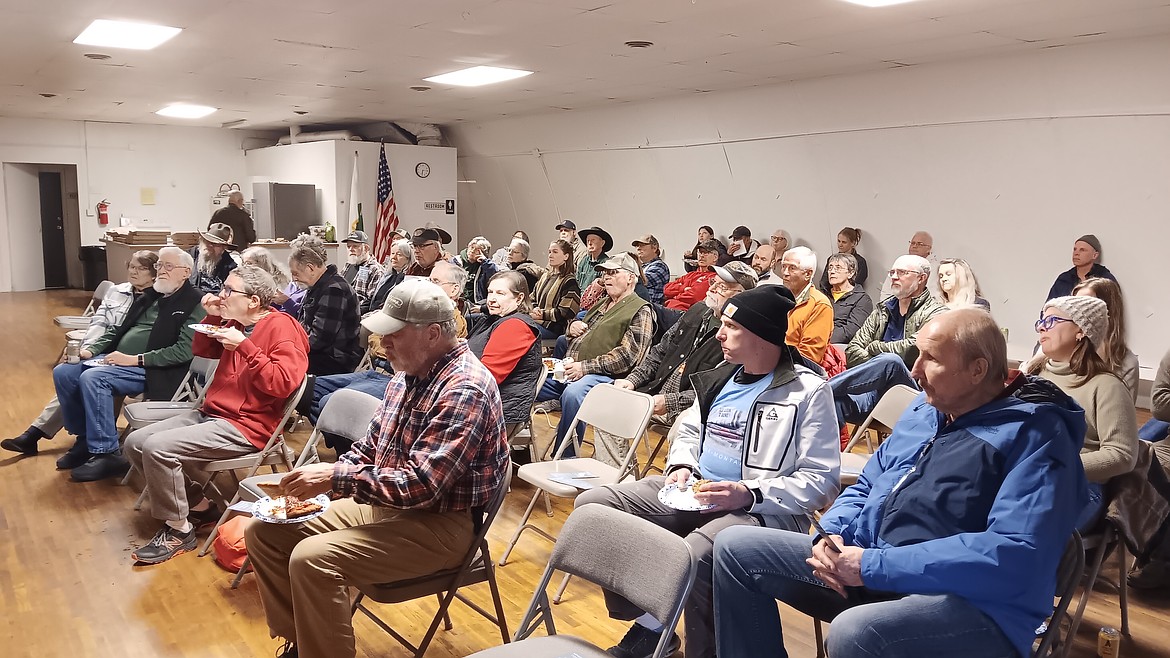
Over 50 residents attended an evening of discussion concerning the Clark Fork River with the Clark Fork Coalition out of Missoula. Restoration research in this part is in the early stages, and they are looking for information that could be important to their study. (Monte Turner/Mineral Independent)
Since 1985, the Clark Fork Coalition has worked to improve the health of the Clark Fork watershed through projects, campaigns and community outreach.
Early efforts focused on the stretch from Butte to Milltown, and more recently extended to Frenchtown. Today, the organization brings together technical, legal and educational expertise to tackle the complex challenges facing the river and its tributaries.
Their long-term vision is simple: a Clark Fork River that flows with clean, cold and abundant water, supporting people, wildlife and the landscape for generations to come.
Last Monday evening, with help from the Mineral County Rec Club and Mineral County Conservation District, the Coalition hosted a community gathering complete with pizza, drinks and an open invitation to talk about the river. The focus was on watershed restoration planning for the central Clark Fork region, which stretches from Drummond, near the confluence with Flint Creek, west to Paradise, where the Flathead River meets the Clark Fork.
Lily Haines, a Community Programs Manager who has been with the Coalition for 11 years, said the goal of the meeting was straightforward.
“We’re here to introduce ourselves and to get feedback and intel from the community on what the priority impairments, locations and opportunities are that need attention in this part of the Clark Fork basin.”
She described the Watershed Restoration Plan in simple terms: “It is a tool that exists at our state level government, that helps us organize and prioritize projects that improve water quality in our service waters.”
Partners in this effort include the Mineral County Conservation District, Mineral County Rec Club, Trout Unlimited and the Lolo National Forest.
Gretchen Watkins, Stream Restoration Project Manager for the Coalition, was one of the keynote speakers at the 4-H Building on the Mineral County Fairgrounds. She clarified how the river is divided into regions.
“The Middle Region begins where the Blackfoot River joins, but the Central Region goes farther east than most realize,” she said. When the conversation turned to fisheries, Watkins noted concerns similar to those raised by Montana Fish, Wildlife & Parks. “The metals within the fish right now, depending on who you talk to, are at levels, especially if you are a nursing or pregnant mother or if you are a subsistence eater of not recommend of more than a fish per week.”
While many anglers practice catch-and-release, she said those who do consume fish should be aware of potential toxins. Watkins also outlined some of the key issues being studied.
“Some of the things we are identifying through this process are sedimentation and erosion which is speeded up through human processes. Definitely those abandoned mines contributing and just the upstream contribution of metals from Butte all the way down,” she said.
She pointed to the former Smurfit facility in Frenchtown as an ongoing area of concern.
“One of the areas of focus is the Smurfit facility which is one of the areas we are targeting,” Watkins said.
She explained that a manmade berm continues to hold back polluted sludge, and while it has long been a concern, the EPA maintains strict monitoring, especially during high water events, with crews ready to respond if needed. Watkins, who joined the Coalition two years ago after teaching Industrial Arts at Big Sky High School in Missoula, said public involvement is key.
“The biggest thing that we’re interested in is reaching out to the public to identify areas that people are willing to participate in these restoration type activities such as planting willows, reconnecting the flood plain. From low tech projects as fencing to keeping the cattle out of the stream beds and establishing those corridors allowing the river to flow, to what you guys have seen on Flat Creek (in Superior) where the contaminates were removed through a Superfund and DEQ. The Clean Water Act, through the federal government is who determines the level needed,” she explained.
Sam Carlson, the Coalition’s Staff Science Director based in Helena, spoke about ongoing monitoring efforts. While sediment contamination downstream of Smurfit-Stone has been studied in the past, it is not continuously monitored.
“What we’re really looking for are those nasty algae blooms that we get from time to time. We do that across the whole river.”
When asked about declining brown trout populations in the Upper Clark Fork, Carlson pointed to several possible factors.
“The obvious culprit is the Superfund Cleanup up there. Cleaning up the mine tailings, it disturbs the ecosystem. That is definitely one factor but I don’t feel that explains the entirety of what we’re witnessing because we’re seeing it in other rivers, too. We see it in the Big Hole River and I’m speaking of fish populations in general now.”
He added that recent years have brought difficult water conditions.
“We’ve had several bad-water years which are low flows and high temperatures mainly early in the year. It sort of compounds the impact.”
He also noted the need for stronger spring runoff to help clean spawning gravel. The Coalition’s work is ongoing, but its mission remains clear: to protect and restore the Clark Fork watershed, recognizing that a healthy river is closely tied to a healthy community.
The Mineral County Conservation District, a volunteer board, plays a key role in local conservation efforts. The district promotes soil and water conservation and administers 310 permits under Montana’s Natural Streambed and Land Preservation Act. This law requires anyone planning work in or near a perennial stream to first obtain approval from the local conservation district, helping ensure projects do not harm waterways, stream banks or neighboring landowners.
Stephanie Todd, Administrator for the district, said partnerships are essential.
“It’s a very small amount of taxpayer’s money that the MCC receives, and it shows up as ‘soil’ on tax statements. Then we get grants from the DNRC, which is state funded. We also partner with the U.S. Forest Service. NRCS, DEQ, Army Corps of Engineers which are all of your bureaucratic types, and then Trout Unlimited which is a nonprofit and then our other partner in the county is FWP. So, we hit all of the nonprofit, state and federal entities to help with conservation in Montana,” she shared.
Todd also addressed a recent issue highlighted in the Feb. 25 edition of the Mineral Independent. A photo accompanying a River to Rails Jamboree article showed a side-by-side vehicle driving through a stream, something that is illegal in Montana. The photo in question was taken in Idaho and provided by the event organizers.
“The process of a violation such as this one would include collaboration with the person who operated the vehicle, FWP and the Board of Supervisors and could be issued a fine and ordered to remediate any damages, determined by the 310 Bylaws of Mineral County,” Todd explained.
State regulations prohibit motorized vehicles in or along perennial streams due to impacts on vegetation, streamflow, water clarity and fish habitat.
ARTICLES BY MONTE TURNER
St. Regis mill expanding operations, adding employees
Driving along Montana 135 just outside St. Regis, it’s hard to miss the towering stacks of bundled posts and poles, and the large building at Big Sky Forest Products.
Superior students send postcards from the British Isles
Every two years, Superior teacher Jeff Schultz organizes an unforgettable European tour for students and locals touring different countries.
Legion begins refurbishing highway fatality markers
Ray Welch American Legion Post 13 in St. Regis is responsible for maintaining fatality markers along Interstate 90 from Lookout Pass to mile marker 77, just east of Alberton, as well as along Montana 135 from St. Regis to the Sanders County line.