
Students write letters, fight for TRIO program
JOEL MARTIN | Hagadone News Network | UPDATED 5 months, 1 week AGO
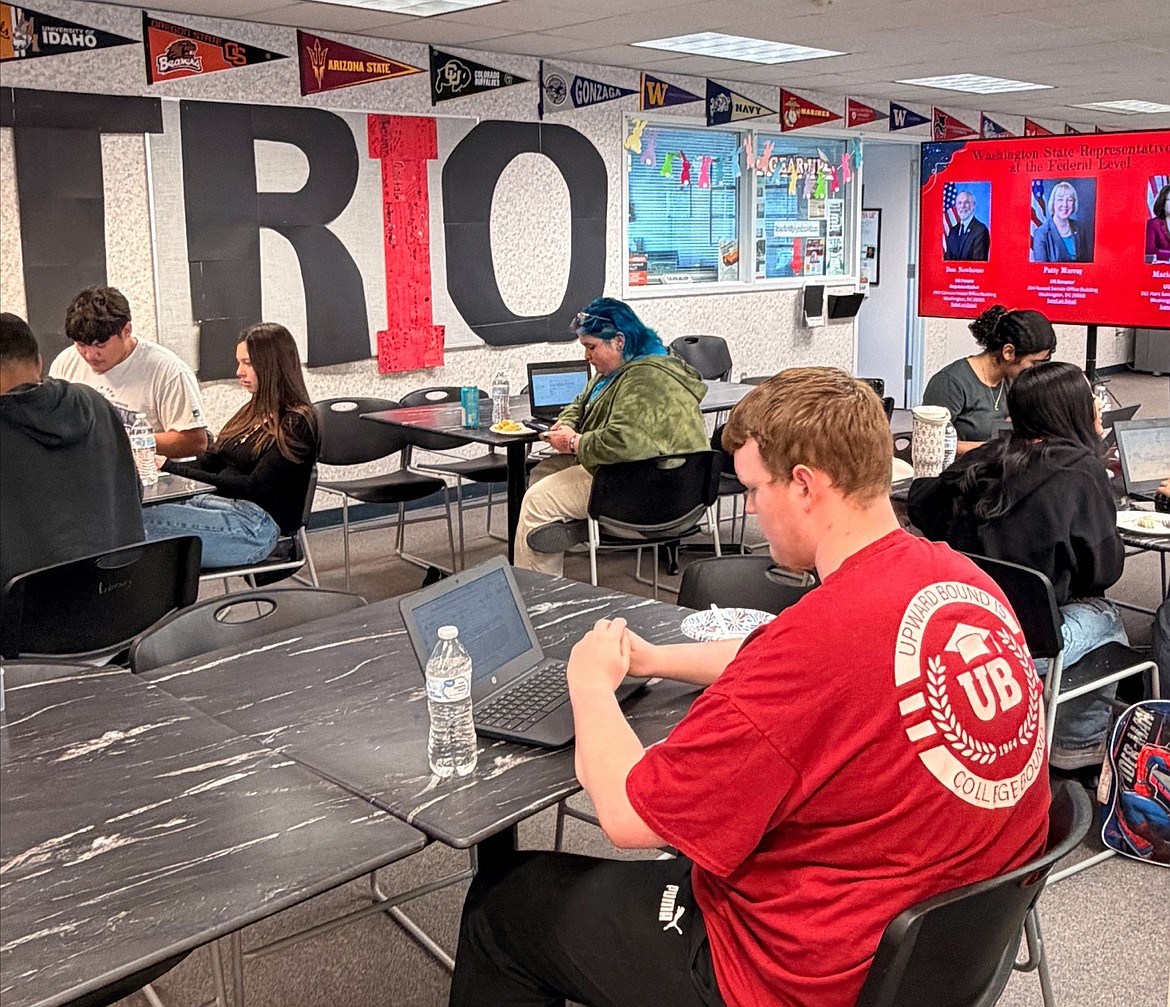
Moses Lake High School students gather April 30 to write letters and emails to their elected officials, asking them to preserve funding for the TRIO Upward Bound program.
COURTESY PHOTO/IRINA ESTES
Joel Martin has been with the Columbia Basin Herald for more than 25 years in a variety of roles and is the most-tenured employee in the building. Martin is a married father of eight and enjoys spending time with his children and his wife, Christina. He is passionate about the paper’s mission of informing the people of the Columbia Basin because he knows it is important to record the history of the communities the publication serves. | May 7, 2026 3:00 AM
MOSES LAKE — Some Moses Lake High School students gathered April 30 to make their voices heard.
“I’ve grown up in a low-income first-generation household,” Vanguard Academy student Daniel Heeney wrote in a letter to state Rep. Alex Ybarra. “I’ve always wanted to pursue higher education and a career as a veterinarian, but that would not have been possible without TRIO (Upward Bound). Before I joined TRIO UB I lacked things like motivation, knowledge, and leadership. TRIO UB provided me with knowledge and insights that have helped me find and win scholarships making college more affordable.”
Heeney was one of about 20 students from the TRIO Upward Bound program who gathered to write to lawmakers at both the state and federal levels, asking them to fight to keep the program funded. The proposed federal budget for 2026 eliminates funding for the program, which helps low-income and first-generation students go on to higher education.
TRIO staff help students apply for scholarships and sometimes take them on campus tours if their parents are unable to, explained WSU TRIO Upward Bound Program Director Irina Estes. WSU TRIO serves 63 students at Moses Lake High School, Estes said, and a TRIO program at Big Bend Community College serves other MLHS students.
Last year’s budget would have cut the program as well, Estes said, but Congress replaced the funding, and the students hope to make that happen again.
“One of my students came to me and ... said ‘I heard there’s a possibility that TRIO won’t be around next year, and what can we do to help fight that?’” Estes said.
That student, Serenity Maltos, reached out to other students in both the WSU TRIO and the sister chapter at Big Bend and arranged a time for students to gather at Moses Lake high School to write letters and emails to their elected officials about their experiences in the program, Estes said. The event was completely student-led, Estes added, although some TRIO staff members were there as volunteers on their own time.
“The students … were the ones who opened up the meeting explaining what’s happening,” Estes said. “They’re the ones who were walking around and providing feedback.”
“Before TRIO, I believed that being a first-generation student meant having to be alone through everything,” Janet Farias wrote. “I could not rely on my parents for tutoring or help with homework. I could not rely on my siblings, as I am the oldest. I only had myself to rely on, through getting through my homework, through finding and applying for scholarships, and through understanding what it meant to go through college. However, upon joining TRIO, I realized that this was not a journey I had to do alone, as with TRIO, I learned that being a first-generation student would be me having an education beyond high school, as my parents were unable to pursue that.”
Sophomore Sparrow Skinner addressed her request to Sen. Maria Cantwell.
“TRIO doesn’t just help people who are struggling financially. It is not a handout. It is a support, and for many, a lifeline. TRIO helps people who are first-generation college students, people in marginalized communities, and people who have no idea how to further their education. It isn’t free money. It’s equity.”
ARTICLES BY JOEL MARTIN

Endless battle
Noxious Weed Control Board works to keep invasive plants under control
MOSES LAKE — Some of the nastiest plants in Grant County were the topic of a class led by Jay Johnson, a consultant with the Grant County Noxious Weed Control Board, Tuesday. The Noxious Weed Control Board, as its name would suggest, is tasked with keeping weeds under control in Grant County. That’s not a small job; the board’s website lists 129 species of noxious weeds that are found around Grant County. A noxious weed is defined as an invasive, non-native plant that threatens agricultural crops, local ecosystems or fish and wildlife habitat, according to the Noxious Weed Control Board. Washington state law requires that these weeds be identified and their spread kept to a minimum, if not completely eradicated. “We’re one of those agencies a lot of people don’t really understand,” Johnson said. “We’re a county office and … our funding is tax-based assessment. When you get your tax bill and you look down at all the expenses that you pay for, there we are.”

BASIN EVENTS: Oct. 16-24
COLUMBIA BASIN — Whether you feel like shopping, crafting, learning or seeing a show, there’s something happening for you this week in the Basin. Oct. 16 ‘My Family (Mi Familia)’ screening Spanning three generations, “My Family (Mi Familia)” is a heartfelt drama that follows the Sánchez family as they build their lives in East Los Angeles. Through love, hardship, triumph, and sacrifice, the film explores the immigrant experience, the strength of family bonds, and the traditions that connect one generation to the next. Lowrider show and taco truck before the screening. Sponsored by Columbia Basin Allied Arts, EDUBS C/S and the Moses Lake Creative District. $12 per person. Doors open at 6 p.m., film begins at 7 p.m. at the Moses Lake Civic Center Auditorium, 401 S. Balsam St. Tickets and info: www.cba-arts.org.

Moses Lake author encourages women to look beyond church culture norms
MOSES LAKE — A Moses Lake author’s book, “A Christian Woman Striving to Live Her Faith in a Man-Controlled World,” takes aim at the role to which many churches relegate the female half of their congregations. “It’s to encourage women in the faith,” Linda Curran said. “A lot of churches say, ‘Teach Sunday school, do this, do that, but don’t (evangelize.)’" In her book, Curran recounts a time when she moved to a new community and joined a church there. She was surprised to learn that, as a new female member, she had been automatically assigned church cleaning duties. When she questioned it, she wrote, she was met with condescension and her objections were brushed aside. In other churches, she said, women who were capable of teaching were relegated to “women’s ministry.”