
Bigfork celebrates 125 years this Sunday
ELSA ERICKSEN | Hagadone News Network | UPDATED 5 months AGO
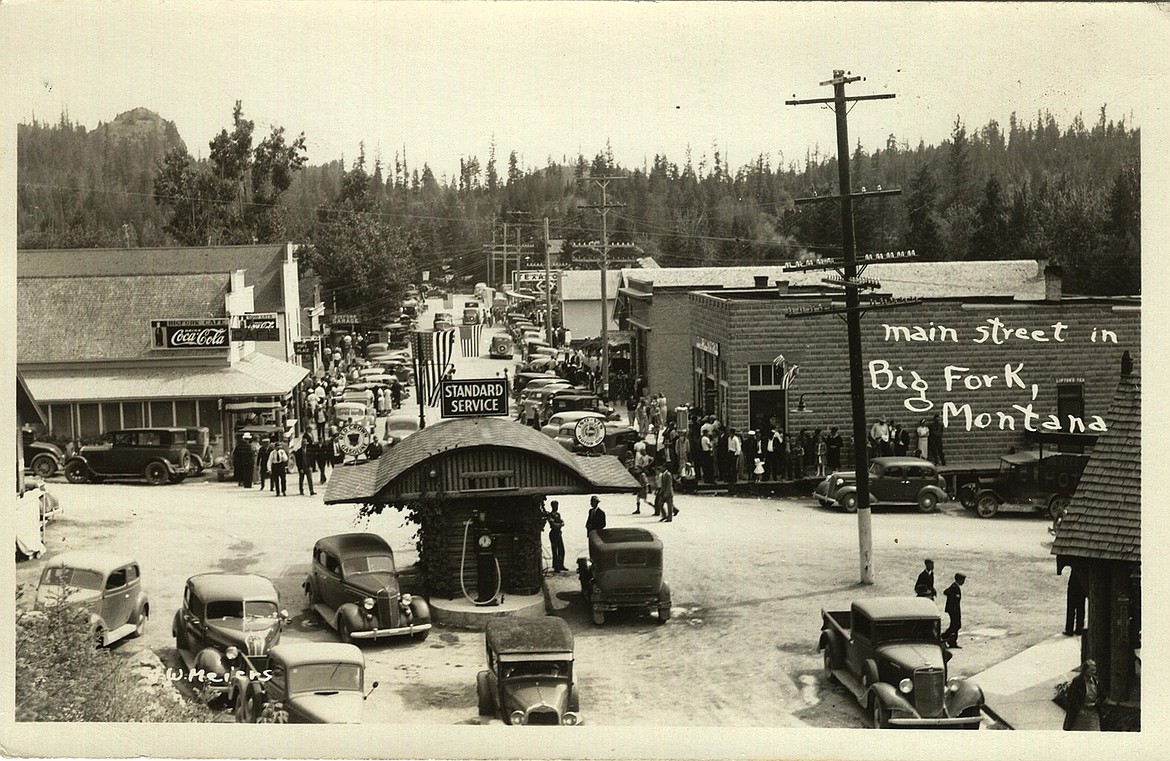
Looking south along Electric Avenue in downtown Bigfork during a 4th of July celebration in the 1930s. (J.W. Meiers/Denny Kellogg Collection)
On May 17, 1901, Everit L. Sliter, a scrappy 35-year-old from Michigan, filed an official plat for a townsite on the northeast shore of Flathead Lake. The proposed settlement was situated between the Flathead and Swan rivers in the shadow of the Swan Mountain Range and consisted of 11 blocks and 94 lots. Sliter named the new community Big Fork.
More than a century later, the village of Bigfork has grown and changed, but its residents are still enamored with their tightknit community on the lakeshore. This Sunday, Bigfork will commemorate the 125th anniversary with community-wide celebration hosted by the Bigfork Art and Culture Center. The event brings together local organizations, historic sites, businesses and families for a day to celebrate the heritage of Bigfork.
The anniversary is about more than a single day of events, according to the Center’s Executive Director Julie Bottum. It is a chance for residents to reconnect with the stories that shaped the community and to share those stories with the next generation.
“Bigfork is unincorporated, so we don't have that really unifying piece,” explained Bottum. "A goal of this project is to help encourage people that are new to the area to become part of something that honors Bigfork itself.”
The day’s festivities are scheduled to begin at 9 a.m. at the Bigfork Inn Courtyard with a welcome by the Bigfork Historical Committee and a land acknowledgment from the Confederated Salish and Kootenai Tribes.
The celebration continues with a historical walking tour hosted by the Art and Culture Center along with local students. While many of Bigfork’s historic sites no longer exist, the tour includes stops at the Bigfork Inn, Bridge Street, the original dock site, the old post office and early homesteads.
A community heritage picnic will take place at Riverview Place with lunch and vintage games including sack races and tug-of-war.
The afternoon’s events include a historical artisan market on Electric Avenue with booths featuring pioneer crafts, blacksmithing, and storytelling.
The Art and Culture Center is hosting a grand re-opening, featuring a Heritage Arts of Bigfork exhibit and a slideshow of photos from the last 125 years. A youth art exhibit titled “Imagining Bigfork Then and Now” will also be on display.
“Bigfork has always been the community that persisted in spite of all of its challenges,” said Bottum. “It’s just an incredible community, and it was built on the backs of volunteers. It had to be built by these individuals because there wasn’t anybody else that was going to do it. And now we’re in this beautiful place where we have this beautiful, wonderful community situated in this confluence of waters that’s just magnificent. Now, let’s peel back the layers and say, ‘This is where we came from, and let’s respect those roots going forward.’”
Bigfork’s roots weren’t planted all that long ago, in the grand scheme of history. It was just a few generations ago that Sliter first arrived in the Flathead Valley, and while the origins of the Bigfork’s name have been lost to time, many of the other details surrounding the town’s founding have been passed down throughout the years and preserved by the Bigfork Historical Committee.
In 1889, Sliter and a few friends set out on foot from Helena to the Flathead Valley for a fishing trip. According to family legends, Sliter borrowed a canoe, caught enough trout to cover the bottom of the canoe, and decided he might stay a while. He purchased 160 acres of land on the north side of the bay for $320.
At the time, Bigfork was an inaccessible tract of land bordered by two treacherous river crossings and inhabited by only a handful of pioneering settlers. Sliter spent his first Flathead Valley winter in a root cellar with his dog, trading deerskins for ammunition, coffee and sugar.
Over the next decade, a community sprang up around Sliter’s entrepreneurial spirit. He accumulated more than 500 acres and planted 4,000 fruit trees. He constructed a 14-bedroom home that doubled as Bigfork’s first inn.
By 1901, Bigfork was attracting sustained interest from neighboring communities, and Sliter laid out his vision for the future town in the original platting document. There was only one problem: the land where Sliter envisioned streets, homes and businesses was covered with stumps that were never removed after the forests were cut down.
But Sliter, with the plucky determination that would come to define the town he founded, was not to be deterred. He invested nearly all the money from the sale of the lots, procured a stump-pulling machine and cleared the land that would become the center of Bigfork.
In Bigfork’s early days, May 17 was widely celebrated, but for reasons entirely unrelated to the founding of the town. May 17 is the holiday Syttende Mai in Norway, which celebrates Constitution Day and is comparable to the Fourth of July in the United States.
While there are no records to indicate the date was intentionally chosen to coincide with the Norwegian holiday, there was a sizable Scandinavian population in the Bigfork area in its early years. A historical photo from May 17, 1902, captures residents gathered together not to celebrate their fledgling village’s first birthday but Syttende Mai.
In the year 2026, though, residents will gather to celebrate the history of their town, a place that quickly became a gathering place for travelers, loggers, merchants and families building new lives in Northwest Montana.
For more information about Bigfork 125 and a complete schedule of events, visit baccbigfork.org/classes-camps/details/bigforks-125th.
ARTICLES BY ELSA ERICKSEN

The century club: Montana's centenarians reflect on 100 years of life
Completing those hundred laps around the sun is no easy feat. There are an estimated 108,000 centenarians in the United States.
Lakeside residents turn to citizen-initiated zoning to protect neighborhood
For the last three years, Fetveit has spearheaded a neighbor-led effort to create a new zoning district in Lakeside that would protect this area along the lakeshore from overdevelopment.
Effort to rebuild iconic Bigfork cross is underway
When completed, the new cross will stand 100 feet tall with a crossbeam that spans 53 feet. The metal roof trusses that will be used to construct the cross will be 5 feet wide.