
Court rules that misconduct allegations against Mineral County sheriff are not Brady material
HANNAH SHIELDS | Hagadone News Network | UPDATED 5 months, 1 week AGO
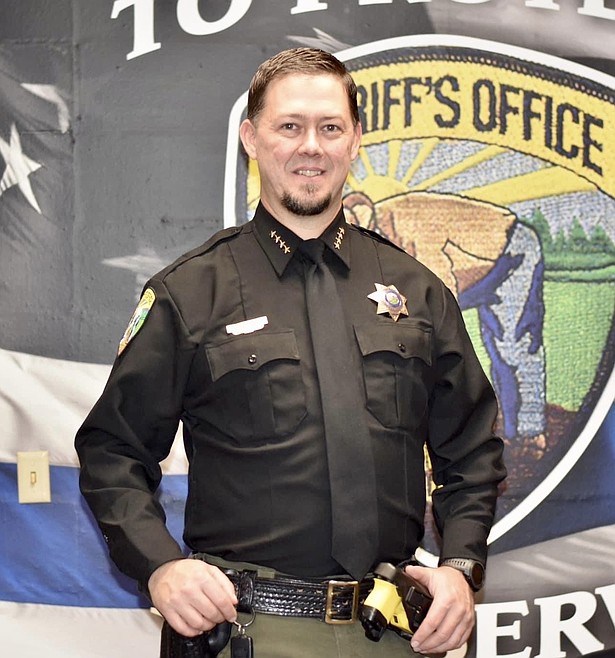
Mineral County Sheriff Ryan Funke. (Courtesy photo)
RURAL GOVERNMENT REPORTER, REPORT FOR AMERICA Hannah Shields covers rural government and accountability reporting for the Daily Inter Lake and Northwest Montana weekly papers as part of the national Report for America program. Her reporting focuses on transparency, public spending and the impact of local government decisions on small communities. Shields has covered issues ranging from school district finances to development disputes and rural infrastructure projects. She regularly uses public records and investigative reporting to examine institutions that affect local residents. Her work helps bring greater oversight and visibility to rural government across Northwest Montana. IMPACT: Hannah’s work strengthens transparency and accountability in rural communities that often lack consistent watchdog coverage. | May 16, 2026 12:00 AM
The Mineral County sheriff pinched the bridge of his nose as he silently wept in the county’s courtroom on Wednesday.
His were tears of relief.
After eight hours of witness testimony from criminal defense attorneys, Missoula County District Court Judge Shane Vannatta ruled that the allegations of misconduct against Sheriff Ryan Funke was not Brady material, and that failure to disclose the evidence would not undermine the integrity of criminal trials where Funke is a witness.
“The court agrees it is a nothing burger,” Vannatta said.
Vannatta’s ruling is related to a lawsuit filed by Funke against Mineral County commissioners in 2023, after the county intervened in his hiring of Micah Allard as a deputy. The judge decided earlier in the case that Allard’s previous employment discrepancies did not warrant disclosure in criminal cases under Brady law.
The U.S. Supreme Court decided in its Brady decision that information the defense might use to discredit a law enforcement witness must be provided to the defense by prosecutors.
Last year, the Mineral County Attorney’s Office claimed it had potential Brady material against Funke. County Attorney Debra Jackson submitted an internal investigation into Funke from 10 years ago when he served as a deputy in Lake County. Her office made a motion asking the court if the report had to be turned over to the defense in criminal trials where Funke is a witness.
Allegations in the investigation claimed that Funke falsely stated he read a suspect their Miranda rights in his police report, according to court documents. The investigation was never adjudicated, however, and a settlement agreement was reached.
Vannatta ruled in January that the allegations qualified as Brady material. However, the judge agreed to Funke’s request to reconsider the ruling, given that his initial decision was made solely on the materials presented and Funke was not afforded due process.
ALTHOUGH THE May 13 evidentiary hearing was unsealed by the judge two days earlier – at the emailed request of a local media outlet – roughly six hours of it remained closed to the public for confidentiality reasons.
Vannatta agreed to open the hearing after recognizing the significance of public interest, given the upcoming primary election where Funke is running against Republican challenger Ben Banks.
But he’s also required by the Montana Supreme Court to balance the public’s right to know with the right to privacy. Confidential criminal justice information, law enforcement employment information and internal affairs investigation information are sealed from the public.
During the hearing, additional material brought against Funke was discussed with witnesses behind closed doors.
These include an alleged false statement he made on an application for a search warrant, where it’s unclear if Funke was accurate in stating that he attempted to pin a car door on the driver’s side in a high-speed chase. There were also additional allegations of Funke failing to read a detained suspect their Miranda rights.
The courtroom was open for the first 45 minutes of the hearing, in which attorneys offered their opening statements. Special Prosecuting Attorney Adam Duerke, who represented the state, then began questioning his first witness, Deputy Lake County Attorney Ben Anciaux, on the importance of accurate police reports in a criminal trial.
Anciaux said judges rely on police reports, witnesses and gathered evidence to find probable cause before charging a suspect with a crime. When a judge receives an affidavit from a search warrant, they must trust that the document is entirely factual, he said.
The courtroom then closed after about 20 minutes of questioning. Roughly 70 members of the public watching on Zoom were ushered into an online waiting room and a handful of people who attended in person sat outside in a hallway.
An interview with Lake County Attorney Steve Eschenbaucher, the second witness, was completely sealed.
THAT AFTERNOON, the courtroom reopened at 4 p.m. for the remaining interviews with two more witnesses: criminal defense attorney Robert Long, and Roy Miller, who is running unopposed in the June primary to be the next Mineral County attorney.
Both witness attorneys said the suspected Miranda allegations against Funke are unlikely to sway a jury in future criminal cases where he’s a witness. Long said that a jury would be “underwhelmed” by the evidence.
He agreed that inconsistencies from officers could be used to impeach their credibility in a trial. However, he said it depends on how big the inconsistency is when it comes to impacting the jury’s verdict.
“There’s little ones and there’s big ones, so the bigger the better,” Long said.
Miller made a similar remark, saying a potential Miranda violation from a decade ago isn’t likely to diminish Funke’s reliability in front of a jury.
“[To] say with a reasonable degree of probability that it will destroy this witness’s credibility with a jury 10 years later ... I don’t see that,” Miller said.
However, special prosecuting attorney Duerke asked Miller about the responsibility of the prosecutor to provide Brady or Giglio information (similar to Brady, where evidence could diminish a government witness’s credibility), regardless of the impact on the verdict’s outcome.
Miller said it is much more difficult for the defense counsel to search for Brady evidence when it’s not disclosed by the prosecutor.
“We would have investigations, and that is a much harder road to travel,” Miller said.
“Why?” Duerke asked.
“Because we’re in the dark,” Miller replied.
IN THEIR closing statements, Duerke reiterated the importance of transparency in the courtroom and holding law enforcement officers accountable. The purpose of Brady material is to disclose any evidence that the officer has not been truthful in the past, he said.
Attorney Paul Leischer, representing Funke, argued that prosecutors should not have to disclose materials that are relevant to a suppression hearing. A suppression hearing is a pre-trial to a criminal case where a judge decides whether the evidence has been legally gathered and can be used in court.
“At the end of the day, the question comes ... if the state did not disclose this in the future criminal prosecution, would that result in a violation of Brady?” Leischer asked.
Vannatta said Funke’s failure to provide Miranda warnings didn’t necessarily constitute Brady material. He is familiar in cases where officers forget to provide a Miranda warning “in the heat of the moment.” The judge noted suppression hearings already exist to remedy potential Miranda violations.
However, he raised concern with Funke’s alleged false statements on the search warrant application. The statements appeared inconsistent with audio and video footage, he said, and this could result in perjury. However, he later added that whether the statements were inconsistent is “truly in the eye of the beholder.”
“The court struggles to find that it’s an inconsistency that would reflect upon the credibility of Mr. Funke,” Vannatta said.
The sheriff was moved to tears when the court adjourned, and Leischer gave him a hearty pat on the back. Funke, overwhelmed with emotion, was unable to provide a comment when approached by reporters.
“It wasn’t fair what happened 10 years ago,” Leischer said.
Report for America reporter Hannah Shields can be reached at (406) 758-4439 or [email protected]. If you value local journalism, pledge your support at dailyinterlake.com/support.
ARTICLES BY HANNAH SHIELDS

Property owners pool money build Rollins fire department's new station
Construction of the nine-bay station began in May 2025 and wrapped up earlier this year, adding approximately 9,000 square feet of garage space to the original 6,000-square-foot station.

Lakeside resort vote tabled a second time by Flathead County commissioners
Territory 1889 is a members-only resort planned to span 1,700 acres west of U.S. 93, near Blacktail Mountain.

Crews contain 1,700-acre Bras Fire near Hot Springs
A grass fire that threatened two residences and scorched 1,688 acres east of Hot Springs was fully contained Monday afternoon.