
Pesticide applicators continue their education at trade conferences
JOEL MARTIN | Hagadone News Network | UPDATED 4 months, 2 weeks AGO
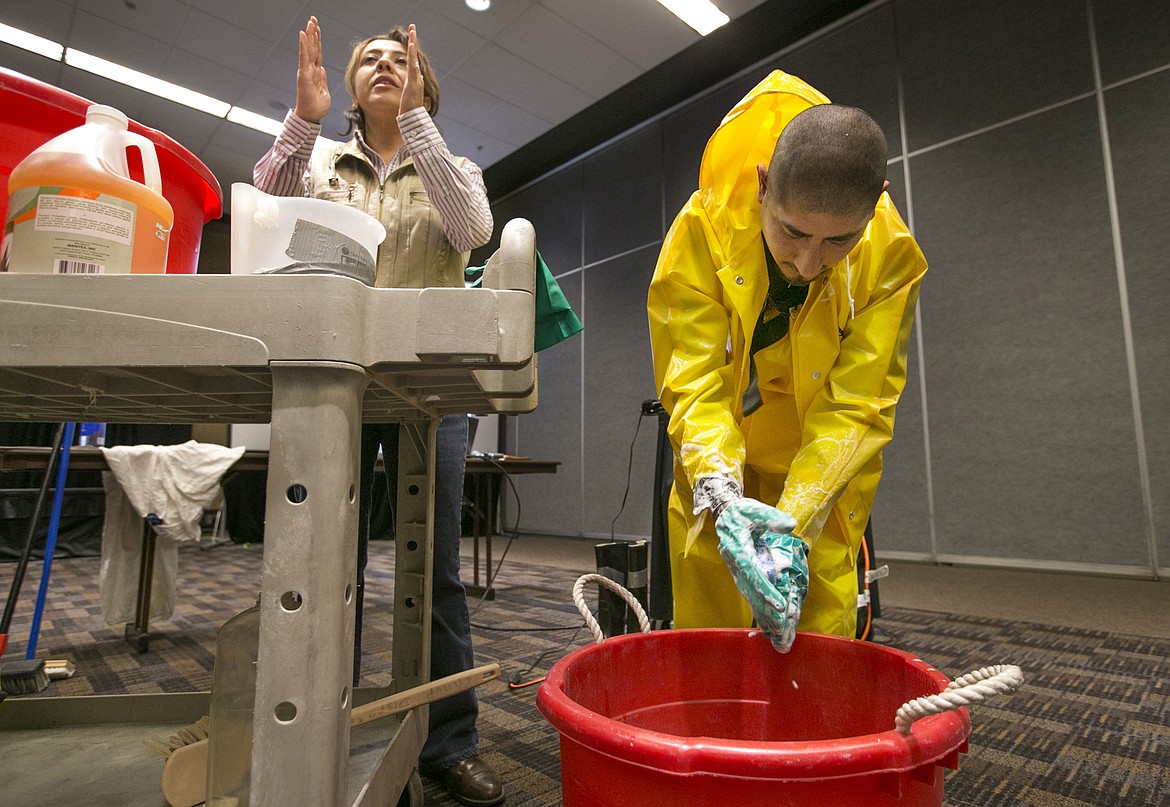
A farm worker washes his hands as a WSDA instructor explains the proper way to wash up after using pesticides at a pesticide training workshop.
AP
Joel Martin has been with the Columbia Basin Herald for more than 25 years in a variety of roles and is the most-tenured employee in the building. Martin is a married father of eight and enjoys spending time with his children and his wife, Christina. He is passionate about the paper’s mission of informing the people of the Columbia Basin because he knows it is important to record the history of the communities the publication serves. | May 29, 2026 11:18 AM
MOSES LAKE — A driver’s license has to be updated every so often to make sure the driver isn’t a danger to themselves or others. So, it’s not surprising that a license to handle deadly chemicals would need renewing too.
“This requirement has been in place for quite some time, probably 20 or more years,” said Washington State Department of Agriculture Licensing and Recertification Program Manager Christina Zimmerman, “There could be changes in pesticide application techniques and technology – it’s just changing so quickly right now – but it’s more making sure that licensees, pesticide applicators or consultants or even pesticide distributors stay abreast of any new requirements or restrictions.”
Pesticide licensing isn’t a simple matter. The WSDA administers 27 different tests for individuals seeking their pesticide applicator license, Zimmerman said, and which ones and how many an applicant takes depend on the kind of work they’ll be doing.
“Once they get their license, we issue them what’s called a recertification cycle (for) a maximum of five years,” Zimmerman said. During that cycle they can earn continuing education credits to show that they’re remaining competent to apply pesticides, or at the end of that cycle they can choose to take the exams again.”
Most applicators don’t want to sit for the exams every five years, Zimmerman said, although there are some who do in order to get it out of the way or to save money on continuing education. The other, more popular, way to maintain pesticide applicator’s license is to attend seminars that touch on pesticide application at agricultural trade shows and conventions. The hosting agency, called a course sponsor, submits an application to the WSDA requesting that the things a licensed applicator learns there be counted toward their recertification when the time comes to renew their license.
“They have to submit an application to us at least 30 days in advance of that event and give us their agenda for every single speaker or presentation,” Zimmerman said. “They have to give a description of what (the seminar) is, how long it is, (verify) that it’s an acceptable topic, and then assign it to that course.”
The topic does have to have a bearing on pesticide application safety or regulations, Zimmerman said.
“We have a guidance document on our website available to course sponsors that outlines all the topics that are acceptable,” she said. “We (also) give them examples of topics that aren’t acceptable. Sometimes in those conferences they do (seminars on) customer relations or business practices or things like that. Those don’t qualify for credit.”
The course sponsor takes attendance for the seminar and submits to the WSFA who was there and for how long. The WSFDA assigns one credit for every 50 minutes of instruction, Zimmerman said.
It’s up to the host of the expo or trade show what kind of seminars they apply for credit for, said Sheri Nolan, account manager for Ag Association Management. Nolan coordinates, among others, the Pacific Northwest Vegetable Association conference in November and the Northwest Hay Expo in January, both of which offer pesticide recertification credits. The boards of directors of those organizations plan out the seminars for each conference, Nolan said, partly with an eye toward which ones they can count for pesticide credits.
“The board usually when they put the program together, know that (a given seminar) is going to qualify,” Nolan said. “I get a summary from the speakers, and I put that in the information that goes to the state, and then the state will determine whether or not that particular topic qualifies for that credit.”
In order to receive credit, the attendee has to sign in at the seminar, said Diahne Gill, who manages the Spokane Ag Show, one of the largest trade expos in the Northwest.
“Usually we offer nine or 10 credits per show, and an attendee can attend as many sessions as they’re able to,” Gill said. “We have hosts in the room who keep track of the paperwork and make sure that people don’t leave halfway through and want their credits. We don’t hand the paperwork out until the end of the session, because it is required that they attend the entire session.”
“We usually do it by half-day,” Nolan said. “An attendee comes in and they have to spend that half-day, and at the end of that half-day, we put out the sign up sheets and everybody signs up for their credits. And then I take all the information back to the office and retype in all of the attendee information into the state’s forms to submit them.”
Both Gill and Nolan manage shows that bring attendees from Oregon and Idaho as well, and they have a separate set of rules – and of paperwork – for recertification credit. Navigating those waters isn’t always easy, Nolan said.
“Each state requires something a little different,” Nolan said. “It’s not something where I can apply it in one state and (apply it the same way) to the other two states. Would it be wonderful if I could? Absolutely. I’m taking all of this information I gather and applying it to each state individually in whatever format and information they’re requesting. Oregon requires a specific form and an online system. Washington, I … have to go through their whole online (system) and retype in or recopy all of the data into their form. And the same with Idaho. It’s a definite process.”
A private applicator, one who owns or works for a farm, needs 20 credits over the course of five years, Zimmerman said. In theory, that could be knocked out in one season’s worth of conventions, kind of like pulling an all-night study session the night before a test. In practice, Zimmerman said, that loophole is closed by state law.
“They can get a maximum of 10 credits per calendar year,” she said. “The reason we do that is we don’t want someone to just do everything at once. We want it to be at least a little spread out so they’re getting education in more than just a month of their time.”
The pesticide licensing maze is a complex one, but Zimmerman said the WSFA has an entire staff of people who will help an applicant through it.
“We want people to know they can always … reach out to us,” she said. “We have multiple people available to respond and explain what they need to do. It’s much simpler than they might think it is or just by looking at the website … There’s just so much information (and) we know it’s overwhelming; we want to make sure people know ithat we’re available to help them through it. That’s what we’re here for.”
ARTICLES BY JOEL MARTIN
Endless battle
Noxious Weed Control Board works to keep invasive plants under control
MOSES LAKE — Some of the nastiest plants in Grant County were the topic of a class led by Jay Johnson, a consultant with the Grant County Noxious Weed Control Board, Tuesday. The Noxious Weed Control Board, as its name would suggest, is tasked with keeping weeds under control in Grant County. That’s not a small job; the board’s website lists 129 species of noxious weeds that are found around Grant County. A noxious weed is defined as an invasive, non-native plant that threatens agricultural crops, local ecosystems or fish and wildlife habitat, according to the Noxious Weed Control Board. Washington state law requires that these weeds be identified and their spread kept to a minimum, if not completely eradicated. “We’re one of those agencies a lot of people don’t really understand,” Johnson said. “We’re a county office and … our funding is tax-based assessment. When you get your tax bill and you look down at all the expenses that you pay for, there we are.”

BASIN EVENTS: Oct. 16-24
COLUMBIA BASIN — Whether you feel like shopping, crafting, learning or seeing a show, there’s something happening for you this week in the Basin. Oct. 16 ‘My Family (Mi Familia)’ screening Spanning three generations, “My Family (Mi Familia)” is a heartfelt drama that follows the Sánchez family as they build their lives in East Los Angeles. Through love, hardship, triumph, and sacrifice, the film explores the immigrant experience, the strength of family bonds, and the traditions that connect one generation to the next. Lowrider show and taco truck before the screening. Sponsored by Columbia Basin Allied Arts, EDUBS C/S and the Moses Lake Creative District. $12 per person. Doors open at 6 p.m., film begins at 7 p.m. at the Moses Lake Civic Center Auditorium, 401 S. Balsam St. Tickets and info: www.cba-arts.org.

Moses Lake author encourages women to look beyond church culture norms
MOSES LAKE — A Moses Lake author’s book, “A Christian Woman Striving to Live Her Faith in a Man-Controlled World,” takes aim at the role to which many churches relegate the female half of their congregations. “It’s to encourage women in the faith,” Linda Curran said. “A lot of churches say, ‘Teach Sunday school, do this, do that, but don’t (evangelize.)’" In her book, Curran recounts a time when she moved to a new community and joined a church there. She was surprised to learn that, as a new female member, she had been automatically assigned church cleaning duties. When she questioned it, she wrote, she was met with condescension and her objections were brushed aside. In other churches, she said, women who were capable of teaching were relegated to “women’s ministry.”