
On the football field, Flathead Valley veterans find a new sense of purpose
ELSA ERICKSEN | Hagadone News Network | UPDATED 31 minutes AGO
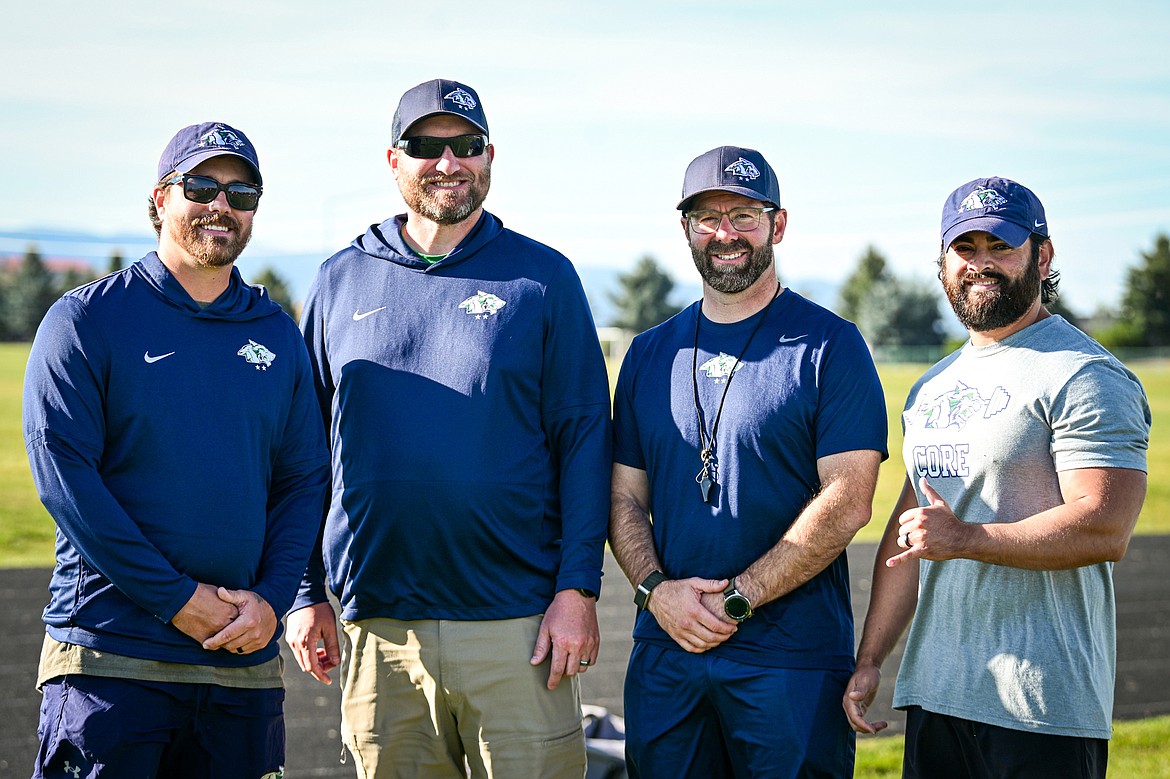
Glacier Wolfpack football coaches and veterans, from left, Logan Wise, wide receivers coach and U.S. Navy veteran; Matthew Pickar, assistant offensive line coach and U.S. Army veteran; Chris Leck, assistant linebackers coach and U.S. Navy veteran; and Vince Espinosa, wide receivers coach and U.S. Army veteran. (Casey Kreider/Daily Inter Lake)
Casey Kreider
For the group of teenage boys assembled on the practice football field by Glacier High School, the world had narrowed to the 100 yards of green grass fenced in by white paint, a bubble so solid that not even the belting lyrics of "The Real Slim Shady" could penetrate it.
"Third down! Third down!" a coach shouted. "Trade left! Bunch right! Middle-middle-middle! Left hash!"
The quarterback dropped back a few steps, glanced downfield for a moment, and let the ball fly. The dull thud of cleats trampling the earth reverberated as a couple of lean wide receivers shot off. The ball hung in the air for a few long seconds before gravity claimed it, and it fell to the ground. Overthrown.
But this was only practice, taking place on a sunny Tuesday afternoon, as the Glacier Wolfpack prepared to take on the Helena Bengals later that week (they would go on to rout the Bengals 49-13). The wide receivers trotted back to their starting points and started over, running their routes until the motions became second nature.
There was an air of intensity, even during these mock drills, as if these high school football players in their oversized helmets were already under the stadium lights.
Watching the action unfold from behind the brim of his baseball cap was wide receiver assistant coach Vince Espinosa. In his 30s, Espinosa is laidback and easy going, but on the football field, he switches into a different mode of operation, intently watching players run routes and fine tuning their efforts through repetition. It's a discipline that he honed on a very different playing field, alongside a group of men who wore camouflage uniforms instead of helmets and pads.
A decade before Espinosa joined the coaching staff at Glacier High School in 2022, he was a fresh college graduate who had enlisted in the U.S. Army as an artilleryman. He operated Paladins and fired 155mm big rounds, deploying in 2014 to the Middle East as part of Operation Enduring Freedom.
Long before he was running wide receiver drills, Espinosa was running mock operations on makeshift compounds designed to look like those in the Middle East.
"In the military, we have what are called sandbox tables," he said. "Let's just say we're trying to get into a building. We'll draw it on a sandbox table first, and we'll all stand around and walk through it with one another. The first entrance and doorway, you guys are going in. The second one, you guys are going in. The third one, you guys are going in, and then we'll come out and consolidate again. We're just walking through it on the sand table."
When Espinosa and his fellow soldiers finally deployed overseas and came into contact with enemy forces, they had already run through every scenario they could think of. It was second nature.
The Wolfpack doesn't use sandbox tables, and the stakes are admittedly lower on the gridiron than in a theater of war, but for Espinosa, along with three other veterans on the team's coaching staff, high school football has been an invaluable part of life following military service.
FOR VETERANS, the transition back to civilian life can be challenging. In one sense, everything seems easier to navigate without the all-encompassing demands of the military. There's no basic training, no deployments, no constant threats from the other side.
As a surface warfare officer in the U.S. Navy, linebackers assistant coach Chris Leck ran counter-narcotic deployments in South and Central America scouting for drug runners coming out of Colombia in the 1990s. He captured a couple tons of cocaine before heading to the Middle East in the 2000s as part of Operation Iraqi Freedom.
In comparison, high school football is nothing.
"Throw ball, catch ball. It might look complex, but it's very simple," fellow wide receivers assistant coach Logan Wise said while laughing.
Wise also did a stint in the Navy, nine years in all, deploying in 2013 and 2017 as part of Operation Enduring Freedom and Operation Inherent Resolve. He was drawn to the camaraderie and found friends for life in the service. They all attended each other's weddings. At one point, Wise thought he would stay until retirement. Now, he says the same thing about Wolfpack football.
"It's year three now, and I would do this forever," he said.
For Wise, like many others, the team helps fill the void that opened when he left the Navy. In that intense environment, with a shared schedule, language and mission, the camaraderie was powerful.
"It was the best experience ever," Espinosa said of his time in the Army. "A lot of discipline, a lot of structure, best group of friends ever."
But back in the civilian world, all of that was gone.
"When you get out, you get a job doing something by yourself," Espinosa said. "It's just not the same, and you're always kind of searching for the same thing."
For a while, Espinosa thought about becoming a firefighter, drawn to the structure and ranking system that felt familiar. Instead, he began operating a gym, Kalispell’s Access Fitness, and started volunteering as a coach with the Wolfpack.
On the football field, he found a community that parallelled the one he left behind. Head coach Grady Bennett, who has helmed the Glacier football program for 20 years, has cultivated a team culture that emphasizes responsibility and discipline. Morning meetings, afternoon practices and team workouts throughout the year ask a lot of the players. For these veterans, being on a team working towards a shared goal is a familiar feeling, even if the goal is simply to take down crosstown rival Flathead High School.
THIS SEASON is Matt Pickar's first with the Wolfpack, and unlike his fellow veteran coaches, the team isn't just a way to carry on the brotherhood he found in the armed services.
The offensive lineman coach hasn't played football since he was in high school himself more than two decades ago, and he admitted that a lot has changed since then. Instead of going off to play college ball like many of the other coaches, Pickar's life was shaped by the events of Sept. 11 — the towers came down when he was starting his junior year of high school, and he immediately knew he was going to enlist, but he had to wait until he graduated from high school.
In 2003, Pickar entered the Army as an infantryman before transitioning to a sniper team where he was a sergeant. He deployed to Afghanistan in 2004 and Iraq from 2005 to 2006 before suffering an injury in 2007 and medically retiring.
Pickar's return to civilian life was rocky. He struggled with the lingering effects of a head injury which made it challenging for him to focus. He sat around for a year after he got out of the Army before studying forestry and natural resource management through the GI Bill, a degree he never put to use.
"I wasn't a very pleasant person to be around for a long time, and I've been working on it for years," Pickar said. "Then, I was able to volunteer with the team, and the last couple months have really changed my mindset. People who know me well don't even recognize me at this point."
Pickar is teaching offensive linemen — many of whom haven't yet hit their growth spurts — the basics of pass blocking and run blocking, but he's found a deeper sense of purpose pouring into these boys on the cusp of adulthood.
"We're teaching these kids to be men and what it means to be responsible adults and to function in society," he said. "I've found that's been the most healing for me. Before the game, I try to pinpoint something that's been going on in practice as an overall theme and take it back to a shortcoming I've had in life. I share that story with them and apply it to football."
The other veterans have also rallied around this purpose championed by Bennett.
"This is not a program where people show up and don't have a plan," Leck said. "There's a plan to everything, and it's more about creating great people, great husband and fathers, and all those things that matter in life, not just great football players. Those ideals and characteristics are displayed by these young men."
"Our program is all about trying to help young boys become good men, and that's what the military is about," Bennett said of the veterans on his coach staff. "They bring such an infectious energy and love for God, county, life and the boys. I think it's awesome. They really understand what the true mission of our program is."
Reporter Elsa Ericksen can be reached at 406-758-4459 or [email protected]. If you value local journalism, pledge your support at dailyinterlake.com/support.
ARTICLES BY ELSA ERICKSEN
On the football field, Flathead Valley veterans find a new sense of purpose
Watching the action unfold from behind the brim of his baseball cap was wide receiver assistant coach Vince Espinosa. In his 30s, Espinosa is laidback and easy going, but on the football field, he switches into a different mode of operation, intently watching players run routes and fine tuning their efforts through repetition. It's a discipline that he honed on a very different playing field, alongside a group of men who wore camouflage uniforms instead of helmets and pads.

Longtime Lakeside QRU volunteer retires after 45 years
In January of 1981, Mary Granger was among 15 Lakeside community members gathered at the schoolhouse to take part in an American Red Cross Advanced First Aid course. Granger was 31 and an elementary school teacher with no medical background, but she was eager to help her neighbors in need.

Echo Lake resident sues county over kayak tour decision
A property owner along Echo Lake is suing the Flathead County Board of Adjustment over its decision to approve a conditional use permit for a business that offers kayak tours from a private residence on Peterson Lake.