
Logging projects moving more quickly under new federal forest policy
KELSEY EVANS | Hagadone News Network | UPDATED 3 days, 13 hours AGO
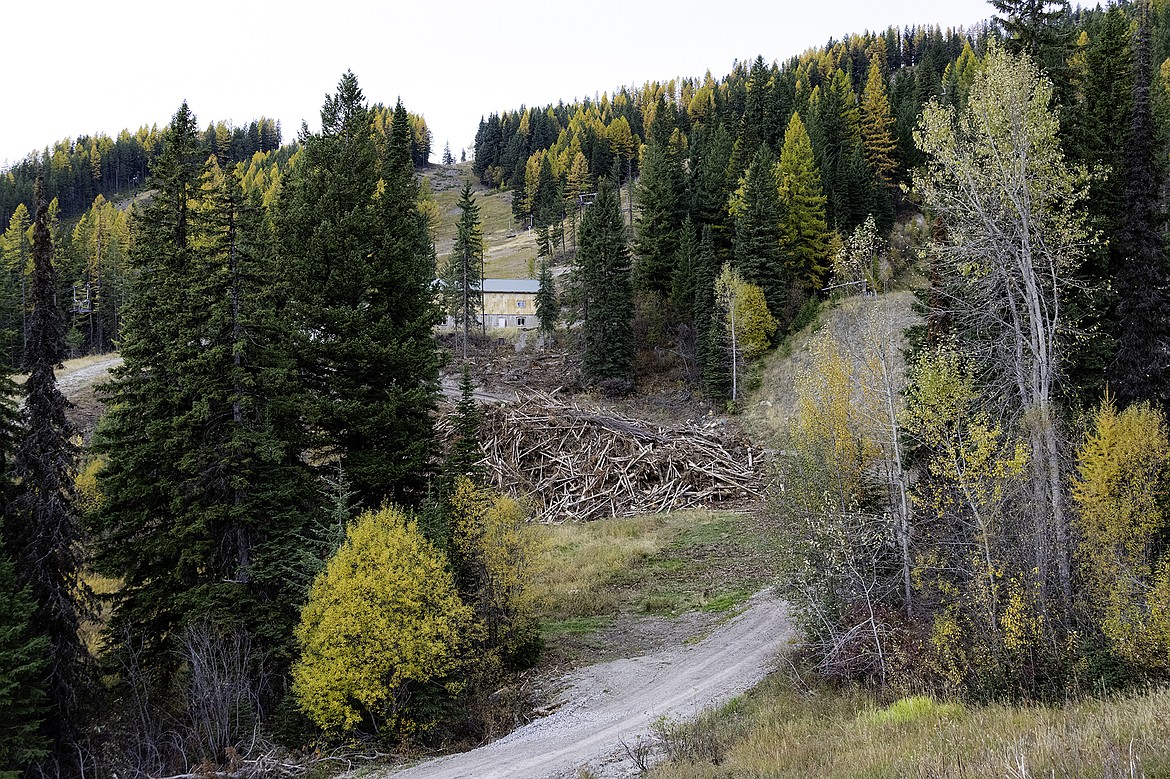
A slash pile at the base of Big Mountain on Oct. 19. (Seth B. Anderson Photo)
SETH ANDERSON PHOTOGRAPHY
Flathead National Forest announced the Big Mountain Fuels Reduction Project on Feb. 20. A mere two months later, machinery was rolling, and timber was being harvested from the slopes at Whitefish Mountain Resort.
Now, the project is nearly wrapped up as snow starts to fall ahead of ski season.
A two-week public comment period was provided ahead of the 200-acre project, intended to protect the ski resort's infrastructure from wildfire risk. Deemed by forest officials to not have significant environmental effects and seen as addressing a high-risk area, the project was categorically exempt and authorized as an emergency.
It represents just one of many local timber projects that are moving forward more quicky and with a narrower opportunity for public scrutiny following policy changes at the federal level.
Locally, foresters say the new rules are generally proving to be more efficient, while conservationists express concern over environmental effects and a rushed public participation process.
In March 2025, President Donald Trump signed an executive order directing the immediate expansion of timber production in national forests. Secretary of Agriculture Brooke Rollins followed the order with an April 2025 memorandum declaring a wildfire emergency across 59% of national forest land.
Emergency authorizations were introduced under President Joe Biden's Infrastructure Investment and Jobs Act, but only became widely utilized under Rollins' direction.
Flathead National Forest spokesperson Kira Powell said that the emergency authority has enabled the agency to move more efficiently from project development to implementation.
“The goal is to increase the pace and scale of acres treated in the future,” Powell said. “We continue to conduct full environmental analyses through interdisciplinary review and maintain thorough consultation with regulatory agencies, including the U.S. Fish and Wildlife Service, as well as our tribal partners.”
Revised regulations take effect this month that will shorten the public comment period for environmental assessments from 30 days to 15 days.
The changes are to “consolidate and streamline processes, increase efficiency, and better align with the agency’s statutory obligations and recent rescissions and revisions to National Environmental Policy Act regulations,” a U.S. Department of Agriculture document reads.
The shorter public comment period will be an additional way to allow projects to move more quickly from the development to implementation phase, Powell contended.
“Despite this change, the Flathead National Forest remains committed to public involvement in project development and greatly values community input on forest management,” Powell said.
Proposed projects will be posted on project websites for public review, and the public will be notified as projects reach key milestones in the review process, Powell said.
In addition to shortening public comment, recent National Environmental Policy Act changes encourage agencies to expand the use of categorical exclusions, which means environmental assessment or environmental impact statements are not required.
Environmental impact statements are now also capped at two years and 150 pages, and environmental assessments are capped at one year and 75 pages.
Paul McKenzie, general manager and vice president of F.H. Stoltze Land and Lumber Company, said forest projects are moving faster under the new rules.
"Categorical exclusions sometimes get portrayed as if there's no analysis. That's not the case," McKenzie said. "There just isn't the same level of re-analysis of things done over and over again. If you've read a lot of environmental assessments done in the past, two-thirds of the documents are restating the same things for the known effects of the known activities that they continue to repeat.
"We know there's certain effects that occur, both positive and negative. The categorical exclusion looks at what's different and new ... That's the greatest benefit. You're not reinventing the wheel every time."
McKenzie said the company is seeing expedited processes for insect disease outbreaks and blowdown from last year. Going back to the Good Neighbor Authority, he believes policies are generally taking forest management in the right direction.
"Because what challenges our national forests is the amount of resources, time and staff it takes to do the paperwork. And that's a barrier to catching up to the rate, pace and scale of what Mother Nature is throwing at us," he said.
McKenzie said that frequent lawsuits against national forest projects often come down to paperwork errors and that as a result, both the agency and industry lose a tremendous amount of money.
The expedited projects have helped keep projects steady while other projects are halted by lawsuits, he said.
"We're resourceful and usually have ways to backfill," he said.
The business has seen a lot of salvage projects recently.
Following a December 2025 wind event, large amounts of blowdown were included in the Rad Reid and Coal Banks salvage projects, but additional areas of concentrated blowdown are still being discovered, according to Powell.
One emergency authorized project, the 2026 Emergency Blowdown project, looks to reduce wildfire risk by removing blowdown on the Idaho Panhandle, Nez Perce-Clearwater, Lolo, Flathead, Bitterroot and Kootenai national forests. The project had a seven-day public comment period in June. The project’s environmental assessment will span multiple forests and identify specific treatment units.
“The 2026 Blowdown Emergency project is an additional tool enabling the forest to expeditiously address the highly impacted areas that were discovered later in the season while still achieving a timeframe that recovers economic value of the fallen trees,” Powell said.
Swan View Coalition and Friends of the Wild Swan last month filed a lawsuit against the Flathead National Forest over the West Reservoir project near the Hungry Horse Reservoir. The groups allege the forest service illegally used emergency procedures to sidestep Endangered Species Act requirements.
The groups said it sued the Trump administration over its attempt to rush through a timber project in grizzly bear and bull trout habitat under the guise of a "purported 'emergency." The lawsuit says species would be harmed through 4.7 miles of new road construction and other project activities.
The complaint echoed a June 5 suit against the same project. The prior suit stirred new evaluations of the project, but the groups allege that the new analyses "largely replicated the previous errors, perpetuating the long series of ESA violations," according to a press release from the groups.
The two groups are also plaintiffs in a new suit filed last week that alleges the Forest Service and U.S. Fish and Wildlife failed to consider the impacts of logging roads on endangered species. The suit is in regard to the Flathead National Forest's 2018 Forest Plan's deeming of "impassable" roads equivalent to environmentally "reclaimed" roads.
Both lawsuits will look to digest rule changes to the ESA, as the U.S. Fish and Wildlife Service this year eliminated a long-standing definition of "harm" from the law so that habitat destruction alone no longer automatically counts as a prohibited "harm."
The change effectively rescinded what has been a legal foothold for wildlife for the last 50 years.
In an interview with the Pilot, Peter Metcalf, executive director of Glacier-Two Medicine Alliance, expressed concern with the rapidity of projects. He said that several flew under the radar.
He said without public meetings, affected communities no longer can directly interact with Forest Service officials.
"You'd think if you wanted to create a more wise wildfire community response plan that face-to-face interactions would be critical," he said.
"Public comment periods are no longer standardized in any meaningful way, if they exist at all. And then it cuts out, most notably, the objection period, which is the last phase in the decision-making process that allows for disagreements... what that means is that people who may have a disagreement, they can no longer resolve it. They now have to go to court. It functions to limit both the quality of the analysis and the role of the public, including the timber industry and other commercial interest, on having a say on how these lands are managed."
Editor Kelsey Evans can be reached at 406-862-3505 or [email protected]. If you value local journalism, pledge your support at whitefishpilot.com/support.
ARTICLES BY KELSEY EVANS

Eureka shooter had clean background check, school district says
The Whitefish School District conducted a sound background check prior to hiring Matthew David Dye, said a statement issued by the district last week.

Bulldogs fall to East Helena in quarterfinals
Carrying a strong Bulldog mentality and a consistent record, the Bulldogs were hopeful entering the quarterfinals against East Helena Friday.

Whitefish area statehouse seats go to Democrats
The House District 3 seat was retained by Democrat Debo Powers while the House District 4 seat flipped and went to Democrat Paula Koch, marking a blue stronghold in deep-red Flathead County.